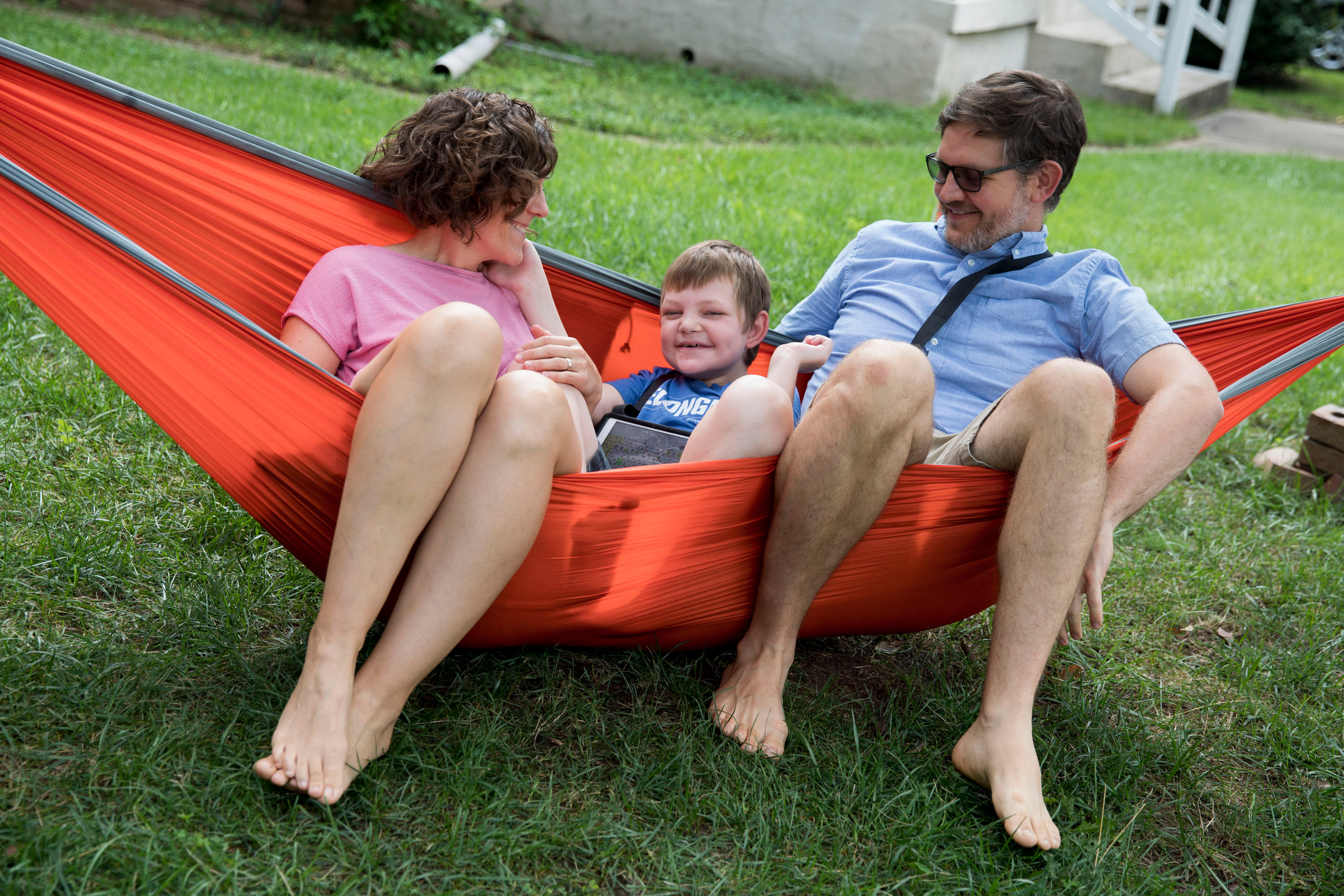
As he watches, David Rosenblatt’s 8-year-old son Nico takes part in a virtual speech therapy session. Rosenblatt pays for this therapy out of pocket as one of the various tools the family uses to assist Nico, who has complex developmental disabilities caused by a genetic condition called Angelman Syndrome, meaning he mainly communicates using an assistive device.
A majority of Nico’s supports come through the Arlington Public School system. He attends class along children without disabilities, but has a dedicated aide to help with classwork, social interactions and personal needs. Being in that setting has been a huge boon to Nico, says Rosenblatt.
“A huge thing that Nico gets out of school is being a part of a physical community,” he says. “For him, being in a space where you can’t touch people or share things with people or get their attention, is very, very challenging.”
Those challenges became a reality earlier this spring when the COVID-19 pandemic hit, shuttering schools and sending kids home to learn on computers. Parents of kids with disabilities say virtual learning has been a particular burden; in some cases, children are falling behind or acting out as the educational supports they once relied on were yanked away.
And that challenging reality is expected to continue for the months to come. Arlington Public Schools, which kick off on Tuesday, will remain virtual for at least the first quarter of the academic year. And parents like Rosenblatt say they are frustrated that local school systems have not fully addressed how to help kids with disabilities like Nico.
But some school administrators say they’ve been left with no good choices. The pandemic upended almost every facet of traditional schooling, not to mention the additional and intensive in-person supports that many children with disabilities need on a daily basis.
‘We’re The Ones Trying To Come Up With Solutions’
Like Rosenblatt, Elizabeth Daggett is frustrated.
Her son Henry has Christianson Syndrome, a genetic mutation that causes him to have developmental delays and epilepsy. “He’s like a 2-year-old, but in a 9-year-old’s body,” she says.
When he’s in school, Henry needs a dedicated aide. In his public charter school in D.C., he’s in a separate classroom where there are eight children with special needs and five adults to support them.
But when his school closed in March, Henry stopped receiving the supports he usually got through school — physical therapy, occupational therapy and speech therapy. And Daggett says he didn’t take well to virtual learning. “My son’s just not interested at looking at a screen and he would just throw the iPad,” she says.
Daggett asked if the teaching aide could come to their house to support her son in a socially distanced way, but says the school declined because of liability concerns.
When schools first shut down, Daggett says she was sympathetic. But as D.C. schools have started up again for the new academic year, that feeling is wearing off.
“I feel like all the schools have had time to evaluate what worked, what didn’t work, what can we do better,” she says. They’ve received no information from her son’s school about their plans either for in-person learning or otherwise. “We’re the ones trying to come up with solutions.”
Daggett and her husband work full time jobs and they have two other children they need to support with online learning. It’s exhausting, she says. “I just want my son to get what he’s supposed to get and how can we do it safely?” she asks.
Judith Sandalow, the executive director of Children’s Law Center in Washington, says many school systems are not providing the supports in these kids’ individualized education program, or IEPs. IEPs are documents developed for children eligible for special education to make sure they keep making progress.
“Many children with special education needs are getting no education remotely,” Sandalow says.
She’s heard stories from parents across the region saying their children are regressing. “One student we worked with had begun learning to speak, and since the pandemic has literally stopped speaking. And we’re seeing this over and over, where students are actually going backwards without the sustained support of teachers and therapists,” says Sandalow.
It’s not just the students whose individual education plans aren’t being followed Sandalow worries about — it’s also the kids who aren’t being evaluated. “Children have developmental moments where if you don’t catch it during that time, they may never make progress,” she says. “And way too many school districts have stepped back and are refusing to do evaluations.”
Challenges For Schools
School officials and administrators say the pandemic has left them in a difficult position, and they’ve been trying as best they can to adjust learning models and staffing for children with disabilities.
Arlington Public Schools special education officials Kelly Krug and Heather Rothenbuescher say teams have been working over the summer to provide teachers the professional development and technology supports they need. “It’s all happening very fast,” says Krug.
They say when school opens, all services will be available virtually, including speech, physical and counseling supports. Children who need one-on-one aides will get them — virtually.
But Rosenblatt, who’s seen his son act out more and become anxious, remains frustrated. He would have liked to see more done over the summer to create plans for children for whom virtual learning just isn’t working.
“Arlington Public Schools has only just put together a group to figure out how to educate these children. It feels a little bit like they’re acknowledging these kids after all the other kids. I would have liked to see kids with the most significant support needs prioritized earlier in this process,” he says.
Advocates say there are many empty school buildings that could be used and children could learn in socially distanced classrooms. Rosenblatt agrees.
“I would like to see some creative and flexible solutions. I think there are situations where we should be sending staff into the family homes. I think the risk profile of supporting individual students is probably lower than working in a school building,” he says.
In a district survey, many APS staff members had agreed to do a mix of in-person and virtual classes, so there are teachers and aides who are willing to provide in-person teaching.
But Rothenbuescher and Krug say bringing students into schools entails many moving parts. They need to figure out which staff members to assign, which buildings could be used, transportation routes, and whether there is enough protective equipment for everyone. “It’s nuanced,” says Rothenbuescher.
A Fear Of Lawsuits
On top of all that, there’s the ever-present fear of lawsuits. “That’s always at the top of our mind that that could happen,” says Rothenbuescher.
Approximately 14% of children in public schools receive special education services. Children with disabilities have a legal right to a “free, appropriate public education.” But administrators say the federal law guaranteeing that right never could have contemplated how it would play out in a pandemic.
“When the federal law was designed, it was never designed to be met during a pandemic,” says Sasha Pudelski, the advocacy director for the School Superintendents Association.
The AASA, along with other school leadership groups, have urged Congress to relax the rules around special education so districts can’t be sued.
“Special education is the most litigious education issue. And there are tens of thousands of complaints that are filed that cost districts a lot of money to respond to, sometimes up to $50,000 just to have an initial hearing,” says Pudelski.
In one survey the organization did, it found districts were very concerned about being sued. “Litigation was at the top of the list in terms of concerns for school districts, along with funding,” she says. In more than 20 states parents of children with disabilities have already entered into a class-action lawsuit. Pudelski says school leaders have to focus on all vulnerable populations — low-income students, English-language learners, and those reading below grade level.
“Superintendents are worried about equity. As school system leaders, we have to look out for every population of students,” she says. “We have received almost no funding from the federal government so far to deal with the costs related to the pandemic and reopening. And when special education as a system generally is woefully underfunded in this country.”
Sandalow, though, disagrees with that argument.
“We wouldn’t stand for it if superintendents said, ‘We’re just not going to educate girls this year.’ And really, that’s what they’re saying when they’re asking not to implement a student with special education needs’ learning plan,” she says.
Sandalow says lawsuits aren’t the problem, they’re just a means for a parent can make sure that their child is being treated equally and fairly. “In a school system that actually gives the child a decent education, there are no lawsuits,” she says.
She and other advocates worry that if the federal government gives states and districts permission not to follow IEP’s this year, educators won’t even try — and the gains they’ve worked so hard to achieve will be lost.
An Example In Loudoun County
Parents point to Virginia’s Loudoun County as an example of a district that has prioritized kids with disabilities.
Over the summer, county schools held classes for approximately 700 children with special needs, from early childhood through third grade, so they would keep learning. About 65 students chose in-person classes, while the rest did a mix of virtual and in-person. This fall, while most children will learn virtually, school leaders say those with special needs can choose the approach that works for them.
“I don’t believe there’s anything that replaces the opportunity for in-person instructional activities in a safe manner,” says Asia Jones, the Assistant Superintendent for People Services in Loudoun County Public Schools. “Our school board has provided the opportunity for a staged approach for hybrid instruction for some students, starting with our students with disabilities in our self-contained programs. These are students with very complex disabilities from as early as age 2 in early childhood special education to our students who are of age 22.”
Those classes will start Oct. 13 — before any other students return to the classroom. Jones says schools are planning schedules so the teacher and children stay in small cohorts and can maintain social distance. Children who need it will also receive in person therapies.
For David Rosenblatt, there’s little more than anxiety about the months to come. He says his son Nico has grown anxious and is acting out more. The pandemic has affected his other children, but he’s not as worried about them. “I have a lot of confidence in their ability to bounce back,” he says.
For Nico, Rosenblatt worries that missing out on in-person learning and his usual supports will derail his learning even into the future.
“I think that gap and the lost time for kids like Nico is already a lot more dramatic,” he says. “And so this is going to put them a lot further behind.”
This story originally appeared on wamu.org