 Jordan Pascale
Faced with a looming, pandemic-induced budget shortfall, Metro says it will continue to operate with reduced service, institute furloughs for non-union workers and possibly lay off other employees in the coming year if the federal government doesn’t step in with more funding.
So far, Congress has not indicated that it plans to provide more federal relief money for public transit. The American Public Transit Association says the industry needs $32 billion to keep agencies across the country running. WMATA’s General Manager says Metro would need about $250 million to plug the budget gap.
Metro is among a growing number of public transit agencies–like those in New York, San Francisco and Denver–that are dealing with budget fallouts from the coronavirus pandemic, and are facing massive cuts.
The $876 million Metro received earlier this year in the CARES Act is set to run out by December or January. With only a fraction of the public riding, Metro has been burning through the funds at about $100 million a month to offset the cost of lost fare revenue and additional costs related to the pandemic.
Metro’s board is set to address the budget crisis on Thursday.
Pandemic Recovery, Vaccine Taking Longer Than Metro Predicted
General Manager Paul Wiedefeld says the region is not recovering as fast as WMATA expected when it made recovery plans in May.
Back then, it planned to ramp up service in increments and fully return to regular service by spring 2021. That plan predicted that schools would reopen this fall and businesses would start to return to a more normal pace.
Wiedefeld says that hasn’t happened.
“The recovery pace is much slower than we all had hoped for,” he said. “The virus is not abating. The businesses that we hoped… would start to come back [have not]. We all anticipated these schools would be back in September… that hasn’t occurred.
“The ridership has not come back as we hoped it would be.”
Fare revenue only makes up about a third of the cost of operation. But the pandemic has most affected Metro’s largest fare money-maker: the long-distance commuters traveling during peak periods, most of whom are white-collar workers who can work from home.
That group accounts for nearly two-thirds of fare revenue.
Metrorail ridership has increased recently but is still down nearly 90% compared to last year. Metrobus ridership is down about 60%. Metro expects those trends to hold through July.
With no federal money on the horizon, Metro said there’s a $212 million shortfall in this fiscal year’s budget that ends in July 2021.
Earlier this year, Metro predicted the region would handle the virus by the end of the year, but now it’s betting on “wide-spread resurgence” through the winter. It also is predicting a vaccine won’t be widely available until July, much later than they originally thought.
That means a delayed return to ridership for work and leisure trips, and increased telework through at least July.
“Generally, the rider sentiment in some of the surveys that we’ve done shows there’s a fear to use the system [until a vaccine is distributed],” Wiedefeld said.
Possible Service Changes
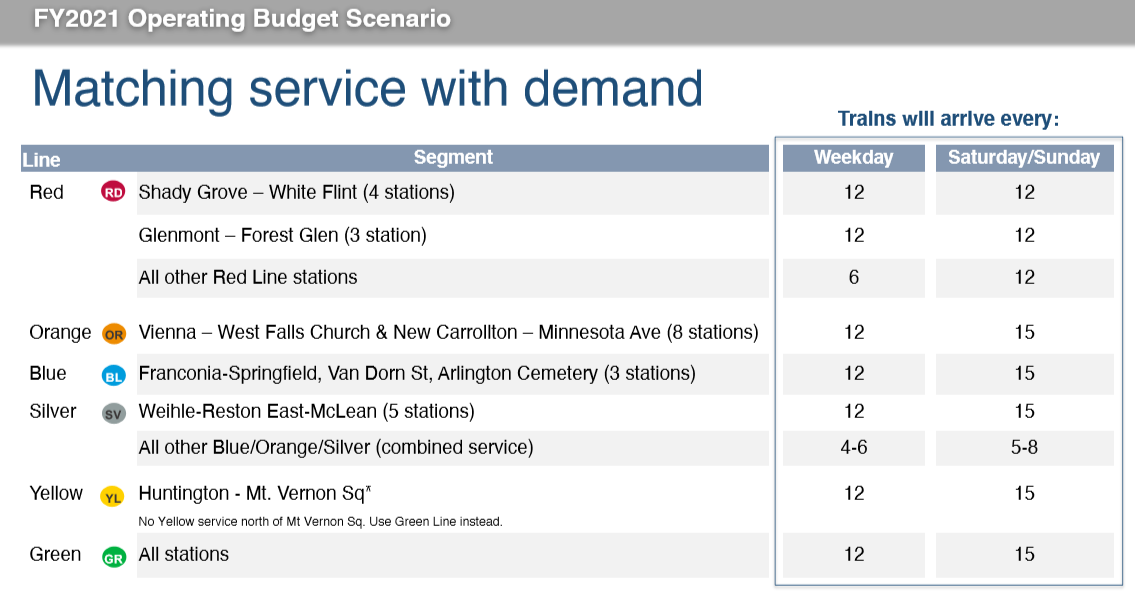
Metro will propose continuing with reduced service at about 75% of pre-COVID levels, with changes starting in mid-December, Wiedefeld said.
“We’re trying to balance this financial pressure,” he said. “But how do you continue to meet those [essential] trips that people need? How do you have the capacity, the room to make social distance and make people feel safe to use the system? And then how do you support the economy of the region… as you start to open?”
Bus service would stay at service levels in place now instead of ramping back up to full service, and the agency would again collect fares starting in January 2021. Bus fares had been eliminated during the pandemic to protect bus operators. The fare machines are at the front of the bus and riders have been asked to enter in the rear of the bus. Metro would instead install shields to protect operators.
On rail, most lines would be reduced to a train every 10 minutes during peak periods and a train every 12 minutes during off-peak periods. That’s down from trains every eight minutes during peak hours. The exception is the Red Line, which would see six minutes between every train all day.
The system would close at 9 p.m. on weekdays and 11 p.m. on Friday and Saturday. That’s two hours earlier closing time Sunday through Thursday.
The opening of the second phase of the Silver Line would be delayed until July 1, 2021.
The Red Line Grosvenor and Silver Spring turnbacks and Yellow Line turnback at Mt. Vernon Square would also likely be reinstituted. The turnbacks reverse some trains that are not as full toward the end of the lines.
The Plan To Address The Budget Gap
So far, no major layoffs are planned, but Metro says the changes would reduce its workforce of nearly 13,000 people by 1,700 employees.
Wiedefeld said they are first looking at leaving unfilled positions open and asking for early retirements.
“Our approach that we’re going to take is to do as much as we can to not impact people that currently have jobs,” Wiedefeld said. “So we know the number of full-time equivalents that we have to get you to get to that number.
“But how we get there, we’re going to have to work through.”
Wiedefeld said these plans could also get pulled back quickly if the feds come through.
In a recent WMATA employee town hall, ATU Local 689 President Raymond Jackson said he’s hoping to save jobs.
“It’s close to the worse it’s been,” Jackson said of the financial situation, other than mass layoffs in the early 1990s. “It’s pretty bad.”
In a letter to Congress members, the union wrote, “We recognize that everyone has made incredible sacrifices during this pandemic. But we believe that laying off some of the very same essential workers that have kept this country moving while millions of people worked from the comfort of their homes, is unconscionable.”
Board Chair Paul Smedberg said the priorities are to keep workers and riders safe, protect essential trips, keep enough service to meet demand, allow for social distancing and be intentional about equity in service cuts.
Metro’s board will discuss the “likely” budget cut scenarios Thursday. That will be followed by a few months of virtual public hearings and a final board vote in November. Metro is also beginning the fiscal year 2022 talks earlier than normal because of the pandemic.
Wiedefeld’s proposals to trim $43 million include cutting contractor work, eliminating “runners” who shuttle items for station managers, have only one station manager per station and a five-day furlough for non-union employees. Non-union employees would also forgo a pay increase. Metro will also defer some capital projects like IT equipment replacement and new digital signs in stations.
The cuts would also affect the paratransit contract, which would be reduced to only meet the current demand. Wiedefeld said they were keeping those drivers employed for as long as they could, but now need to make the cut.
Metro says workers will get a 60-day notice if layoffs are needed.
Smedberg said he hopes the federal government will step up and says the local delegation has been supportive.
“This region has really invested not only in WMATA, but transit in general and wants to make sure when people do come back to work that transit is their option,” Smedberg said. “They do not want people getting back in their automobiles and they want to make sure that transit is there for folks, that there is going to be a reliable level of service.”