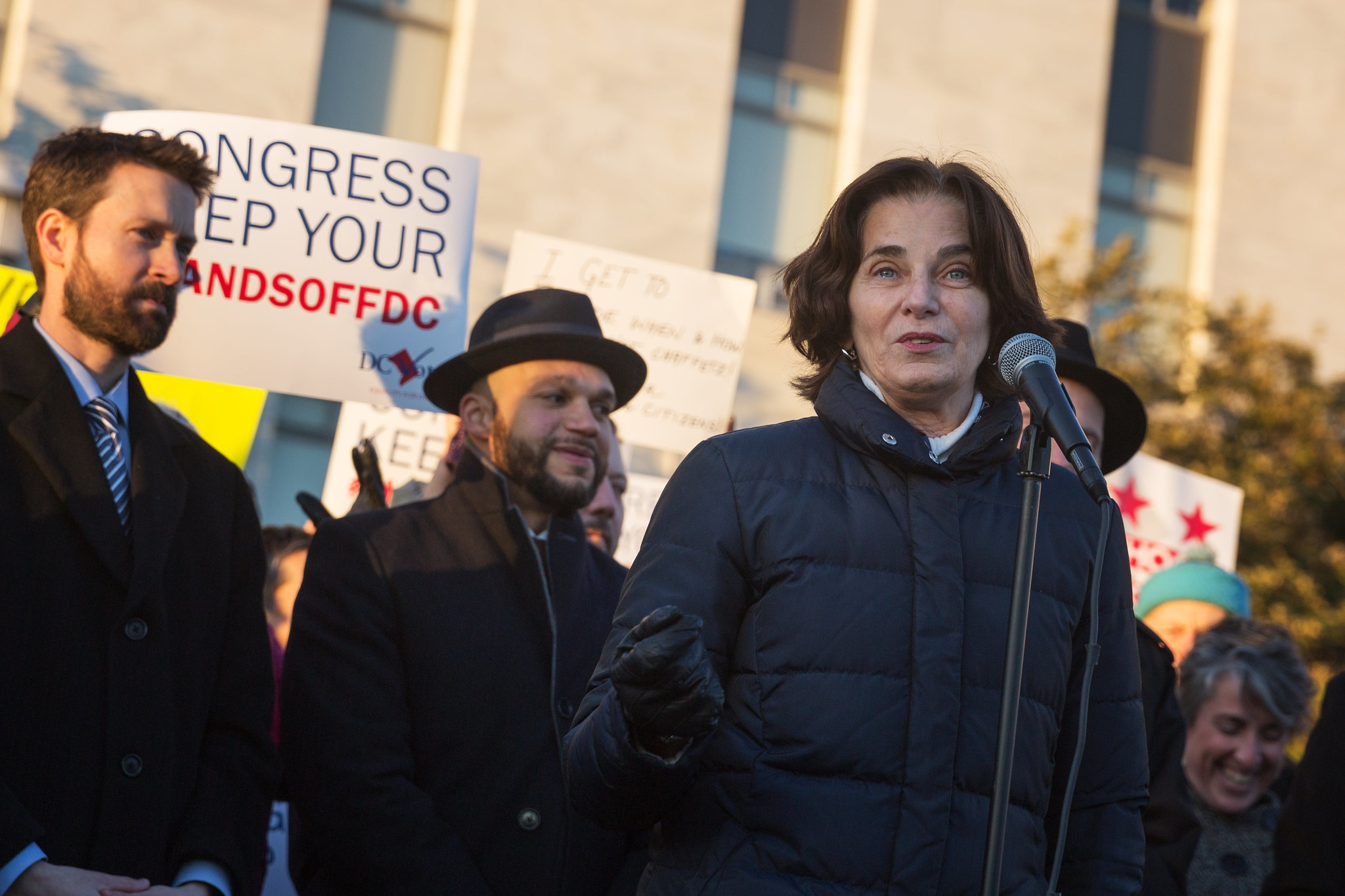
Normally on the anniversary of 9/11, Ward 3 Councilmember Mary Cheh attends a ceremony to acknowledge D.C.’s firefighters and emergency medical personnel. But this year, she was unable to attend for medical reasons: she’s participating in a late-stage clinical trial for a potential coronavirus vaccine.
Cheh is among volunteers helping to test a trial vaccine jointly developed by the Cambridge, Massachusetts-based biotech company Moderna, Inc. and the National Institutes of Health. Cheh wished she could attend Friday’s ceremony, but notes that the trial process is “very time-sensitive.”
“That’s the only regret I have about today,” she adds.
Cheh first got interested in participating after hearing her friend, who is a doctor, talk about doing it. “I know it’s minor, but it made me feel like I was doing something to help things along,” she says.
They decided to do it together, and Cheh signed up a little over a month ago. Cheh says she’s “a little squeamish” when it comes to needles, and having moral support from a pal who is also a physician made a big difference. “I had a friend and a doctor,” she says. “What could be better?”
The pair had their second in-person appointment in Rockville on Friday, where they had blood drawn, underwent a physical exam, had a nasal swab COVID-19 test, and received their second and final dose of the trial vaccine, which Cheh compares to the size of a flu shot.
After the first dose, which Cheh got about a month ago, she said she initially felt fine and wondered if she’d gotten the placebo, which half of all participants get instead of the Moderna/NIH vaccine.
The following day, Cheh says, “I felt like I was hit by a truck.” She had muscle achiness, fatigue, and soreness at the injection site. The symptoms lasted about two days, Cheh says.
“I’m kind of dreading tomorrow because I’m gonna feel probably terrible, but it’s all for science and I want to do my part,” Cheh says.
Cheh says people are paid for participating and are compensated $100 for each test vaccine injection. They also receive some compensation for other parts of the process.
Countries around the world are racing to develop a vaccine in the wake of the pandemic, with more than 200 trials currently in development, according to the Washington Post. Some have expressed concerns about rushing the process, saying developing a vaccine within 12 to 18 months would be a “world record,” per the paper.
The NIH previously announced the launch of Phase 3 trials in July, with goals of determining whether the vaccine could “prevent symptomatic COVID-19 after two doses” in addition to asymptomatic coronavirus infections and COVID-19 deaths. They aimed to enroll about 30,000 adult volunteers nationwide.
Cheh says researchers are closely monitoring participants. Following each dose, she is required to do daily virtual check-ins via an app for about a week to monitor symptoms and answer questions about her health.
She says she and her friend will have seven more in-person appointments over the course of two years and will get regular phone calls. Cheh hopes her involvement can help speed up the process to find a vaccine.
“People are hurting,” she says. “This is just a little tiny, tiny thing for me to do, but it was something.”