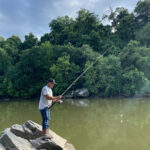
Mizanur Rahman, 47, has been going to East Potomac Park three times a week since losing his job in March due to the pandemic. There, instead of watching planes land at Reagan National Airport, as many visitors do, he angles for catfish in the Washington Channel with three different rods.
“If I get a big enough fish, I take [it] home and then we cook,” says Rahman, who emigrated to D.C from Bangladesh. He says he turned to fishing over the spring to help feed his three children and spend time outdoors. “We have a lot of fish in my country, so I enjoy the fish — all of them,” Rahman says.
Rahman is among various area residents who’ve taken up fishing during the pandemic, whether as first-timers or return fishers. It’s let them get out of the house while complying with social-distancing guidelines and, at least for now, seems to be growing in popularity, according to local fishing businesses and environmental experts.
Sometimes, as Rahman well knows, it even results in dinner.
Upper Northwest resident Alan Marzilli says he learned to fish on family trips to the Jersey Shore when he was younger, but, until the pandemic hit, had barely picked up a fishing rod since he was a teenager.
“I got back into it in part because of the restrictions,” notes Marzilli, a 49-year-old freelance writer and stay-at-home dad. He says a list of COVID-19-safe activities “rang a bell” for him that fishing was still an option for recreation. Since March, he’s purchased several rods and a kayak designed to accommodate his fishing gear.
Marzilli enjoys the camaraderie that comes with seeing other fishers cast their lines. “Even if you don’t catch anything, you just get to enjoy the water and your surroundings,” he says. Recently, on a trip to a local Bass Pro Shop, he learned the store was selling out of items — a sign of budding interest in fishing.
Richard Farino, the owner of District Angling, a fly-fishing supply store in Arlington, says his business experienced a boost in customers after the pandemic reached the region. “Everybody bought up everything to the point where I just wasn’t able to get product anymore because everything was sold out,” he says.
Farino also noticed a surge in customers who wanted to try fishing for the first time. He attributes it to quarantine boredom. “People wanted to get out and do things” he says.
Officials responsible for the area’s waterways have made similar observations. Tommy Wells, who leads the D.C. Department of Energy and Environment, says his office has seen the popularity of fishing increase during the COVID-19 crisis, as people are looking for low-contact activities to avoid contracting the virus.
“What I’ve observed personally is more people fishing from the riverbanks,” says Wells.
During the pandemic, local governments have recognized the importance of fishing for food. Maryland Gov. Larry Hogan exempted so-called “subsistence fishing” from his March 30 stay-at-home order, and Virginia allowed all types of fishing to continue during its shutdown.
Still, the District cautions against eating American eel, striped bass, and carp caught in D.C. waterways, because they can absorb high levels of polychlorinated biphenyls, commonly known as PCBs, and other chemicals. It also warns against eating more than a few servings a month of several other kinds of local fish, including catfish, northern snakehead, and largemouth bass.
Wells says the city will post more signs around common fishing spots to alert residents about this health advisory and, later this month, will release a report on the health of the city’s waterways.
“For many years we’ve had people that supplement their food by fishing in the rivers, and, in general, that’s a good thing to do,” says Wells.
Larry Dixon, 65, is a regular fisher at Fletcher’s Cove, located in D.C. along the Potomac River. A resident of Capitol Heights, Maryland, he’s been coming to the inlet to fish for catfish, bass, and white sucker for more than 40 years, pandemic or not.
“I always eat what I catch out here,” Dixon said on the riverfront on a recent Sunday morning, over the beats of a Chuck Brown song playing from a portable speaker. Roughly a third of his diet comes from what he catches in the Potomac, he points out, and he fishes with an 8-foot catfish rod that has a high-end spinning reel. “Anything short of a shark it’ll bring it in,” said Dixon, who learned to fish from his grandmother when he was five.
Fishers like Dixon are not new to the D.C. area. A report published last January by researchers from the National Park Service and the University of Maryland found that most of the 90-plus subsistence fishers interviewed on the Potomac and Anacostia rivers were middle-aged Black men who had been fishing for more than 20 years. It recommended that regional park officials expand resources for anglers due to the popularity of subsistence fishing.
“There’s a lot of that type of activity in the D.C. area that doesn’t get recognized enough,” says Amber Cohen, a research assistant at the University of Maryland who helped compile the report. Many of the Black anglers who were interviewed for the project said they learned to fish on childhood trips visiting family in the South, according to Shirley Fiske, a research professor at the university.
“It is undergirded by this whole southern, rural tradition of subsistence living,” Fiske says. “Almost everybody learned fishing from a family member. It is an activity that spans multiple generations.”
That’s how Octavia Richardson got started fishing: Her mother taught her and her siblings when they were growing up. As she reeled in a 6-inch perch at East Potomac Park on a recent Saturday night, Richardson, 60, said fishing is important to her family, who bring food, drinks, and lawn chairs to relax while casting their lines. It’s been this way even during the pandemic.
“The atmosphere is really calm and tranquil,” explained Richardson. “You get to enjoy some of your life just by doing this.”