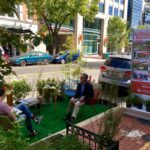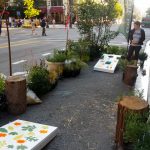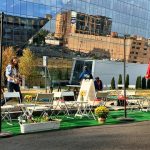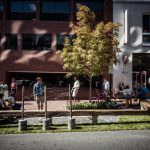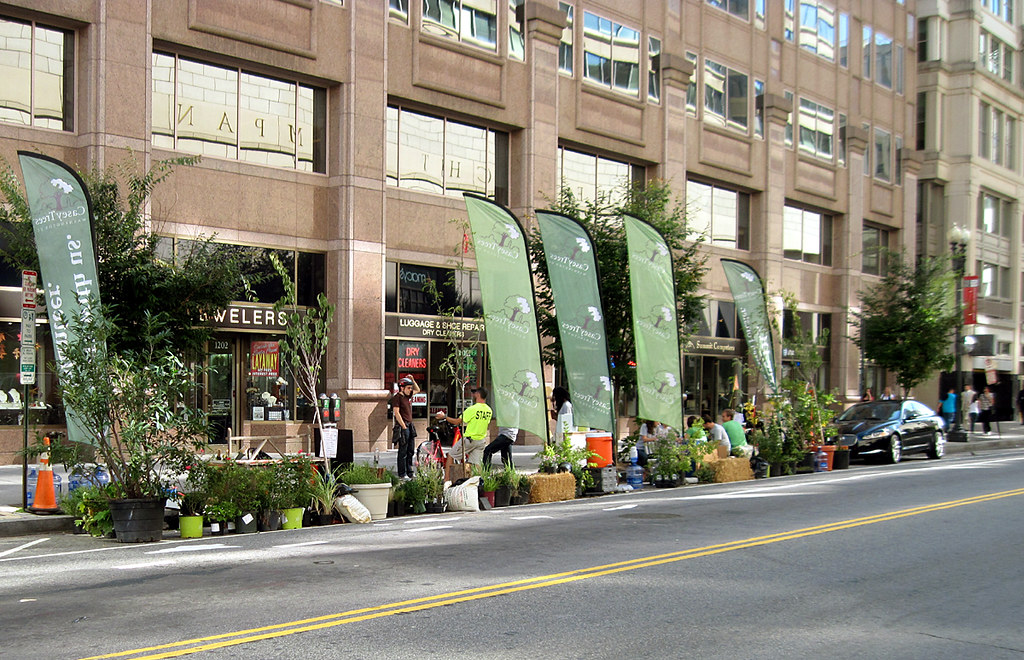
Local parks have become increasingly popular over the past few months, and D.C. is about to get a bunch more. PARK(ing) Day, an annual event that brings pop-up parks to the District, will return on Sept. 18.
The event, which allows residents and businesses to transform curbside parking spots into temporary parks, will take place from 9 a.m. until 4 p.m.
“This is a reflection of how we are consistently thinking about how to reimagine public space and to use it creatively to support the community,” says Jeff Marootian, director of the D.C. Department of Transportation.
PARK(ing) Day started in San Francisco in 2005 and has since been held on the third Friday in September in cities across the globe. In past years, local installations have included a parklet pool party and an open-access dining table.
Like many events in the wake of the pandemic, PARK(ing) Day will look a bit different this year. It will feature nine parklets, or small outdoor community spaces, at these locations:
- 633 T Street NW
- 117 Carroll Street NW
- 711 and 713 Kennedy Street NW
- 3714 14th Street NW
- 6900 4th Street NW
- 650 K Street NW
- 721 D Street SE
- 400 K Street NW
- 900 4th Street SW
In front of the Howard Theatre, Landscape Architecture Bureau and Wayside Studio are presenting an installation called Diasflora, which uses plants to map Black population data that “helps viewers celebrate the city’s Black history while acknowledging the complex histories that have influenced both demographic and floristic trends,” per Wayside Studio’s website. People can also tune in virtually on Instagram.
The Southwest Business Improvement District will also host a parklet on 4th Street SW featuring a traffic-calming mural from Chalk Riot and an information booth with details on new safety measures in the neighborhood, along with setups from other hosts in three of the city’s eight wards.
In accordance with health and safety guidelines, attendees must wear masks, and chairs at adjacent tables must have six feet of space between them.