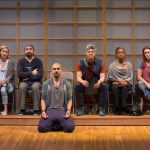
After the COVID-19 pandemic hit the D.C. area, Round House Theatre in Bethesda pivoted to virtual shows. The company produced “Homebound,” a web series on life under stay-at-home orders, and planned a whole slate of programming with social distancing in mind.
But adapting live shows to remote performances has proved challenging for Round House’s staff. Ryan Rilette, the company’s artistic director, points out that traditional theater is based on an in-person audience witnessing a live performance. He even cites research that’s shown audience members’ heart rates can synchronize with each other during productions.
“You can’t get that experience from a television,” Rilette says. “You can’t get that experience from a computer. You can’t get it when there’s something in the way, a filter between you and a person.”
Round House is among several D.C. area theaters that have scrambled to adjust to the novel coronavirus. Some have implemented virtual programming, including interactive and audio-centric shows, while others have canceled events through the end of 2020, due to safety and financial concerns. The changes have opened up new opportunities for local venues, but also led to staff layoffs or furloughs in some cases, as audience sizes remain substantially reduced.
For its part, Round House is about to put on a provocative new production, “American Dreams,” where viewers play the studio audience of a government-run game show that determines which of three immigrant-contestants win U.S. citizenship. The production, scheduled to run from Oct. 5 through Oct. 11, takes place on Zoom and features custom design, live audience voting, and question-and-answer segments. Rilette says the goal is to spur audience members to contemplate “what kind of America we are looking for.”
“American Dreams” premiered at Cleveland Public Theatre in 2018. But, with COVID-19 restrictions complicating tour plans, the New York City-based Working Theater partnered with Round House and several other institutions for a virtual tour where each participating theater or university hosts the show on specific dates. The actors perform from their homes, using their own light and camera setups.
Rilette says interactive components like those in “American Dreams” are relatively new for Round House, but are a way to recreate the communal experience offered by conventional theater. “It’s the closest thing you can get to actually knowing who’s in the room with you watching the show,” he says.
At Synetic Theater in Crystal City, staff are preparing for “Joy,” a Zoom-based performance for which viewers will be sent a box of props to use throughout the show. The show, running from Oct. 16 through Nov. 8, consists of two separate but parallel productions that star Vato Tsikurishvili and Maria Simpkins, respectively. Drawing on stories of joy in Tsikurishvili’s and Simpkins’s lives, the performances will feature photos, videos, and live shots from the company’s stage. (Viewers can purchase tickets to one show or both.)
Paata Tsikurishvili, the founding artistic director of Synetic Theater and Vato’s father, sees coronavirus constraints as “an opportunity to find a different storytelling angle” for shows. Before the pandemic, Synetic ran a limited number of programs with interactive elements. Now, productions like “Joy” offer new ways of thinking about the customs of theatergoing, according to Synetic associate producer J.P. McLaurin.
“It’s like, ‘Okay, well, the [prop] box is our lobby, and you open the box and that’s the curtain going up,'” McLaurin notes. “So, what are all of those things that we have to train our brains to think differently about? Because that’s all part of the audience experience.”
While the props are still being finalized, McLaurin says they’ll relate to what the actors talk about during the shows. He adds that the “sensory experience” of having the props will help viewers combat screen fatigue and feeling passive while participating in a digital experience.
In the District, Woolly Mammoth Theatre Company is relying on an older technology for its new production “Human Resources“: telephones. The show, which runs from Oct. 1 through Oct. 25, is an audio anthology that audience members access through a repurposed customer-service hotline. Using an access code that will open up a menu of options, audience members can call artists who will then tell intimate stories over the phone.
“The options, and what you find once you start going down the rabbit hole, are completely intentional and unique,” Woolly Mammoth’s artistic director Maria Manuela Goyanes tells DCist in an email. The show also includes a secret code that listeners can unlock, if they go far enough in the anthology. Tickets are valid for four-day windows, during which audience members can call in at any time. “Human Resources” is being presented in partnership with the Telephonic Literary Union, which makes stories for small audiences.
Yuvika Tolani, a producer who helped create the show, says the frustration that comes from calling bureaucratic customer-service or human-resource hotlines took on new resonance during the pandemic, since call centers have become increasingly strapped. “I feel that we really prioritized giving people a sense of mystery but also agency,” she says. “And giving people a sense of being held and feeling safe within the construct of this hotline, partially because of all of the anxiety, frustration, and hopelessness people have to wade through.”
Goyanes, the theater’s artistic director, says interactivity was already a hallmark of Woolly Mammoth’s programming before COVID-19. She points to “As Far As My Fingertips Take Me,” a 2019 production about an encounter between a refugee and an audience member that was mediated through a gallery wall.
Still, Goyanes doesn’t see virtual productions, even interactive ones, as a substitute for live theater but rather as a supplement. “I wonder if, from an audience perspective, folks will be more interested and willing to try something that they have never tried before from the safety and comfort from their own homes,” she says.
Even as the region has started to reopen, official capacity restrictions make it highly unlikely for theaters to turn a profit, say the artistic directors who spoke to DCist. The restrictions and overall economic slowdown have also impacted actors and production crews, who’ve lost jobs or wages during the pandemic. (In the District, most theaters and performances spaces remain physically closed under the city’s phase two reopening.)
In June, Maboud Ebrahimzadeh, a professional stage actor and resident artist at Round House who co-starred in “Homebound,” told DCist that the 10 weeks of pay he received for the show was significantly less than what he makes for usual union-acting contracts. “I’m just focusing on creating income right now, so that when theaters come calling next year, I can still afford to do it,” he said at the time.
McLaurin of Crystal City’s Synetic Theater says that while Synetic met its financial goal for its first virtual production, “The Decameron,” it’s been difficult for the staff to budget due to uncertainties around audience demand. “Our audience isn’t used to this format, so we have to spend extra time and extra care in making sure [the] digital marketing is explanatory enough, or that we’re reaching the people we want to reach,” he says. (He declined to discuss specific figures.)
GALA Hispanic Theatre in Columbia Heights recently announced plans to welcome back in-person audiences, and could be one of the first local theaters to do so. It’s one of five District venues that city officials picked to participate in a “live entertainment pilot” initiative, which features a slew of restrictions on capacity and operations.
Rilette of Bethesda’s Round House says it’s too soon to tell how long companies will continue to produce virtual shows. His theater is currently planning to bring back in-person shows next spring, though he adds that a successful COVID-19 vaccine could take a while to finalize and distribute.
“There’s going to be a long period where some people start coming back to the theater [and] some people stay at home,” he says.