 Eliza Tebo
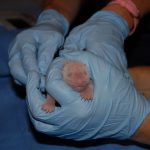
In an elaborate reveal Monday morning, Smithsonian National Zoo panda keepers announced that the zoo’s 6-week-old giant panda is male.
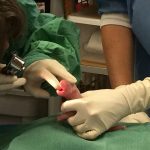
The yet-to-be named cub was born Aug. 21, one of four surviving descendants of mother Mei Xiang and the third male. The cub’s sex was determined via genetic testing of a cheek swab taken at his first veterinary exam on Sept. 19.
In its announcement, zoo staff members unveiled a painting rendered by father Tian Tian, whose blue hue served as a signifier of the cub’s sex.
The cub weighs 3.6 pounds and is 14 inches long, from nose to tail, and is beginning to open his eyes, according to an exam conducted Thursday.
We won’t know the cub’s name for several more weeks, as the zoo usually waits 100 days to name baby pandas. National Zoo spokesperson Pamela Baker-Masson told DCist/WAMU in August that many countries, including China, wait to name cubs till they are 100 days old, as many struggle to survive past their infancy. The zoo will continue to provide updates on the cub’s progress, she said shortly after his birth.
“We will do our very best to engage everybody and just take everybody along for this very joyful journey,” Baker-Masson said. “I know from the feedback we’re getting that it’s just a really awesome moment of joy, and we can all use more of that in our lives right now.”
Mei Xiang, 22, is the oldest giant panda in the country, and the second oldest in the world known to give birth, according to a press release. The pregnancy was the result of artificial insemination using frozen semen from Tian Tian, the first time a U.S. zoo has generated a successful pregnancy and birth using exclusively frozen semen, the press release says.
The young cub joins Tai Shan, Bao Bao and Bei Bei as one of Mei Xiang’s four surviving offspring. All but the youngest now live in China; through a breeding agreement with the China Wildlife Conservation Association, the zoo transfers cubs to China when they turn 4.
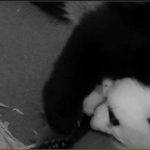
Though the panda habitat is currently closed to maintain a calm environment around mother and son, viewers can check in on the family using the Giant Panda Cam on the zoo website.