Margaret Barthel
 Jenny Gathright
This story was updated at 12:10 p.m. on Oct. 7.
The segment of the District referred to as “official Washington” is often discussed as a separate entity, as if it’s cordoned off from the daily lives of the vast majority of people who call D.C. home. But there’s no discrete barrier between the two parts of the city.
D.C. residents work in the White House as residence staff. They are part of the Secret Service. They are staffers for members of Congress who attend White House events. They are the servers and cooks at the restaurants where government officials dine. And they walk, shop, and travel in a community that has been working for months to contain the spread of COVID-19.
Now, with a growing tally of coronavirus cases linked to the Trump administration and recent events at the White House, some local residents and elected officials have expressed concern about how the outbreak might affect the broader community of people who work at the White House or on Capitol Hill and come into contact with members of the Trump administration and their lawmaker associates.
That concern is heightened by questions around whether the White House cases are being appropriately contact traced, and how the spread might be growing, undetected, in the city.
Public health experts say that the average D.C. resident should not be overly concerned about exposure because of the White House outbreak.
“That said, I think we’re still learning about the extent of the spread and how many people have tested positive,” said Amanda Castel, an epidemiologist at George Washington University.
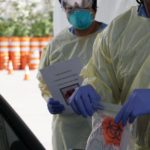
“It’s not just about the politicians that have tested positive,” said District resident Megan Peterman, who spoke to DCist on Tuesday after getting a coronavirus test at the Judiciary Square public testing site. “People work in the White House, and those people also shop at my grocery store and are out about town. It feels frankly really scary.”
The outbreak has already started to affect non-public-facing staff who work at the White House, including two housekeepers and three White House reporters. Concerns about further infections to White House staffers are heightened now that President Trump, who is still contagious, is back at the White House. About 400 people are employed by The White House, though it is not clear how many are currently coming in to work.
In a press briefing Monday afternoon, the president’s physician, Dr. Sean Conley, said they were looking carefully at “how to keep everything safe down at the White House for the President and those around him. We’re looking at where he’s going to be able to carry out his duties, office space.”
It remains unclear what the White House is doing to track and contain the outbreak among members of the administration. In the last week alone, at least 23 people in White House circles have tested positive for the virus, including White House adviser Stephen Miller, Press Secretary Kayleigh McEnany, and Republican National Committee Chairwoman Ronna McDaniel.
D.C. officials and White House medical personnel have been only briefly in touch regarding the spread of the White House outbreak, Mayor Muriel Bowser said at a press briefing on Monday. D.C. Health officials have reached out to the White House, she said, but have not made “substantial contact from the public health side.”
“I recognize … that a lot was going on and they have their hands full with a lot on that level, but I think that one of [DC Health Director Dr. LaQuandra Nesbitt’s] team had a very cursory conversation,” she said. “We’ll continue that communication, those attempts.”
DC Health said Friday that the White House would handle contact tracing efforts, and the city department would not be directly involved. But if White House workers who are District residents test positive, those cases would be subject to the District’s regular contact tracing process, Nesbitt said at the press conference on Monday. D.C. Del. Eleanor Holmes Norton sent the White House a letter on Tuesday, urging them to be more communicative with the city about contact tracing the outbreak.
The New York Times reported Monday that the White House is not contact tracing for the guests at a Sept. 26 Rose Garden event held in honor of Supreme Court nominee Amy Coney Barrett, though several in attendance have since tested positive. Instead, per the Times, the White House is focusing its efforts on people in close contact with the President in the two days before his Thursday diagnosis. The Times also reports that the White House has excluded experts from the Centers for Disease Control and Prevention from the process.
Castel, the GWU epidemiologist, said timely contact tracing is one of the keys to curtailing spread of the virus, but she is not seeing evidence of such a process.
“We’re not seeing that rapid rollout of contact tracing and case investigation that we know can slow the spread of the virus in this situation,” said Castel. “And it would be unfortunate if, because of those delays, many individuals end up getting infected with the virus.”
At the same time, there is evidence that people who attended White House events linked to the virus’s spread have, indeed, been spending time out in the broader D.C. community. Martin Lumet, the proprietor of the Georgetown restaurant La Chaumiere, confirmed on Tuesday over email that Coney Barrett dined at his restaurant with her family after the Rose Garden event. (The family had traveled to D.C. from Indiana, which is on D.C.’s list of high risk states; Travelers from those states are asked to self-quarantine upon arrival to the District.)
“I have not been contacted by any contact tracers so far,” Lumet wrote. “Nobody on our staff has gotten sick or showed any symptoms of illness. All our employees have their temperature checked upon entering the building and no fever was reported.”
Others in the community, even if they were not directly exposed, may have responded to the outbreak by getting tested. Coronavirus testing numbers were up at District public testing sites on Monday, and a D.C. official said the uptick could be related to heightened awareness stemming from the White House outbreak.
“I think it’s put the issue of testing back on people’s radar,” said Jason Qu while he waited in line at the Judiciary Square testing site.
Qu said he’d been tested at Judiciary Square multiple times in the past, and Tuesday morning’s long line stood out. “It’s never wrapped around the block this way.”
At-large D.C. Councilmember Elissa Silverman called on the White House to share information with local public health departments.
“The White House & Congress should be sharing COVID+ cases confidentially with MD, VA, & DC health departments so our region can contact trace and contain community spread,” Silverman tweeted. “White House staffers & their families eat in restaurants, work, shop, go to school & play in our communities.”
New York Times White House correspondent Maggie Haberman reported Monday that two members of the White House residence staff had tested positive for the coronavirus. They worked for the housekeeping department on the third floor, Haberman said. “When their tests came back positive, they were told to use ‘discretion’ in discussing it,” Haberman wrote on Twitter.
Others have expressed concern for secret service agents who are in close contact with the President and other White House officials.
On Twitter, U.S. House Rep. Jennifer Wexton (D-VA) called Trump “absolutely heartless” for getting in the car with secret service agents on Sunday to greet supporters who had gathered outside Walter Reed Hospital.
In his briefing with reporters on Monday, Conley defended the President’s car ride, saying the President’s team worked with infectious disease experts to make sure it was a safe situation.
“The president has been surrounded by medical and security staff for days wearing full PPE, and yesterday the U.S. Secret Service agents were in that same level of PPE for a very short period of time,” Conley said.
A spokesperson for the Secret Service declined to share how many of its agents had tested positive or quarantined as a result of the outbreak, citing “privacy and operational security reasons.” The spokesperson said the privacy policy has been in effect throughout the pandemic and was not created in response to the White House outbreak. (The Secret Service dealt with a recent outbreak of its own linked to a training center in rural Maryland in August, per reporting by the Project on Government Oversight, a watchdog group, and confirmed by the New York Times.)
Concern has also spread to the Senate, where at least two Republicans on the Senate Judiciary Committee have tested positive. Sen. Thom Tillis (R-NC) and Sen. Mike Lee (R-UT) both tested positive for the virus in recent days and had both attended the White House Rose Garden ceremony for Amy Coney Barrett.
Andrei, a Capitol Hill staffer who declined to share his last name because of job-related concerns, said he felt worried about the outbreak—he’d needed to go into the office a few times, and he’d noticed people not wearing masks on the Hill. Andrei also went to get a coronavirus test at Judiciary Square on Tuesday.
“I work in Congress, and I have friends who I know are rightfully concerned about the lack of information about who was infected, and whether their bosses might have been,” he said.
This story has been updated throughout with quotes from D.C. residents and information about Amy Coney Barrett dining out at a local restaurant.