Martin Austermuhle
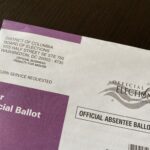
Like hundreds of thousands of D.C. residents, Sarah Mars Bowie got her general election ballot in the mail last week. But she was surprised to receive a ballot for someone else as well.
“I now have a ballot for one Mr. Daniel Fields, who doesn’t live here,” she says.
She isn’t alone. On social media, multiple D.C. voters have reported receiving ballots in the mail for people who don’t live with them. That’s prompted confusion, and a series of questions: What should someone do if they get a ballot addressed to someone else? Toss it? Shred it?
“They should mark ‘return to sender’ and put it back in the mailbox,” says Alice Miller, the director of the D.C. Board of Elections. Residents can also deposit any erroneously sent ballots at one of the 55 ballot drop boxes that opened across the city this week.
In normal times, instances of ballots being mailed to the wrong address may seem like a bureaucratic snafu. But in the midst of an election year where President Donald Trump has repeatedly claimed that mail voting is prone to fraud — despite ample evidence to the contrary — such errors could lead some people to doubt the integrity of the District’s voting system.
“My concern is that it undermines people’s confidence overall in the process,” says D.C. Councilmember Charles Allen, who recently received a ballot for a previous resident of his home. (Allen chairs the D.C. Council’s judiciary committee, which has oversight of the elections board.)
Still, Miller says that even if some ballots are getting delivered to the wrong homes, the likelihood of any fraud resulting from this is extremely low. That’s because, for a mail ballot to count, the envelope in which it is returned to the elections board must be signed and dated. The signature also must match the one that the board has on file for a specific voter.
“If the signatures don’t match, we will not process those ballots,” explains Miller. “We’ll do a second-level check.” She adds that elections officials will send voters in these cases letters requesting additional information. Voter fraud is considered a felony in D.C., and one that can be severely punished.
Election experts say that having any election material delivered to homes where a given voter no longer resides gets to the heart of what’s long been an issue across the U.S.: the quality of voter rolls.
In a 2012 report, the Pew Center on the States said voter-registration systems “are plagued with errors and inefficiencies that waste taxpayer dollars, undermine voter confidence, and fuel partisan disputes over the integrity of our elections.”
Many state-based voter rolls had significant inaccuracies, including names of deceased voters and people registered in multiple states, according to the report. A 2016 audit of D.C.’s voter rolls found a number of inaccuracies, such as the names of a small number of dead people, and voters whose dates of birth were listed as being in the 19th century.
David Becker, the executive director of the D.C.-based Center for Election Innovation and Research, says the quality of voter rolls has improved over the years, including in the District. Still, all state-based voter-registration systems face a similar issue: People move around a lot.
“The American people are highly mobile,” says Becker. “Someone moves out of your state and into another state. There’s a very strong likelihood that the state [someone is] mov[ing] from won’t learn about that, because people don’t contact their old state to say ‘remove me from the voter list.'”
And, he says, this problem is particularly notable in a transient place like D.C. “It just has an extremely high mobility rate, coming and going out,” Becker notes. “There are only a few places in the country that would have similar challenges, places like Clark County, Nevada, and New York City.” (Clark County contains Las Vegas.)
In a July 2016 response to the audit of D.C.’s voter rolls, Michael Bennett, the chair of elections board, wrote that the city is a “very transient jurisdiction… voters move within and outside the District without notifying the BOE.”
Back in 2012, a solution was devised to address the challenge of voter mobility: the Electronic Registration Information Center, known among election officials as ERIC. Essentially, ERIC is a mechanism for state-based databases to speak to each other, so they can catch when someone relocates and changes their voter registration. D.C. is a member jurisdiction of the system, as are Maryland, Virginia, and 28 other U.S. states. (There’s a separate database system, STEVE, to check for voters who die.)
But Miller says ERIC has two key faults: 20 states still aren’t members, and it relies on people who move updating their voter registration in a timely fashion. “Not everybody always registers at their new address,” she says.
D.C. works separately with Maryland and Virginia to compare voter lists, said Bennett in his response to the critical audit. “This comparison resulted in the removal of dual registrants and the referral of individuals who had voted in more than one jurisdiction during a presidential election to the U.S. Attorney’s office for prosecution,” he wrote.
There’s also the matter of removing people from voter rolls. This isn’t as easy as it may sound, according to elections experts.
Say a D.C. voter doesn’t vote in 2020. That fact will be noted by the elections board, which will then reach out to check if the person still lives at the address that the board has on file. If the person has moved, they aren’t immediately removed from the rolls, as the law requires that two more election cycles in which they don’t vote pass before they can be scrubbed. (Federal rules also prohibit changes to voter records within 90 days of a presidential election, says Becker, of the Center for Election Innovation and Research.)
Eventually, when election officials try assessing whether inactive voters have moved out of the District, Miller says it will be critical for residents to return the cards that officials send in search of registered voters who didn’t cast ballots.
“That does help us to keep the rolls updated,” she says. The process will start in January.
In August, the elections board sent mailers to the District’s more than 460,000 registered voters to ensure that voters would get their ballots at the address on file. If a mailer came to someone who no longer lived at a particular address, the current resident was asked to send the mailer back indicating this. But the mailers were poorly designed — leading to widespread confusion.
Also in the summer, the elections board scrapped a tool that experts say is crucial for getting accurate information in voter rolls: online voter registration. (Officials say the app that facilitated online registration was unreliable.) Since then, the board has rolled out a different online process that will be used until a new app is developed.
Becker says he’s unsurprised that these issues are coming to the surface in D.C. The city rolled out a full vote-by-mail system in a matter of months, he says, while some western have been administering widespread mail voting for years. Those state have some of the most accurate voter rolls in the country, he adds.
Allen, of the D.C. Council, says his efforts to follow up on the ballot that was wrongly sent to his house haven’t succeeded. “I have sent [letters] multiple times for those three people that don’t live here, [saying] they no longer live here,” Allen says. “And that has never been updated. That’s probably the story that’s playing out in a lot of places around the District.”
Still, Allen says he’s confident there won’t be a surge in fraudulent voting from errant ballots. “It’s important for folks to remember that the voting fraud is a crime,” he says, “and we have checks to find you.”