 Jordan Pascale
Metro’s Board of Directors is beginning to formulate its budget for July 2021 through June 2022, and so far it is filled with uncertainties and question marks caused by the COVID-19 pandemic. How soon will schools return? Will workers be allowed and more inclined to work from home? If they do go back to the office and traffic isn’t bad, will they just opt to drive?
Those are some of the scenarios the transit agency is currently working through. But board members agreed on Thursday that Metro should plan for the worst-case scenario: Ridership won’t return to pre-COVID levels for years.
“In talking to other transit properties, what we’ve seen internationally… [continued low ridership] seems to be where the new normal is,” said General Manager Paul Wiedefeld at the meeting. “So we will have to deal with that issue ongoing.”
Wiedefeld insisted WMATA doesn’t want to cut service since it has a cascading effect on riders, the region’s economy and Metro’s own workers. “But we also have to deal with the financial realities that we’re all faced with at the federal level, at the state level and the local level,” he said.
Metro is facing nearly a $250 million budget gap through the rest of this fiscal year that ends in June 2021, and it could face anywhere from a $167 to $345 million gap in the fiscal year after that. If localities can’t afford to pay their full share of subsidy to WMATA, the hole is expected to be $135 million deeper.
Federal funding through the CARES Act will keep Metro afloat through the rest of the year. But more help does not appear on the way; negotiations on any future federal aid package were largely put on hold this week by President Trump.
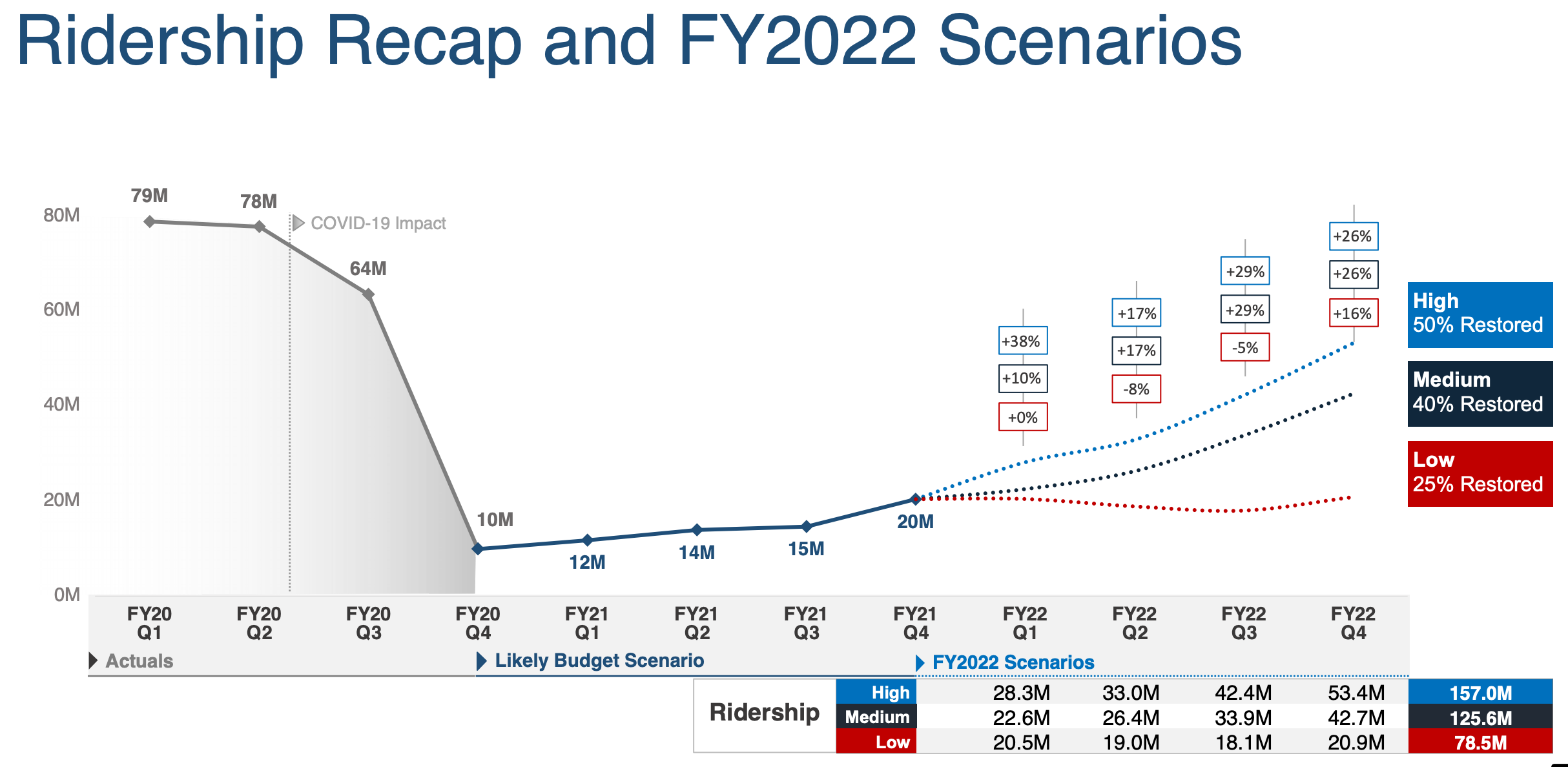
Meanwhile, Metro says ridership will likely only be 25-50% of pre-pandemic levels, which will stifle fare revenue by nearly $560 million.
WMATA laid out three potential scenarios for ridership returning based on what happens with the virus, a possible vaccine, rider sentiment, and what kind of trips people are willing to take.
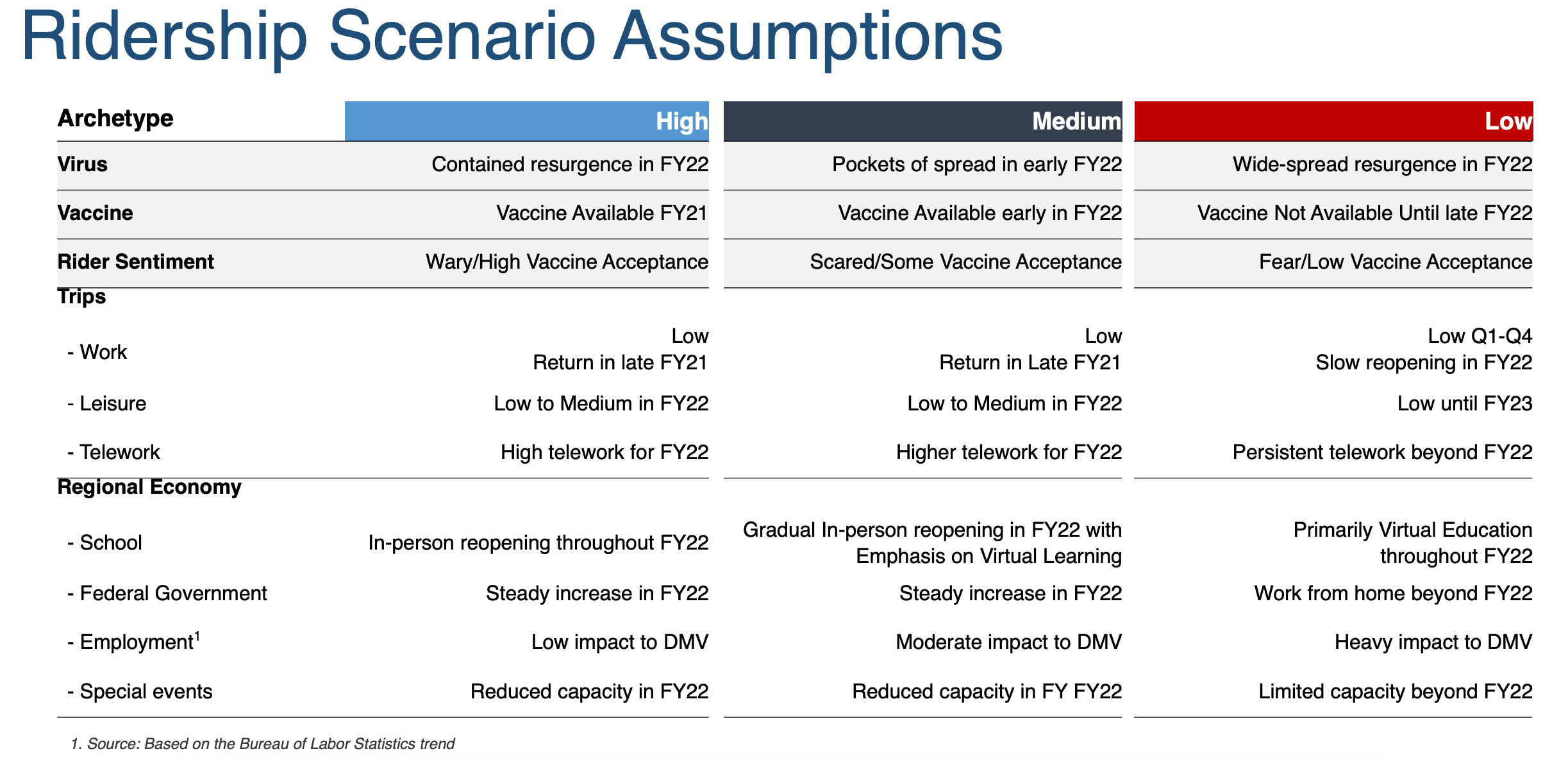
And here’s how that translates into ridership levels on a graph. Metro had about 79 million riders a quarter before the COVID cliff reduced it down to about 10 million. Metro says that at best it could get to 53 million riders by spring 2022.
The revenue side is also missing Metro’s biggest moneymakers: long-distance rail commuters. Maryland Board Member Michael Goldman said ridership can’t be treated interchangeably.
“We need a more fine-tuned analysis,” he said. “A rider on Metrobus pays a different fare than those on rail.”
Goldman pointed out that a rider from the suburbs can pay $6 one way plus parking costs, compared to $2 bus fare. “If the riders aren’t out there coming in from the far out stations, maybe we don’t need as much service there,” he said.
Earlier in the budget cycle, Goldman railed against turnbacks, which reduces services to the outer stations, on the Red Line.
Board members say Metro needs to closely monitor rider behavior and traffic trends. A Metro survey found that 53% of former riders that are teleworking full-time would ride Metrorail again only when an effective vaccine becomes available.
Devin Rouse, an alternate federal board member, says school is a major driver for most people.
“With a kid at home, that’s just not a realistic option [to return to work if school is not in person],” he said. “So I think one of the major demarcation points probably next fall is if we get back schools in person on a full-time basis.”
Rouse also said if traffic isn’t bad and a commute in the city is 20 minutes, many will opt to drive instead of riding with others.
While the revenue side of the balance sheet is an issue, expenses are likely to grow, too. Metro is working on a new contract for ATU Local 689, Metro’s largest union, which will could mean increased cost in wages. And there’s the increased costs of cleaning and PPE during the pandemic.
Additionally, Metro could open the second phase of the Silver Line next summer, though a few problems still have to be worked out before Metro announces a start date.