Ally Schweitzer
The vast majority of eviction cases filed in D.C. don’t result in an actual eviction, and many renters receive multiple notices from the same landlord over the course of their tenancy, according to a report published Thursday by Georgetown University’s McCourt School of Public Policy.
The findings suggest some District landlords routinely use eviction notices not to remove tenants who have violated their lease, but to drum up payments from tenants who have fallen behind, sometimes by only a few hundred dollars.
In 2018, just 5.5% of eviction notices filed in D.C. Superior Court led to an actual eviction. And most of the filings came from a relatively small number of landlords, data show. Just 10 property owners — who together own 16% of the city’s rental housing units — filed more than 37% of all eviction cases that year.
It doesn’t take much for some landlords to file eviction cases, either, the study shows. In 2018, the typical D.C. household facing eviction owed $1,207 when their landlord filed a case — less than the citywide median rent of $1,487. Among households who received a notice, 12% of them owed less than $600.
The study provides evidence of a practice that is well known among tenant advocates and widely acknowledged by landlords and their attorneys, but may not be known to the public, says Eva Rosen, an associate professor at Georgetown who co-authored the report.
It also shows how easily tenants who miss a single rent payment can fall into a cycle of housing insecurity.
“That eviction filing goes onto the [public] record,” Rosen says. “When future landlords look at tenants’ residential histories, they often don’t care whether it’s a filing or an executed eviction. They just see that there’s some eviction process that was initiated, and that’s the number one red flag for a landlord.”
The report’s findings helped inform temporary legislation passed this week by the D.C. Council. A bill sponsored by Chairman Phil Mendelson and Council member Mary Cheh (D-Ward 3) requires D.C. Superior Court to seal within 30 days court records for eviction cases that don’t lead to a judgment against the tenant, and to seal records for executed evictions after three years, unless the tenant was evicted again during the same period. The measure also requires photographic proof that tenants have been served an eviction notice, after a DCist investigation found many tenants were not given proper notice of their eviction hearings.
Additionally, the legislation temporarily prohibits landlords from initiating evictions against tenants who owe less than $600.
“There’s a huge portion of evictions that are happening for very small sums of money. Why are we sending cases to court where people owe $200, $100 or $50?” Rosen says. “It’s not a good use of the court’s time.”
Temporary protections under the bill go into effect for 90 days after it’s signed by Mayor Muriel Bowser, and last for 225 days assuming it passes a standard 30-day Congressional review. But it’s not clear how much of a dent the legislation will make during the pandemic, because residents are already protected from evictions while the city remains under a state of emergency.
The authors of the new report say one way to discourage D.C. landlords from overusing the eviction process in the long term is to raise the price of filing cases. It costs just $15 to file an eviction case in D.C. court — the lowest fee in the country, according to the study.
“That just makes it really too easy for landlords to use the system in this way,” Rosen says.
Cheh and Mendelson’s legislation includes nonbinding language encouraging D.C. Superior Court to raise eviction filing fees to $100, “so that serial filers seeking small sums of money from their tenants are deterred from using eviction filings as a mechanism to collect rent.”
The study looks at those “serial filers.” The 20 property owners with the most eviction filings in D.C. Superior Court initiated almost half of the city’s eviction cases in 2018, though they own less than 21% of the city’s rental units. The study does not identify the biggest evictors, per an agreement between Georgetown University and the court, Rosen says.
Additionally, most D.C. households served an eviction notice receive multiple notices at the same address over time. In 2018, nearly 60% of these households were sent at least one additional eviction filing between 2014 and 2018, according to the report.
“If you see a tenant that’s being filed on two, three, four times at the same residence, you know that tenant is not getting kicked out. So what is happening here?” Rosen says. “Landlords are really using it as a tactic to put a bit of legal pressure on tenants.”
Property owners and their attorneys say eviction filings are necessary to get tenants’ attention when they’re behind on their rent. It’s a legal alternative to illegal means such as harassment or what’s known as “self-help eviction” — when landlords change locks or remove a tenant’s belongings either to evict or intimidate them.
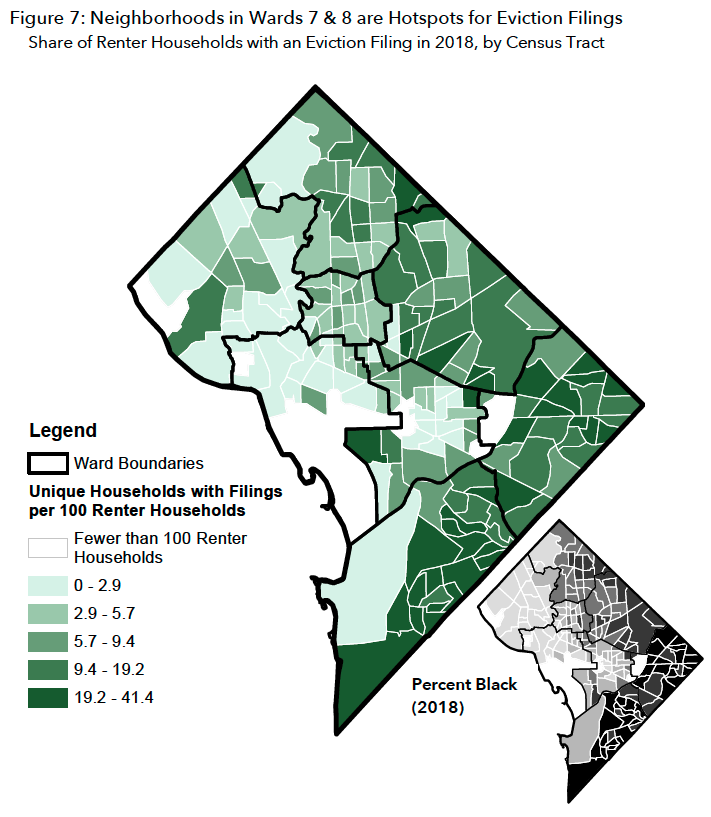
But the report demonstrates how this legal practice may deepen racial and economic inequality in the District. In Ward 8, 25 out of every 100 renter households received at least one eviction filing in 2018. In Ward 7, it was 20 out of every 100 renters. These wards also accounted for most of the District’s executed evictions that year, with more than a third carried out in Ward 8 and a quarter in Ward 7.
What’s less clear, Rosen says, is how often eviction filings result in unofficial evictions — renters vacating their homes soon after they receive a notice, even though they’re not legally required to leave until they’re served a writ by a U.S. Marshal.
“We don’t know how many evictions happen informally,” the professor says.
For that reason alone, the study suggests, making it harder for landlords to use the eviction process as a rent-collecting mechanism could chip away at housing inequity in the District.
But the biggest solutions won’t come from legislative tweaks, Rosen says. The real answer is permanent funding for rental assistance, above and beyond the local programs the District already has.
“If we care about eviction and we care about the problem of eviction filing, long-term rental assistance is really the way to go,” she says. “It’s the most sustainable way to keep people out of the courts entirely.”