Martin Austermuhle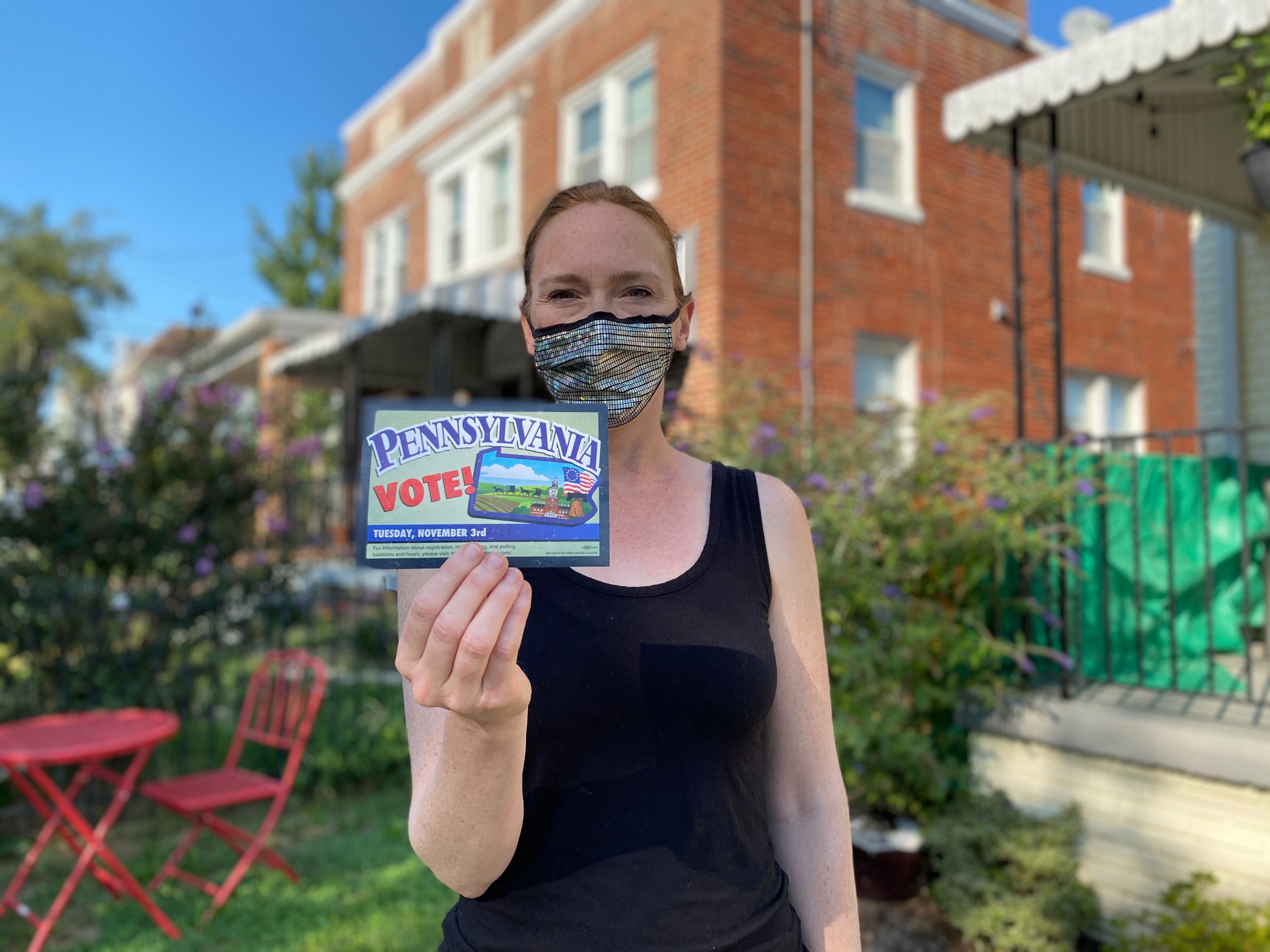
Every vote counts, but Lauren Campbell knows her vote won’t count as much as one cast by someone in, say, Pennsylvania.
That’s the reality Campbell has to live with as a D.C. resident: The city is solidly Democratic, and no one is betting that President Trump will win the city’s three electoral votes in November. (In 2016, Trump got 4% of D.C.’s vote, the lowest tally of any jurisdiction in the country.)
And like many D.C. residents, as well as people in states that aren’t seen as competitive in this year’s presidential contest, Campbell, 40, admits she’s both terrified and motivated — terrified of a second term for Trump, and motivated to do whatever she can to prevent it.
“It’s clear that the current president is going to do anything he can to hold onto power,” she says. “So what I’m looking for is to contribute in my small way to a landslide Biden victory.”
That small way is 4×6 worth of cardboard — a postcard, thousands of them, all bearing hand-written messages to Democratic voters in swing states like Pennsylvania and North Carolina.
“The message for the postcards for this particular campaign is to increase Democratic turnout,” Campbell says.
Faced with a presidential election many say will be the most consequential in a generation, a growing number of Washington-area residents like Campbell are looking for ways to extend their influence beyond the Democratic strongholds where they live. And with a pandemic that has all but done away with traditional means of campaign volunteering like canvassing and door-knocking, they’re looking for ways to get involved at a distance, through phone calls, text messages, postcards, and hand-written letters.
Campbell, an arts administrator who had only volunteered for a campaign once before, says she ordered 8,000 postcards through the Postcards To Swing States initiative. The cards were split between those that would go to voters in Pennsylvania and North Carolina. The front of the cards featured images of state-specific scenes (an Amish countryside and Independence Hall for Pennsylvania, the Outer Banks for North Carolina) and a reminder of the upcoming election, while the backsides were blank. Campbell was provided the messages to write and the people she’d be sending the cards to.
And when she started offering cards to friends and neighbors, demand was high.
“I did not necessarily expect to be able to distribute 8,000 postcards so quickly. I was able to do it all in about three weeks. And people are clamoring for more,” she says.
Reid McCollum, one of the founders of the year-old Chicago-based initiative, says demand for the postcards has been high in the Washington region. He says more than 3,500 people in D.C., Maryland and Virginia have ordered a combined 1,000,000 postcards that will be sent to voters in 14 states in two coordinated mailings later this month. All told, McCollum says the campaign will be sending almost 16 million postcards.
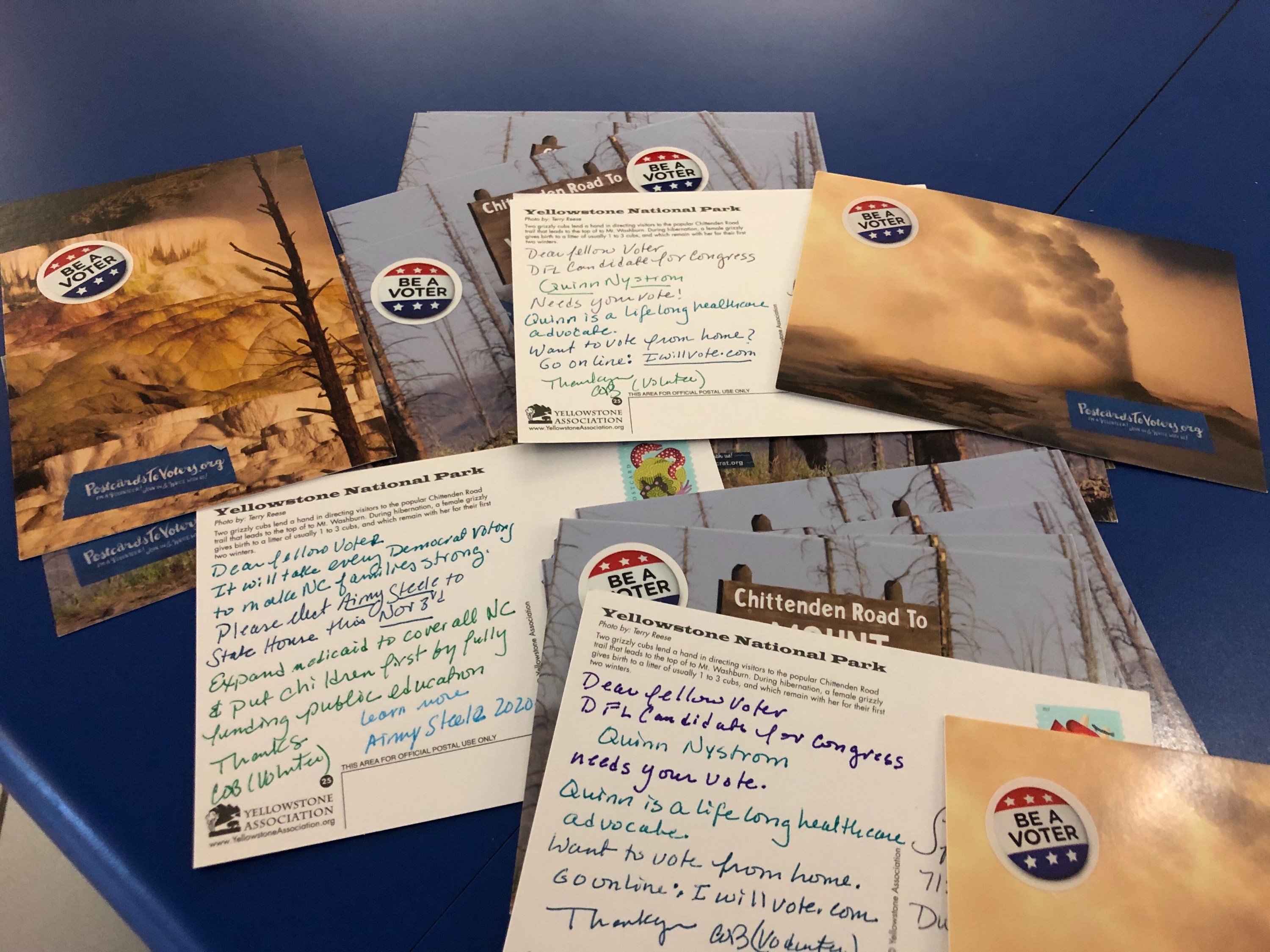
Another postcard-writing initiative, Postcards To Voters, has seen similarly high levels of engagement in the Washington region. Of the two million postcards sent to voters in swing states so far, more than 110,000 postcards came from residents in the Washington region.
“It’s a big blue area with a lot of people that want to do something and probably their own elected representatives and other elected officials are probably already Democrats,” says Tony McMullin, better known as “Tony the Democrat.” He started the postcard effort in 2017. “They find some satisfaction in being able to write postcards to voters in Colorado or Georgia or North Carolina, even Kentucky and Alaska.”

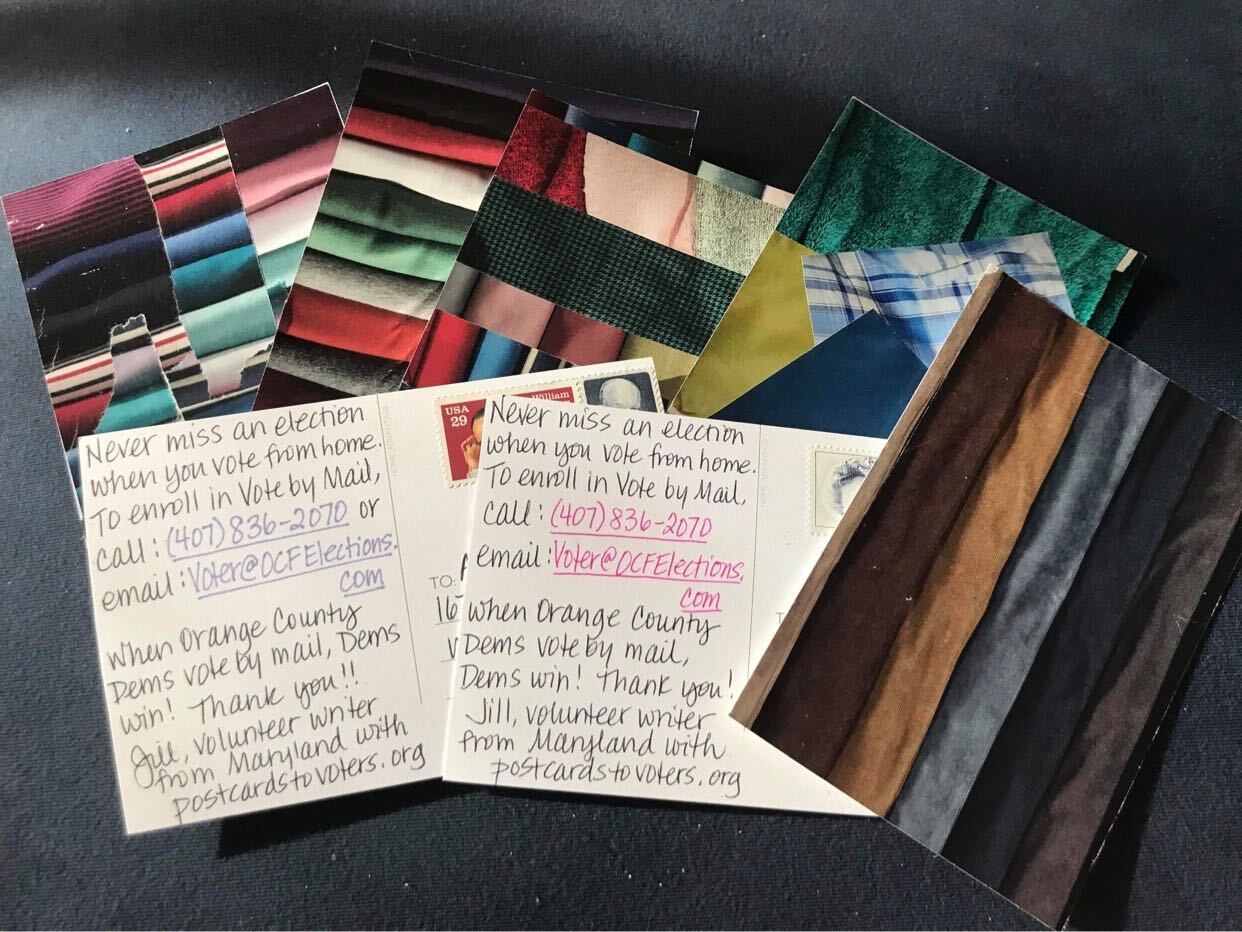


The attraction to postcards is also as practical as it is partisan. With the pandemic still raging across the country, fewer people — especially Democrats — are volunteering to travel beyond their borders to knock on doors or hand out literature. Meanwhile, Republican candidates across the U.S. have kept up more in-person campaigning. (That’s not to say they aren’t sending their own postcards, though; a spokesman for the Virginia Republican Party say they include postcards as one of their outreach tools.)
The in-person campaigning includes President Trump, who has held outdoor rallies and reportedly had staff and volunteers knocking on a million doors a week over the summer. This disparity has Democrats thinking of more socially distant ways to get out the vote.
“I think this opens it up to a lot more volunteers because people who are housebound, as we all are now, but there are people who typically couldn’t have traveled and knocked on doors. So this actually broadens the scope,” says Michelle Hainbach, 58, who lives in Montgomery County and has been both phone-banking and sending letters and postcards on behalf of a few different Democratic campaigns in Iowa and Pennsylvania.
And there’s another perk, says Charlotte Osborn-Bensaada, a 50-year-old D.C. resident who estimates that she has written more than 10,000 postcards to voters since 2017.
“It was something I could do any time of the day,” she says. “I could do it a couple in the morning, I could do it at 10 o’clock at night. I could carry it with me if I was traveling. It was just always something that I could do that was small but continuous.”
But do postcards actually make a difference? Julie Greenberg says she isn’t so sure. She works with 31st Street Swing Left, a D.C.-based group founded in 2017 that raises money and mobilizes voters on behalf of Democratic candidates in swing states across the country. While she says that local interest in helping Democrats win in other states is “really intense” this year, Greenberg says 31st Street largely stays away from postcards.
“There are studies that are considered the gold standard in social science that have never found postcards to impact voter behavior,” she says. “Voter behavior is hard to impact, and only is impacted on the margins. Phone canvassing and door-to-door, face-to-face does help on the margins.”
But others say that simply knocking on more doors won’t mean more votes, especially during a pandemic, when many voters may still be wary to speak to a stranger coming to their house. For Robbin Warner, who founded Postcards4VA in 2017, the proof of postcards’ efficacy in getting voters’ attention is clear.
“I can tell you the story about how people attacked me at meetings when I first introduced postcards, and those same groups have huge postcard operations now,” she says. “We know that when people were canvassing, [voters] would run to the inside of their kitchen and take out the postcard we wrote and say, ‘Oh my God, did you write this postcard?’”
Osborn-Bensaada agrees that changing voter behavior or getting a voter’s attention is very difficult, and that more often than not it happens at the margins — a fraction of those voters reached by a campaign may actually do what the campaign asks them to. But she says that postcards can be done at scale, and the people writing them often go to lengths to make them stand out from normal mail.
“It’s something really positive,” she says. “A lot of us decorate them. We put stickers, we use colored pens. We have stamps. We do all of these things as much as anything to entertain ourselves. But they’re interesting. They look different. It is not your average voter mail. And that also stands out.”
“This is craft activism,” says Warner. “Craftivism, all the way.”
For Lauren Campbell, the work is winding down. After giving away most of her postcards to friends and neighbors, she says she wrote some 200 postcards in nightly batches of 20, or until her hand got tired of writing. “I’ve been watching TV and cranking them out,” she says.
Whether or not her postcards will nudge Democrats in Pennsylvania and North Carolina to come out and vote is something she thinks about. But she also tries to imagine what it would be like if she was on the receiving end.
“I actually think it would make me say, ‘Oh, gosh, I do care about voting,’” she says. “So yes, it does seem like it would be effective.”