Colleen Moriarty’s kids have discovered the beauty of pandemic-era Halloween: You get to choose your own candy.
“When we told our kids there wasn’t going to be trick-or-treating this year, our oldest, who’s in 2nd grade, said, ‘Well, they sell candy at the grocery store. I’m pretty sure we could just go buy our own,’” she recalls. “And one of them said, ‘Well, that’s good, because then we don’t have to buy any of the candy we don’t like.’”
It’s an evolved stance for a kid eyeing what could have been a lackluster Halloween. As COVID-19 cases tick upward in the Washington region, the D.C. Department of Health has advised against trick-or-treating. (Recommendations vary, but Montgomery and Arlington counties are also discouraging going door-to-door.) Official guidelines the District released this month describe trick-or-treating as a high-risk activity, along with such fall staples as bobbing for apples, going on hayrides with people outside your household, taking candy from communal bowls, and visiting indoor haunted houses. Safer bets? Virtual costume parties, at-home candy hunts, and neighborhood drive-through events.
All that said, don’t start booing: Halloween has not been canceled. Like everything else, it will look different this year – we’re wearing medical masks instead of or under our monster-face masks. But there are upsides, like the motherlode of fancy candy (hello, Reese’s) that Moriarty’s kids are anticipating. It’s yet another example of making it work in 2020.
“Some people are getting caught up in the ‘will we, won’t we, should we, shouldn’t we’ with trick or treating,” says Moriarty, who lives in Germantown, Maryland, and co-founded the Adventure Moms DC blog. Her children are 4, 6, and 7. “Our whole mentality throughout this pandemic has been: We can’t control the things that are outside our control. We’re not going to dwell. And for us, Halloween is just a time to enjoy together as a family, and to be a little bit sneaky and get a little bit spooky.”
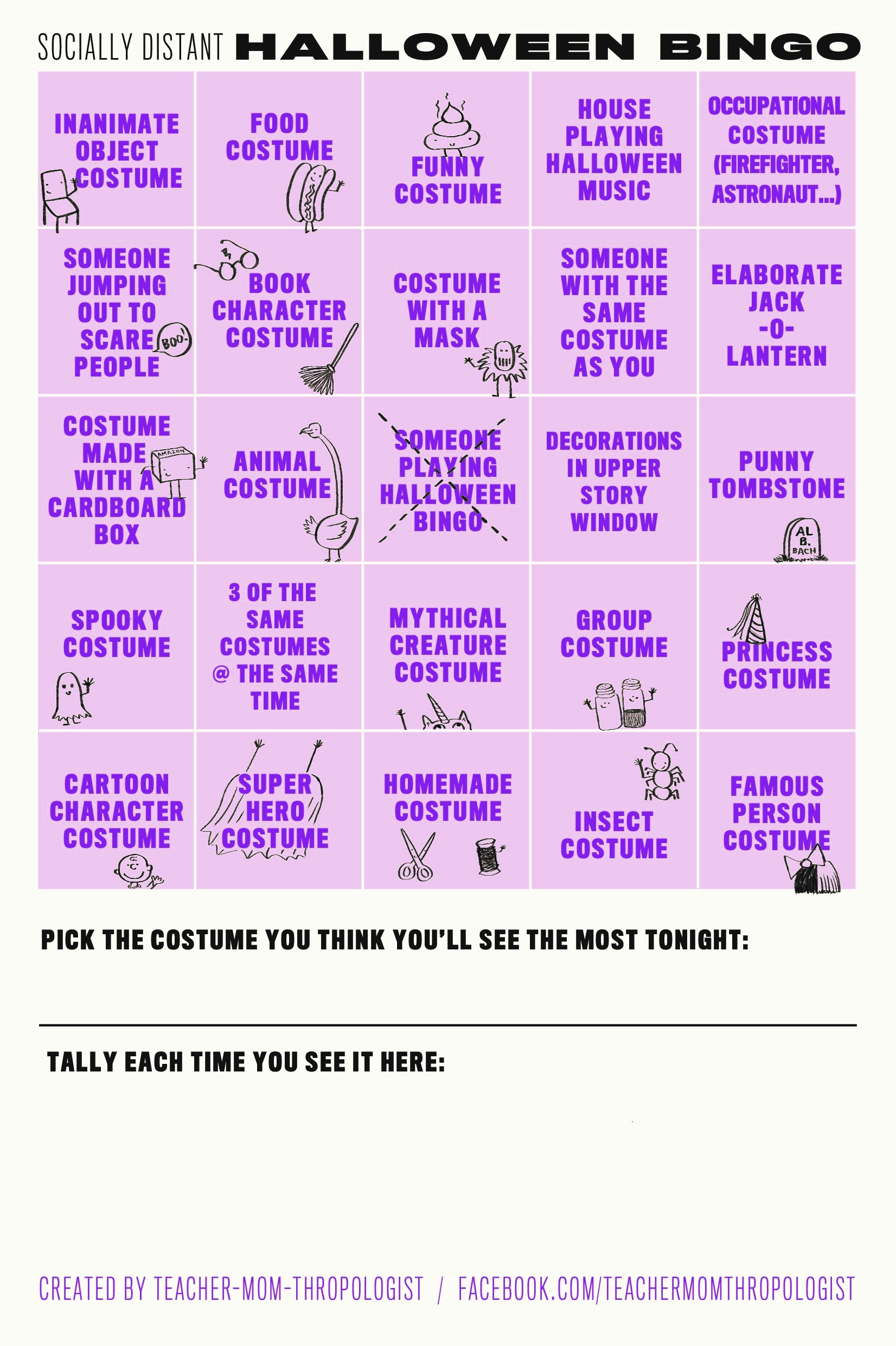
For the past couple years, Elizabeth Corinth, who lives in Capitol Hill, has brought homemade bingo cards along on her Halloween outings with her family. She’s more into costume creativity than candy, and wanted to channel the same to her children, who are 6, 4, and 1. Typically, they would pair the game with trick-or-treating – but since they’re not comfortable going door-to-door this year, Corinth decided to make bingo the star attraction.
In past years, she printed out Microsoft Word versions of the cards, but after deciding to go all-in this year, her sister redesigned them to be colorful and aesthetically pleasing. When the family ventures out on Halloween, they’ll mark off various sights as usual, with a focus on both costumes and decorations: a mythical costume, a house playing Halloween music, a costume made out of a cardboard box, a punny tombstone. But this time, they won’t do any trick-or-treating or accept candy from strangers. Each time one of Corinth’s kids fills a bingo square, they’ll get to pick a treat from a bag their mom packed – a “periodic candy jolt,” as she puts it. Completing an entire row earns a bigger prize: five candies.
“I’ve printed out thousands, and I give them out every year,” Corinth says. “I walk around with a big sign: ‘Ask me for a Halloween bingo card.’ We’re taking this opportunity to look on the bright side and focus on what’s really cool and fun about Halloween.”
Moriarty has also gotten creative about how to keep the Halloween spirit alive. Instead of trick-or-treating, her family plans to “trick and treat” their friends. They painted toilet paper tubes black and attached paper wings, reinventing them into bats, and then stuffed them with candy. When they hit the streets this year, they’ll use a water balloon launcher to project the bats at their neighbors’ doors. Hopefully, the landing thump is loud enough to prompt the residents to pop out and discover the sugary surprise.
“We’re going to try to just BOO a lot of our friends, and keep the fun of it alive,” Moriarty says.
Betsy Good is doing the same – but more furtively. Prior to the pandemic, her family dabbled in ghosting, but they didn’t fully invest in it until this year, at her daughter’s suggestion. Ghosting is “when you drop off candy and a note on someone’s doorstep and then pull a ding dong ditch – hopefully getting out of sight before you’re discovered,” Good explains.
After months of anticipation, the kids – ages 9 and 11 – launched their operation on Oct. 1. The family dresses in black and walks around their D.C. neighborhood, and they’ve learned that if they’re very quiet and have a plan, they can typically “remain in earshot to listen to the confused wonderings of our target.”
So far, it’s been a success. “After Friday’s mission, my kids declared that this is better than Halloween because we get to do it so many times,” Good says. “We’ll see if that sentiment changes on actual Halloween. But for now, I’m considering this a big win.”
Veronica P. Wilson, who lives in the Capitol Hill area, is also pleased with her efforts to salvage Halloween. She describes herself as the “self-congratulating mom of a preschooler” organizing a glow-in-the-dark candy hunt in her backyard, using repurposed plastic Easter eggs. She might invite other kids to join in the fun, assigning different color eggs to each and putting them in separate areas to ensure social distancing. “Costumes on, and the kid still has to work for his candy,” Wilson says of her son, Max. “Patting myself on the back here for saving Halloween.”
And, of course, in this Year of Zoom, many Halloween festivities are going virtual.
Mark Sussman of Hill East is ringing in his 5-month-old daughter’s first Halloween with a costume party on Zoom. She’ll be joining her cousins, who will surely be impressed with her Ruth Bader Ginsburg costume.
Dr. Tamara Gayle, a pediatrician at Children’s National Medical Center, agrees with the District’s move to discourage trick-or-treating. She’s embracing virtual festivities and recommends hosting a Zoom costume parade with all your kids’ friends or classmates (or, of course, your own friends). Don’t forget the prizes: Even remotely, costumes are a serious business.
https://twitter.com/BrooklandBridge/status/1310324554565378049
But for some sugary traditions, Zoom is no replacement. Shani Hernandez loves Halloween — and welcoming the 100-plus trick-or-treaters who stop by her Brookland home each year. “It really made me sad to think that because of COVID-19, we wouldn’t be able to give out candy, and it just made me start thinking: How could we give out candy to the trick-or-treaters in a safe and socially distanced way?”
So she decided to construct a candy chute. Hernandez and her wife, Astrid Joehnk, used a plastic gutter to create an automatic tube. In early October, the couple had completed the prototype and were pondering how to decorate it: perhaps as a cobra or haunted tree branch. On Halloween, she’ll use the chute to dispense individually wrapped bags of candy from her front porch to the sidewalk – a distance of about 15 feet.
“If people don’t want to send their kids, if they don’t feel comfortable, that’s completely understandable,” she says. “I just want to be prepared if they’re OK with it.”
Hernandez recently shared a video of the candy chute with her neighborhood’s Facebook group and worried she might be hit with negative feedback. But the response has been “phenomenal,” she says, and some of her neighbors were inspired to build their own candy chutes. The Brookland group has also been discussing how to approach Halloween this year, and one neighbor created a Google map pinpointing which houses planned to welcome trick-or-treaters. “We’re trying to do this the right way,” she says.
Whatever your Halloween plans are, if you do head out, wear a mask, even if you’re in costume, Gayle advises. A costume mask isn’t a substitute for a cloth mask. She also recommends 2020’s twin favorites: hand sanitizer and social distancing. “If the kids do get candy, always have them sanitize their hands before putting it in their mouth,” she says.
And remember: Perspective is crucial. “The way we present it to our kids is everything,” Moriarty says. “It’s important to package this as a new way to celebrate Halloween, or starting new traditions and trying different things out. It can be exciting and something new you carry on even after the pandemic is over.”