
Eight-year-old Sadie loves ice cream, especially on Friday nights when she gets to enjoy her favorite flavors — cookies and cream or mint chocolate chip — with her grandma. She also loves going outside.
“I can get to enjoy getting the fresh air,” she says.
What she doesn’t like is working on a computer all day for school. “We have to sign in. You have to pay attention and look at the screen,” she says. And according to her mother, 26-year-old Nery Peña, being home all the time has been tough on Sadie, who loves math and talking to her teachers.
“She started crying,” Peña said. “She missed her teachers and her friends.”
Peña and her two daughters, Sadie and Ariella, 6, live in transitional housing provided by Turning Point Center, a two-year housing program for single mothers experiencing homelessness or at risk of becoming homeless. Prior to coming to Turning Point a year and a half ago, Peña was living with her grandmother in a cramped one-bedroom. Now, the bilingual Pre-K teacher has a two-bedroom apartment in Columbia Heights to share with her daughters.
But as the pandemic hit D.C. in March, Turning Point began restricting visitors within the apartment building, not even allowing neighbors in each other’s units. For a time, Peña and her daughters stayed with Peña’s mother on U Street, where they had more space and the girls could interact with Peña’s siblings.
“It was good. It was comforting to have someone else to talk to and see,” Peña says.
But, after 3 weeks, the family returned to their housing unit where Peña says restrictions remain in place. “Their main concern is keeping our building COVID-free,” Peña says.
And for the teacher, it means she now has the added challenge of entertaining and comforting her daughters during a pandemic.
According to the Community Partnership for the Prevention of Homelessness’ 2020 Point-in-Time count of people experiencing homelessness conducted in January of this year, there are 1,143 children in families living in emergency shelters and 279 children in families living in transitional housing in the city. D.C.’s Department of Human Services tells WAMU/DCist that 302 families and 583 children currently live in D.C.-operated shelters.
For those parents, the pandemic and its restrictions have presented unique challenges to offering socialization and playtime for their children, especially as shelters and supportive housing programs restrict movement, visitation and programming.
In D.C.-operated shelters, the main goal is limiting exposure to the illness, says Jenna Cevasco, the Department of Human Services’ short-term family housing manager. According to Cevasco, D.C.’s shelters that house families have outdoor spaces, including playgrounds, as well as community rooms on each floor. During the pandemic, shelters have been limiting the number of families that can occupy community rooms and playgrounds at one time to promote physical distancing.
Programming for children has continued, though, Cevasco says. “Truthfully, it had evolved since the public health emergency started,” she says, adding that in the beginning restrictions on programming were tighter. “We’re getting more innovative about how we’re delivering virtually.”
Several sites participate in the after-school Freedom School program, which is virtual, and some have incorporated reading times and dance programs, she says. “One site organizes [virtual] Zumba and exercise activities with a limited number of kids,” Cevasco says. “We have Xs and spots on the floor to help families know where they can safely stand away from other families.”
Cevasco also says D.C. shelters are well-positioned to support the mental health of families during the pandemic, ensuring referrals are being made to mental health services and connecting kids with their schools to support them.
Play As A Tool For Processing Emotions
The mental impact of the pandemic is top of mind for the Homeless Children’s Playtime Project, another organization that offers children experiencing homelessness space and activities to socialize and have fun.
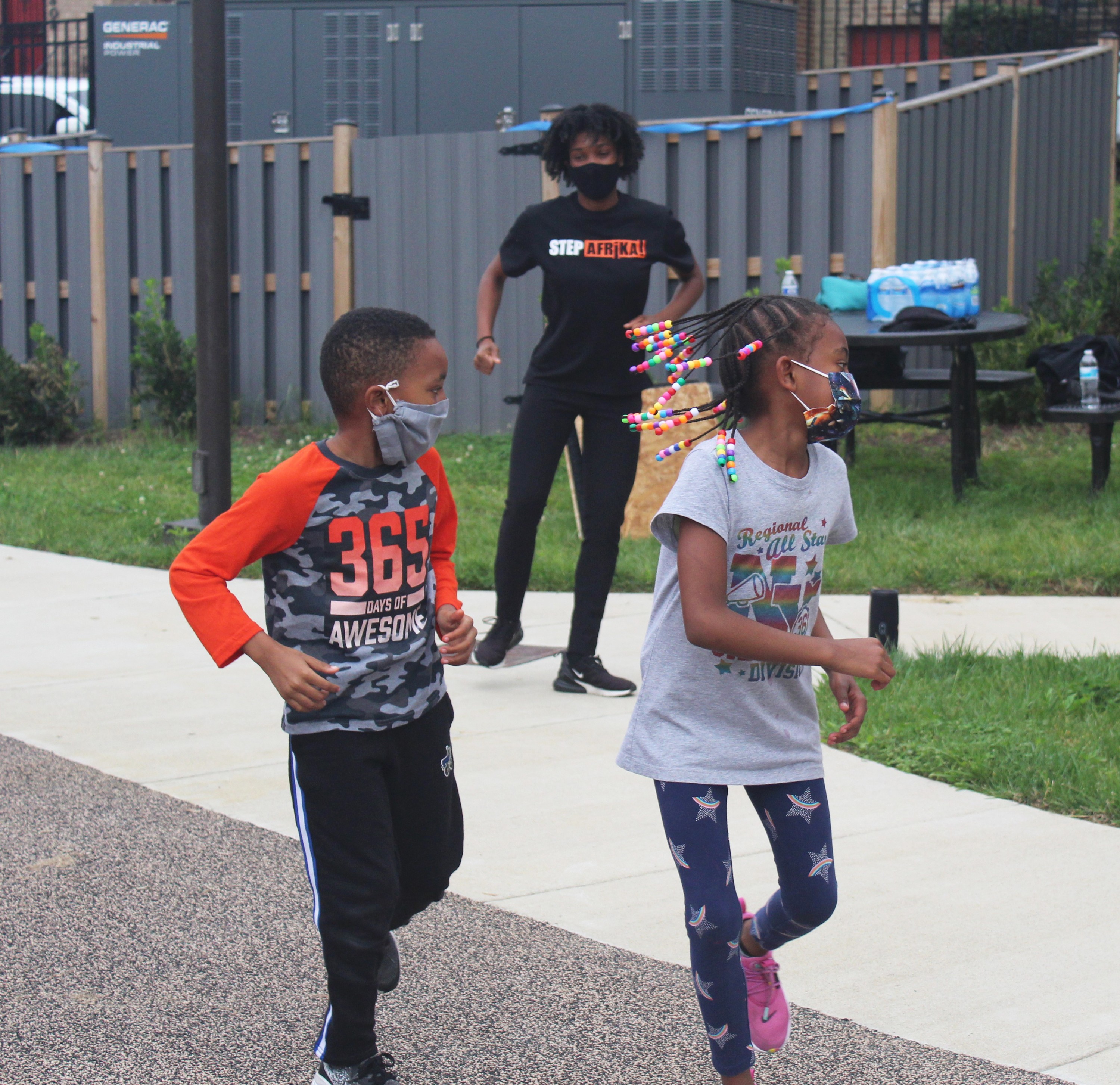
According to Jamila Larson, executive director and co-founder of the Playtime Project, giving children the space to play restores a sense of normalcy, “which is even more important when they’re faced with crisis,” she says. “Play really becomes a tool… for processing emotions.”
Shelters “don’t always have access to the healing powers of play, so we wanted to provide access,” she says, adding that being confined to a shelter can inhibit a child’s healthy expression around playtime.
But the pandemic has forced the organization to pull back and reframe some of its programming even Larson says isolation has been a major problem for families experiencing homelessness.
“I’m not aware of any family homeless shelter setting that allows children and families to go to each other’s rooms,” she says.
This makes their work all the more vital.
“We all need breaks from family members from time to time. Hit the reset button and then come back together. Our families don’t always have that opportunity,” Larson says, which she adds can prevent families from using playtime to heal from the stress of quarantine.
Larson says families have been counting on D.C. Public Schools to offer a sense of normalcy and socialization to their children, but DCPS won’t reopen schools for some in-person learning until November. According to Cevasco, DCPS is giving priority for classroom seats to families experiencing homelessness. (Some charter schools have already started offering small in-person classes.) Larson says the strain on kids to grow up quickly through virtual learning and parents to find ways to engage and entertain them has been formidable.
“In my mind, it’s really a question of play equity because we know parents, with any amount of resources, have figured it out,” Larson says.
But the group also hopes to give parents a bit of a break while allowing kids to be kids. According to Larson, the Playtime Project has been sending families personalized toy packages and launched a Zoom playtime program for preteens. The group has even designated a staff member as the full-time virtual play instructor.
“It never feels like enough,” Larson admits.
That’s why the group will be moving to some in-person programming later this month, offering three 2-hour sessions a week on two different playgrounds. It’ll be different from Playtime Project’s regular in-person programming, which Larson says consisted of allowing children to choose toys and activities in the organization’s open play space. These playtime sessions will be downsized to six children at a time with masks required, and will include some structured activities which Larson says is to engage excited children but also keep them safely distanced from one another.
‘We’ve Had To Get Very Creative’
Other programs that offer housing and support to families experiencing homelessness have also gotten creative in implementing safe programming for children.
House of Ruth is one of them. The organization offers housing programs to women and their children who are survivors of trauma, abuse and homelessness. According to president and CEO Sandra Jackson, most families within the program live in housing units owned by House of Ruth, which include on-site support staff. Given that many women within the program are moms, all programming has a lens on children, Jackson says.
“We’ve had to get very creative,” Jackson says, of the past several months.
Since the pandemic began, House of Ruth has done virtual bingo and exercise programs for families. The organization also has a child development program which has helped parents brainstorm at-home activities.
One mom in House of Ruth’s housing program has been leaning on support staff to help her entertain her three children, ages 3, 8, and 11, as they spend most of their time indoors. Lauren, who WAMU/DCist is referring to by her middle name because she is a survivor of domestic violence, received housing through House of Ruth in July 2017 after living in a shelter in Maryland.
“We call this home. They will know it’s not permanent housing, but it gave us a place for safety and shelter,” Lauren says.
But at the start of the pandemic, Lauren had to quit her job and has been home with her children since. She praises House of Ruth support staff, who live in the apartment complex, for helping her come up with activities for her children.
“I was kind of running out of ideas,” Lauren says. Support staff, who are available 24/7, offer book clubs, arts and crafts, and storytime activities for small groups. “We space ourselves out,” Lauren says. “They’re coming up with a lot of activities here, sometimes after school days.”
These days, Lauren says she sees her children picking up books more often than prior to the pandemic. But, it isn’t always easy to provide constant entertainment or normalcy. When the pandemic first hit and the family spent all of their time indoors, Lauren said it was difficult for her kids to process what was happening. Her eight-year-old son continues to struggle, she says, especially with virtual schooling.
“He’s not great at keeping still, especially at home,” she says.
At Turning Point, Peña also tries to keep Sadie and Ariella from being bored. The three have baked and decorated cakes, colored, tried new foods like bowls of pho, and have even had “camping trips” in the living room. One day, when boredom seemed to be getting the best of them, Peña’s daughters put on a fashion show in their living room which Peña posted on her Instagram. Sometimes Peña and her across-the-hall neighbor open their doors and chat with each other sitting in their doorways. It’s bittersweet though. Her neighbor’s young son loves to see Peña’s daughters and often tries to come over to play with them—which is not allowed.
Getting outside also remains a challenge. After Peña is done with work, she goes through the daily lessons of each of her daughters, particularly for Ariella who has a developmental delay, Peña says. Then, the mom tries to get the girls outside, but after school and homework, there’s only so many hours in the day.
“Sometimes we might not even make it outside,” she says.
But while Peña’s daughter Sadie loves going outside, she also just enjoy hanging out with her mom—especially when they do her favorite activity:
“Going to Target!” Sadie says. “When we get toys!”
This article is part of our 2020 contribution to the DC Homeless Crisis Reporting Project, in collaboration with other local newsrooms. The collective works will be published throughout the day at DCHomelessCrisis.press. You can also join the public Facebook group or follow #DCHomelessCrisis on Twitter to discuss further.