 Dominique Maria Bonessi
More voters than ever intend to vote by mail across the Washington region this fall. That means officials need more time and staff to count all those ballots. The Montgomery County Board of Elections began counting their more than 350,000 mail-in ballots earlier this month.
“We’re pulling 12 to 14 hours a day. Personally, I haven’t seen my kids,” Gilberto Zelaya, a member of the county board, says as he stands by a machine that cuts open dozens of ballot envelopes in just seconds.
The county is using the large gymnasium at the Plum Gar Community Recreation Center in Germantown rather than the smaller board of election offices, to mitigate exposure to COVID-19. At least 60 poll workers sit socially distanced at long tables, wearing masks and gloves.
Gilberto Zelaya, with the Montgomery County Board of Elections, demonstrates one of the first steps to processing ballots, opening the sealed ballot envelopes.
“It’s a slow process, kind of like watching paint dry,” Zelaya says.
Typically, counting mail-in ballots wouldn’t start until two days after election day. And only about two dozen workers would be needed in the county— not 60 — to inspect ballots. Zelaya says the process involves more than just counting ballots.
“They need to be batched, sorted, then prepped for canvas,” he says. “So patience please, patience and we will get there.”
Bipartisan teams of workers separate the ballots from the envelopes.
“Then they are checking to ensure that there’s no extraneous marks,” he says. That means making sure voters “did not use a marker or highlighter or mascara or crayons, and if they did, then they would raise their hand and they would need to duplicate that because it cannot be scanned.”
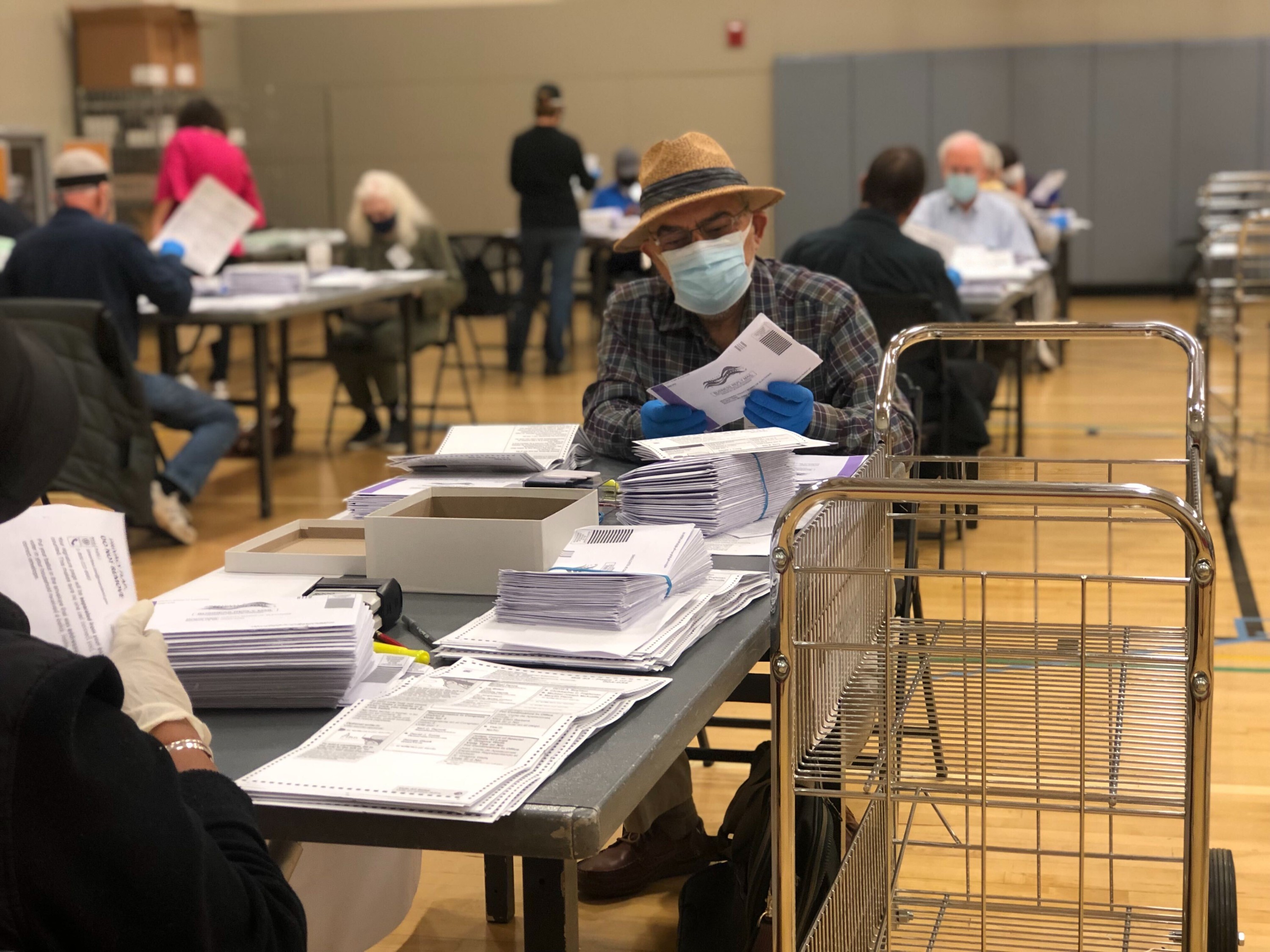
Poll workers separate the ballot from the envelope and inspect it for irregularities.
Duplicating a ballot means the bipartisan team will need to copy the voter’s selections from the original ballot onto a blank one before it can be scanned.
Workers are also making sure that the voter oath on the back of the envelope has been signed. If not, they’ll try to contact the voter to appear at the board of elections to sign it.
Then the ballots go to the county board of elections to be sent through a scanner for official counting. The results remain secret until after the polls close on Election Day.
Ensuring A Complete Count
Almost half of all Maryland voters say they will submit their ballots in the mail this fall, according to a Goucher College Poll. That compares to less than 5% of all votes cast in the 2016 presidential election.
President Trump has cast doubt that mail-in ballots will be accurately counted.
Earlier this week, Montgomery County election officials investigated a viral video that alleged a poll worker was tampering with ballots. County election officials say they did not find any evidence of misconduct and that the worker was following correct policy and procedure.
Mileah Kromer, director of the Goucher poll, says voting has become politicized — as a result, it’s hurting Trump’s own party.
“There’s been a widespread sort of pushback among Republicans for mail-in balloting. The same thing is not happening among Democrats,” Kromer says.
The poll found that 51% of Marylanders say they will vote in-person. The majority of them are Republicans.
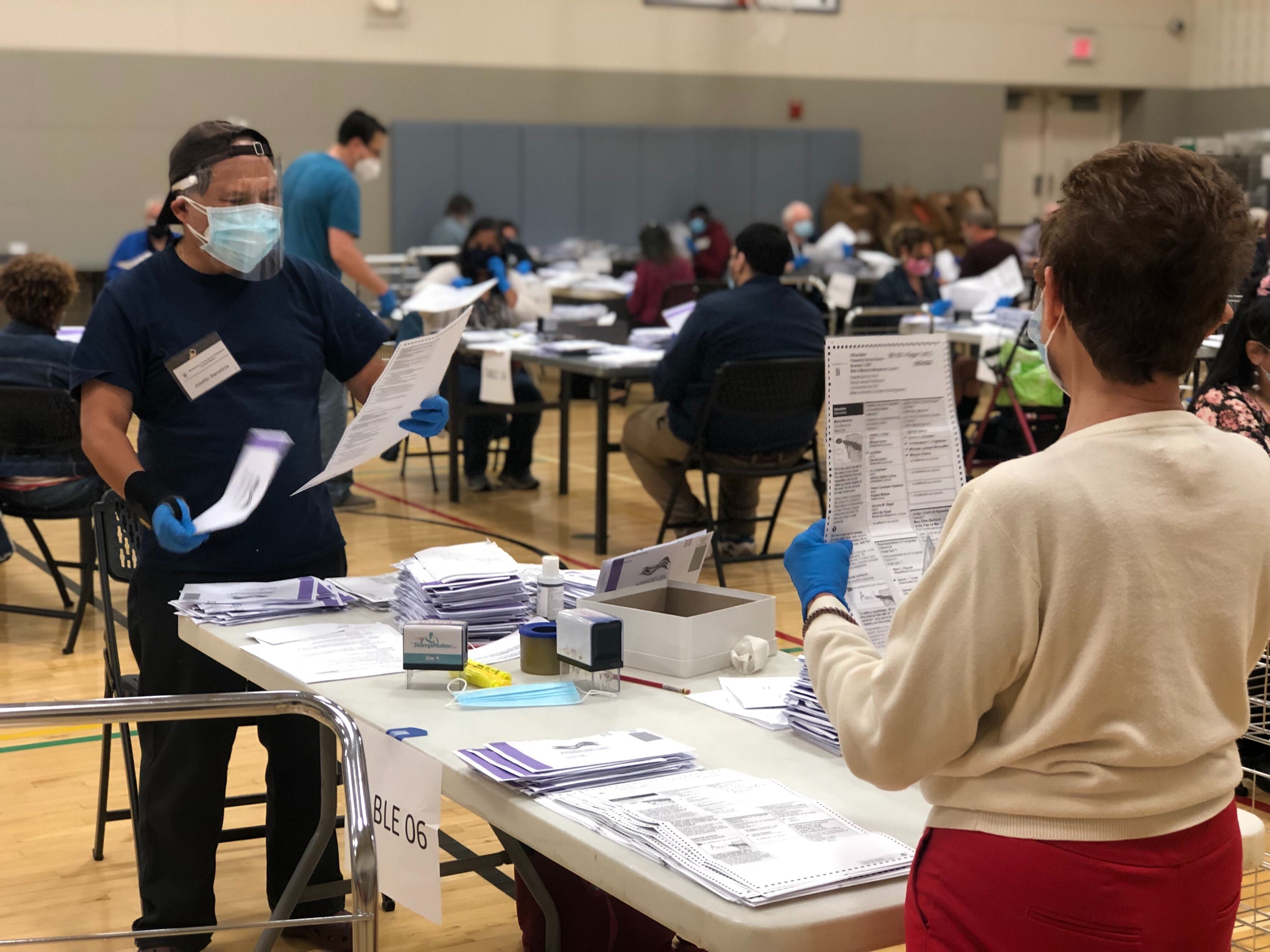
Poll workers are told to raise their hand if there is an issue with the ballot and have an election judge review it to determine next steps.
To dispel some of the rhetoric coming from the White House, David Garreis, president of the Maryland Association of Election Officials, emphasizes all mail-in ballots get counted.
“It’s a proven system. It’s an accurate system. There are numerous checks and balances at every stage,” Garreis says.
Maryland Gov. Larry Hogan allowed local boards of elections to start counting votes on Oct. 1st. Garreis says he thinks that will help state election officials have more complete preliminary results on election night compared to previous elections.
Kromer says another reason for quicker preliminary results is that the outcome of the election in Maryland isn’t likely to be close. ”It’s unlikely we’ll see any surprises here in the state,” Kromer says. “Joe Biden is most likely going to win Maryland.”
What ultimately matters to election officials like Gilberto Zelaya is getting the count right.
“At the end of the day, when we are done and we have certified the elections and audited, it feels good knowing that we’ve done our part to really defend the constitution and to give Americans the added opportunity to vote,” he says.
This story originally appeared on wamu.org