

Iran-born chef Ali Mesghali was set to open Rumi’s Kitchen, an upscale Persian restaurant in D.C.’s Mount Vernon Square, at the beginning of March. Then the COVID-19 pandemic hit.
Deciding to push back the opening date until late August, Mesghali took the extra months to make some pivotal design changes, ensuring that the restaurant adhered to local health and safety guidelines.
One of the most notable differences? While at first glance the dining room appears at capacity with diners, a closer look shows that many tables are actually occupied by mannequins: men sporting foot-high hats to honor traditional whirling dervishes, and women wearing daringly sheer dresses, hands outstretched toward glasses of wine. (The addition takes a page out of the Inn at Little Washington’s early COVID playbook, which saw the restaurant fill its tables with mannequins dolled up in 1940s garb.)
There’s also hand sanitizer strategically placed around the restaurant, as well as temperature checks for guests and staff at the entrance.
Mesghali already runs two other Rumi’s Kitchen outposts, both of which are located in Atlanta. He named them after Rumi, a 13th-century Sufi mystic and poet “whose words and his food were about love,” he says.
Murals of Sufi-era society adorn the wall, and snippets of Rumi’s poems arrive tied to rolled napkins. (One reads: “As you start to walk on the way, the way appears.”) While the restaurant takes some inspiration from an older age, the atmosphere at Rumi’s Kitchen is decidedly modern, evoking trendy, pre-revolution Tehran, with dim, intimate lighting and clubby music.
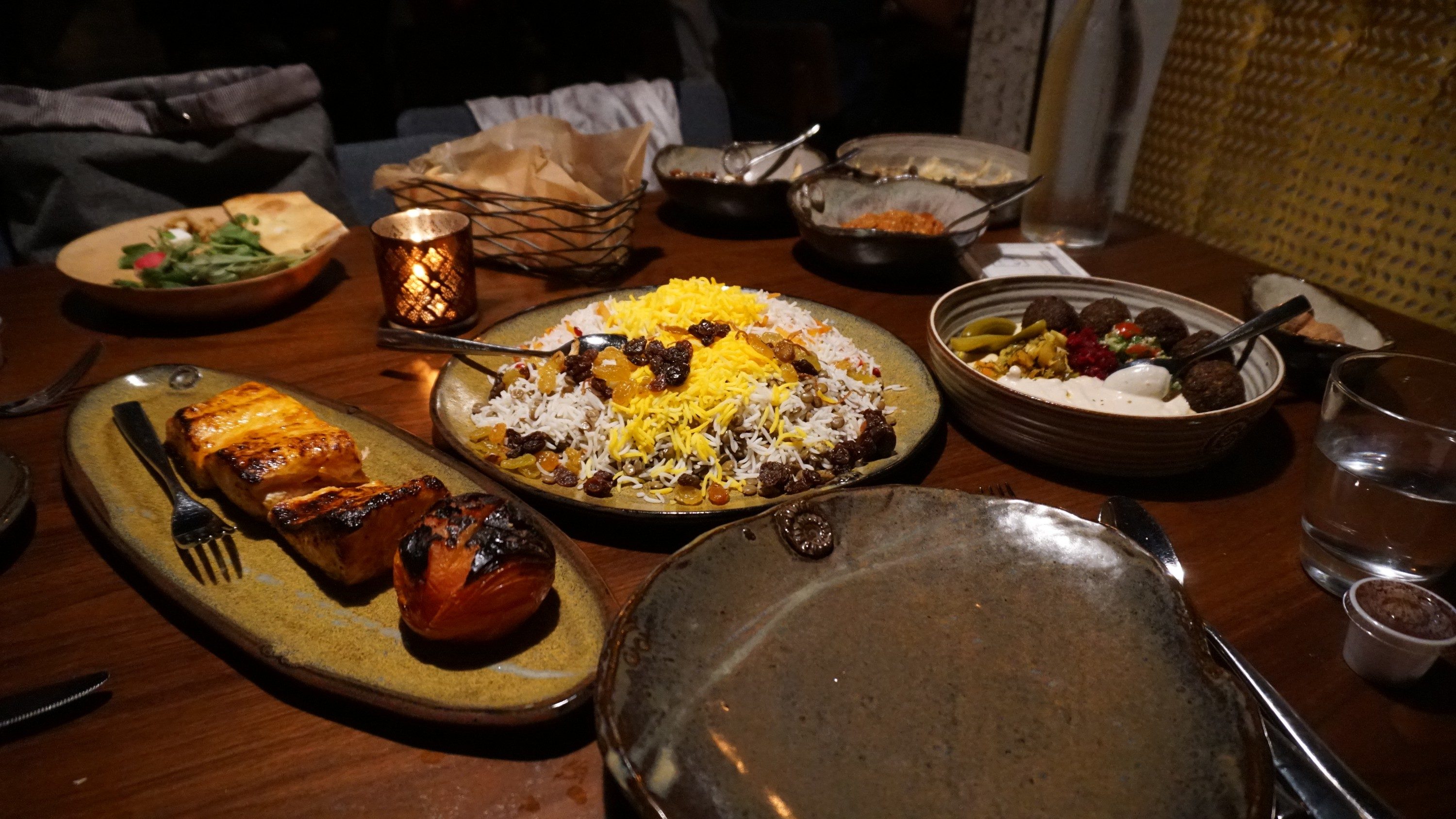
After having their temperatures checked, diners receive a warm welcome: a wrought-iron cradle full of just-baked taftoun, or flatbread, made in-house. It’s meant to pair with the sabzi platter, a palate-readying appetizer of neat squares of feta cheese, a handful of radishes and walnuts, and sprigs of watercress and mint.
The Rumi’s Kitchen menu is split into two styles of dishes: “taste,” or small plates to share, and “feast,” which offers larger entrees.
“I didn’t invent Persian food, but took it apart and put it back together,” says Mesghali, who aims to provide “over-the-top Persian hospitality, to ensure that the diner is the focus of the evening.”
Among the small plate options, Mesghali offers two contrasting kinds of eggplant spreads. The first, kashk badenjoon, takes fried eggplant and folds it into cream of whey for a rich dip; the other, mirza ghasemi, closely mirrors baba ghanoush, a swirling puree of eggplant, tomato, and garlic smoked directly over an open flame. Other appetizers include lamb sausage, creamy falafel, and bowls of hummus topped with mushrooms.
For the “feast,” most options are prepared kebab-style, stuck with spears and cooked over an open flame. One favorite of Mesghali’s is the lamb kebab. It’s a cut of top sirloin, not leg, Mesghali explains, even though lamb leg is a more inexpensive.
“I tried dozens of cuts, and found the top sirloin to be best,” he says. For his version, he marinates the lamb for eight hours in a bath of yogurt, saffron, and onion.
Other kebabs include saffron-marinated chicken breast, Cornish hen, seasoned ground beef, and sea bass. One non-grilled dish is ghormeh sabzi, a “complex, traditional Persian beef stew with many ingredients that, for Persian customers, displays the measure of how good of a cook you are,” Mesghali explains.
No Persian meal is complete without rice, and Mesghali’s rice is nearly a meal all by itself. While each of the menu’s options has its merits, the shirin polo stands out. Known as wedding or Rosh Hashanah rice, it’s a dish typically served during special occasions. Redolent with spices, the grains are laced with in-house dried orange peel, barberries, pistachios, and almonds; butter and sugar are added during cooking to deepen the flavor. Savory, sweet, and popping with color, this rice is as much an homage to family gatherings as it is to a Jackson Pollock painting.
Mesghali began his culinary career in high school as a server in Los Angeles. He moved to Atlanta in 1995 as part of his recovery from an alcohol and drug addiction, but never lost his love of food. He opened the first Rumi’s in 2006.
Though alcohol has been banned in Iran since the 1979 Islamic Revolution, Mesghali includes a number of cocktails on the menu.
“The focus of the cocktail list is to create drinks utilizing Persian ingredients that we use in the food,” he says, pointing to the Tehran Mule, using saffron-infused vodka, as well as the Black Rose, which mixes barberry with mezcal.
The wine list is focused on “small producers and sustainable farming practices and production,” he notes. Homemade sodas and Persian teas are offered as non-alcoholic options.
Rumi’s Kitchen, Mesghali says, is “what the essence of Persian hospitality is all about.”
Rumi’s Kitchen is located at 640 L St. NW. Hours are Mon-Thurs 11:30 a.m.-10 p.m.; Friday 11:30 a.m.-11 p.m.; Saturday 12:00p.m.-11 p.m.; Sunday 12:00 p.m. -10 p.m.
This story has been updated to correct some menu item names and the characterization of the 1979 revolution.