Ally Schweitzer
With around 150,000 D.C. workers still unemployed nearly eight months after the pandemic began, the D.C. Council is considering legislation that would help many of those workers get their jobs back.
The Displaced Workers Right to Reinstatement and Retention Amendment Act, proposed by the labor union Unite Here Local 25, would require D.C. employers to send job offers to employees who were laid off during the pandemic if their positions reopen. Employers wouldn’t be allowed to fill the role with someone new until the old employee rejects the offer.
The bill would apply to people who involuntarily lost their jobs after February 1, 2020 for reasons other than misconduct.
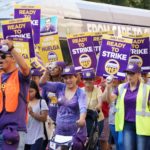
Unite Here Local 25 — which represents more than 7,000 workers at local hotels, casinos and restaurants — says the legislation is intended to help hospitality employees laid off during the pandemic. They worry that some employers may use the pandemic as an opportunity to shed their staff and replace them with cheaper, less experienced workers.
Bartender Tracy Javier, who testified during a committee hearing on the bill Wednesday, said she’s managed to keep some of her shifts at the W Hotel during the pandemic, but most of her coworkers haven’t been as fortunate.
“Those who have held onto the hope of coming back to their hotel once it is safe to do so, should not have that hope snuffed out from under them because of the severity of this virus and the duration of the layoffs,” Javier testified.
The Baltimore City Council recently passed similar legislation over objections from the hotel industry, whose representatives said requiring hotels to rehire laid-off workers after the pandemic deprives them of the “flexibility needed to recover from the economic crisis,” the Baltimore Sun reported. The bill is under review by outgoing Baltimore Mayor Jack Young. No one testified against the D.C. bill during Wednesday’s committee hearing, but the public can submit comments until Nov. 18.
During Wednesday’s hearing before the Committee of the Whole, Unite Here Local 25 Executive Secretary-Treasurer John Boardman said the legislation was based on a “very simple concept”: that workers “thrown out of work, through no fault of their own, [have] a guaranteed right to return to his or her job when that job comes back.”
But an ensuing discussion between Boardman and Council Chair Phil Mendelson revealed that concept may not be so simple.
As written, the legislation applies to all D.C. employers, not only hospitality providers. It would also require companies to reinstate laid-off employees even if the company has since changed hands or undergone restructuring. (It wouldn’t apply if the employer changes industries completely, or needs to fill jobs that laid-off workers aren’t qualified to do.) The intent is to make sure employers can’t evade the law by shifting around their corporate structure, Boardman said, and to protect workers’ jobs even if their employer hits financial turbulence or gets bought by another entity that seeks to cut costs.
“We have seen, over and over again, waves of [corporate] reconfiguration based simply on finances. And there are enormous incentives for financial operatives to displace and disrupt workforces in order to achieve financial advantage,” Boardman said.
But Mendelson asked whether the measure could effectively require businesses to hire workers they never employed in the first place. He cited the hypothetical example of pricey retailer Brooks Brothers being bought by the owner of affordable clothing brand Old Navy. If a Brooks Brothers retail location became an Old Navy, Mendelson asked, would the bill require Old Navy to rehire Brooks Brothers employees laid off during the pandemic?
“I think Brooks Brothers would be deeply distressed if they were taken over by Old Navy, but you are correct in your assumption,” Boardman responded.
Employers in a situation like that, he added, would be allowed to fire rehired workers, but they would have to show cause if they want to terminate them within a 90-day “transition period.”
Mendelson — who sponsored the measure — also raised the possibility of making protections under the bill temporary, instead of permanent, to tailor it to pandemic-related furloughs. But Boardman said as long as the future of the virus remains unclear, workers need some assurance that there’s a job waiting for them in the end.
“I’m pretty sure that we’re not going to be looking to the federal government anytime soon to provide any protection for workers,” Boardman said, apparently referencing the likelihood that Republicans will retain control over the U.S. Senate, narrowing the path toward a second coronavirus relief package. “The protections that are going to exist are largely going to exist because of bills like this that you, as local legislators, initiate.”
But the Council’s labor committee chair, Elissa Silverman, suggested at the end of the hearing that the bill may need tweaking.
“My North Star here is we want to make sure that our workers have the opportunity to come back to their employment, and we don’t create disincentives for those workers to return to their jobs,” Silverman said. “I think we can find a way to do it, but I think it will take some further refinement.”
If the bill survives, the D.C. Council may vote on it Dec. 1.