Amanda Michelle Gomez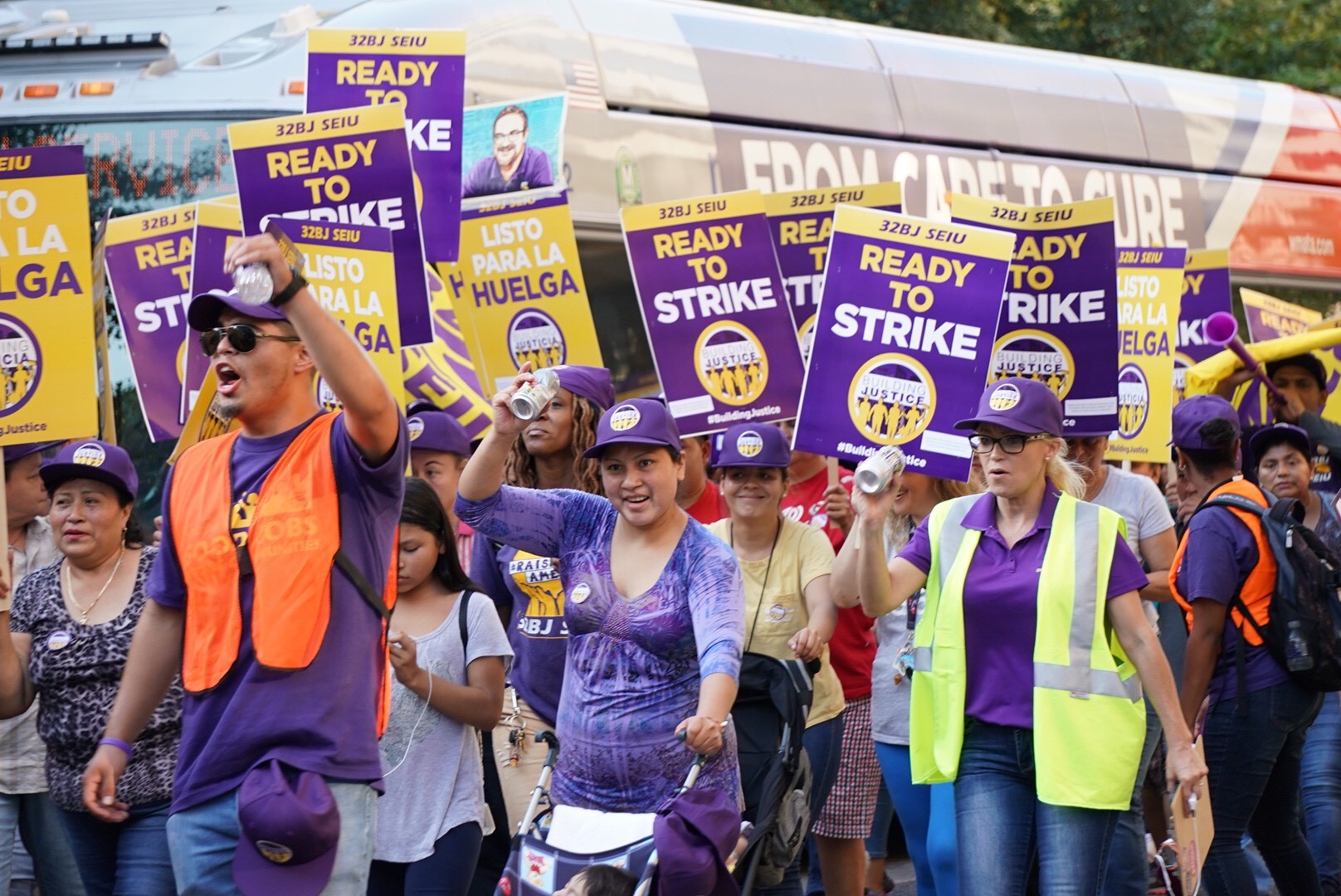
With the D.C. mayoral primary just nine weeks away, local labor unions have begun weighing in and the more well-known ones are split.
Mayor Muriel Bowser picked up endorsements from big-name private-sector unions on Tuesday — specifically, 32BJ Service Employees International Union (SEIU), UNITE HERE Local 23, and UNITE HERE Local 25. Meanwhile, At-Large Councilmember Robert White, arguably her most competitive challenger, seized endorsements from the largest city workers’ unions over the last two weeks: The Washington Teachers’ Union (WTU) and the American Federation of State, County and Municipal Employees (AFSCME) District Council 20.
Unions each have their own endorsement process, some leaning on their boards’ opinion more than others. In interviews with DCist/WAMU, union leaders said the mayor’s pandemic policies that directly impacted their workers partly motivated their endorsements. With the exception of WTU, the unions often go for D.C. mayoral incumbents. Labor endorsements not only give candidates bragging rights — union are very popular, particularly among Democrats — but manpower. Members donate and participate in phone banking and door knocking. Endorsements alone don’t guarantee a win at the ballot box, as recent history demonstrates.
“[Bowser]’s done nothing in our book to not gain our endorsement,” says 32BJ SEIU’s Jaime Contreras.
He is the leader of 21,000 property service workers in the D.C. area. He says the union decided to back the mayor because of her COVID-19 response. “The mayor really went above and beyond to warn building owners not to lay off or cut benefits for these workers,” he says. “She basically told the building owners that they’re getting paid, and so they have really no reason to put these people out of work. And for the most part, that worked because most of our members did stay on the job.” He says the mayor also treated his membership like essential workers, prioritizing them for vaccination, and convinced Metropolitan Washington Airports Authority board members to support pay raises for their airport workers.
To make a decision, Contreras says 32BJ SEIU hosts interviews with non-incumbent candidates, of which all rank-and-file members are invited to attend. Not many members participate in the political process because they are often juggling several jobs, he says. So a relatively small but active group ultimately issues recommendations to the 32BJ SEIU board for final approval. (32BJ SEIU is the largest union representing property service workers nationwide, representing 12 states.)
Robert White was competitive among the local membership, according to Contreras, calling him a “friend of the union.”
“Robert is a good progressive … He’s been a good councilmember, ” he says. “But then other things come into question. Electability, funding — all those things come into consideration as well when we make a recommendation to the board.” 32BJ SEIU endorsed the incumbent in the D.C. mayoral races the last two election cycles, backing Vince Gray in 2014, who lost to Bowser in the primary, and then Bowser in 2018.
UNITE HERE Local 25’s executive secretary-treasurer, John Boardman, similarly described Robert White as a friend of the union and its membership and cited political calculus. “We just felt that the mayor, given her record with us, was the better candidate for our membership and the interests of people who work in the hospitality industry,” he adds.
Local 25’s endorsement of Bowser comes as no surprise, as the mayor just championed legislation that protects their workers’ jobs. She had Council Chairman Phil Mendelson and Ward 6 Councilmember Charles Allen introduce legislation that enabled her to require daily room cleaning at hotels, which secured jobs for countless housekeepers who faced reduced hours and layoffs.
Boardman says their hotel union — whose elected board makes the decision — backed Bowser because of her policies that both directly and indirectly impact their membership. He named her investments in affordable housing, for example. He also said Bowser enables workers to unionize at hotels that are part of D.C. developments, once the project is completed and open for business. “We think that that’s critically important for us and for our members,” he says, “to have a mayor that understands the work that they do and the importance of the opportunity to have the union represent them at that work.”
AFSCME Council 20, which represents thousands of city government employees, announced earlier this month that they are supporting Robert White over their boss. “You have been a consistent champion for our union members,” said an endorsement letter to the councilmember. “We look forward to working with you, as our next mayor, to address the needs and concerns of the working-class people of D.C.” That’s the first time AFSCME Council 20 has backed a challenger to an incumbent for mayor in over a decade, according to the Washington Post.
The endorsement came one month after the mayor and AFSCME Council 20 signed a new contract agreement, which Bowser said in an emailed press release demonstrated “a collaborative negotiation process” and a shared “goal and vision” for city workers. The union’s executive director, Robert Hollingsworth, did not respond to interview requests for this story.
Hollingsworth, a co-negotiator for the contract, said at a March 9 signing ceremony hosted by the mayor that negotiations went smoothly, to many people’s surprise. He also said city workers are deserving of contract wins for having kept D.C. running during one of the hardest times in recent history. According to the mayor, the contract included a 3.5% bonus in Fiscal Year 2022 and 2.5% pay raise in Fiscal Year 2023. Notably, mayoral candidate and Ward 8 Councilmember Trayon White attended the ceremony but Robert White did not.
The Washington Teachers’ Union announced the group would be endorsing Robert White last week. The teachers’ union and the mayor were repeatedly at odds regarding COVID-19 protocols at D.C. Public Schools. Unions representing school staff, including WTU, said the mayor’s team excluded them from reopening conversations. The teachers’ union went as far as filing “unfair labor practice” complaints against DCPS, which the mayor controls, with the Public Employee Relations Board because of the agency’s treatment of teachers during the pandemic.
“The pandemic was just a glaring example of our reality at all times,” says Laura Fuchs, who chairs the committee handling WTU endorsements.
In an email received after publication, Bowser’s campaign noted WTU signed a memorandum of understanding with DCPS regarding the return to in-person learning, which was “a direct result of a meeting the mayor had with all labor leaders involved with schools.” But Fuchs says that meeting only occurred after WTU fought for it and filed their complaint.
The committee, which any rank-and-file member can be a part of but is often a small group of active members, makes recommendations based on candidate questionnaires and forums, Fuchs explained. The committee brings their recommendation to the board, who has no veto power. But if the committee and board disagree, the parties bring their decision to full membership, who ultimately has the final say. The committee and board were in agreement on the Robert White endorsement.
Fuchs ticked off several reasons why her union went for Robert White over Bowser, including the lack of collective bargaining agreement. Their union contract expired three years ago, which she says is not unique to the pandemic because their previous contract was six years over. It’s also rare for the teachers’ union to back incumbents for mayor, according to Fuchs.
“We can’t support people who use the power of mayoral control and shut out — not just us, but who shut us out,” says Fuchs. “They don’t work with us. They don’t communicate with us. They don’t respect our union. It’s not just Bowser.”
This post has been updated to include comment from the mayor’s campaign.