 Dominique Maria Bonessi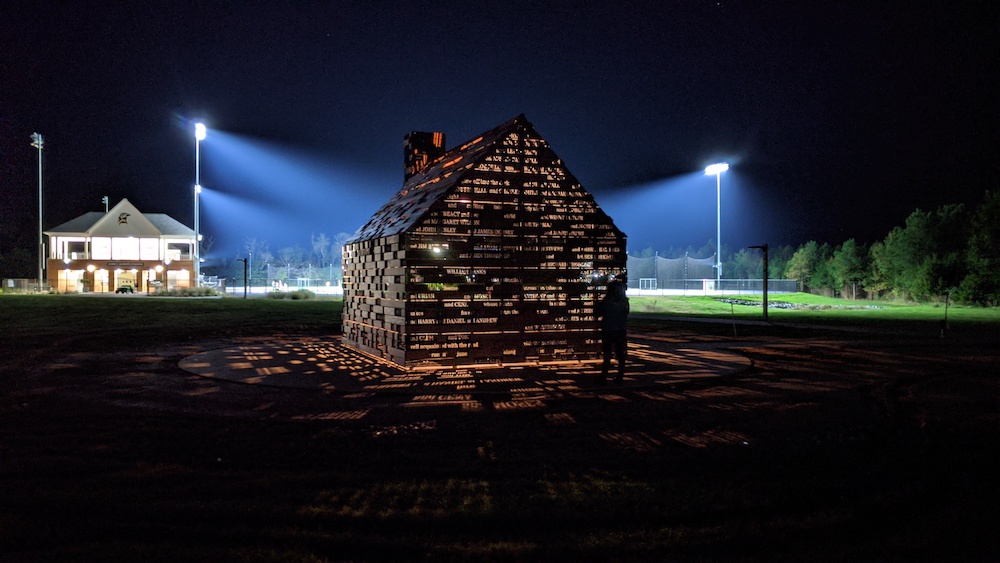
A new art exhibit at St. Mary’s College of Maryland intends to recognize the school’s role in the history of slavery and honor the stories of persistence, resilience, and problem-solving of the enslaved individuals.
“The project spoke to us because it lends voice to those who had been silenced carrying us from absence to presence,” Tuajuanda Jordan, the predominantly white institution’s first African American president, said in a virtual commemoration ceremony to unveil the exhibit.
The exhibit entitled, “Commemorative to Enslaved People of Southern Maryland” was designed by Shane Allbritton and Norman Lee, who were chosen from three proposals brought to the campus community. Jordan says the exhibit is meant to help the predominantly white community of southern Maryland, and those who come to visit, reframe the narrative of St. Mary’s County’s colonial settlers past to one that recognizes the lives of those enslaved on its plantations.
She says the college began digging into its difficult past when they received a pair of shackles as a gift from a faculty member who had discovered it.
“I did not want to touch it,” Jordan said. “It was not good for my spirit to see that. In the here and now, you don’t think about the history of the place even though you understand that this place was a site of slavery.”
The revelations of the institution’s past became more apparent in the summer of 2016 when the college prepared for construction of a sports stadium. During initial stages of the process, the remains of slave quarters were discovered during archaeological site work.
“It gave me great pause,” Jordan said. “It put us on this path to want to understand history.”
Research by the college’s Archivist Kent Randell found evidence of the institution’s relationship with slavery through tax records and census data dating back to 1850. Randell found that Priscilla Greenwell, the acting steward of the college’s female seminary in the early 1800s, was listed as having six slaves. It’s believed by historians that Greenwell was not a woman of means and that the seminary owned the six unnamed slaves, but only their ages and sexes were written down in the census data.
Randell did uncover a list dated March 1814 with the names and ages of at least 50 slaves and might include some of the older slaves that were housed on the college’s land. He also found lists of slaves’ names and ages that dated back to 1750 and 1812. Some of these slaves’ names are engraved on the side of the memorial.
While many of the institution’s records were destroyed in a fire in 1924, it was discovered that between 1750 and 1875 the field where the sports stadium was supposed to go once was the site of three or four slave households. The slaves labored for John Hicks and later John Mackall, well-known farmers who built their wealth on slave labor. The plantation was one of three around St. Mary’s City.
Erasure Poetry
The outdoor art exhibit is a cabin built out of steel, wood, and squares of mirrors. Jordan says she wants to give people pause when they go to the sports fields nearby the exhibit to think about what lies just beneath their feet.
“It is a slave cabin, but it is made of steel. There’s strength there,” Jordan said. “You think about how these people lived, what were their lives like, and how do we make sure that we don’t go back to those times.”
Erasure poetry by Quenton Baker, a nationally-acclaimed poet, is etched into the side of the cabin. The poetry was winnowed from more than 240 historic documents including slave property advertisements, runaway slave notices, newspaper articles, and slave depositions from the plantation.
“The process of erasure when working with the text like this is to turn it on itself,” Baker said. “It’s to strip away those layers of violence and those layers of power and turn it into something that can be used as a lens to look at what was being occluded, to look at what was being obliterated. In this case, enslaved peoples.”
At night the structure is illuminated from the inside and the poetry is projected on the ground around it. The designers say it mimics the star-like pattern found on a number of ceramic artifacts discovered during the college’s archaeological investigation. African folklorists say the star-like pattern could symbolize the web of Anansi which represents resistance of the plantation system and slavery in the new world. Light projecting from the cabin also represents the North Star, relating to a slave’s journey north to freedom.
President Jordan says the challenge with the exhibit was not just connecting to the present, but how to think about it in the future.
Present To The Future
Prior to the presidential election earlier this month, Jordan had the exhibit covered up out of fear of peoples’ reaction to the election results. “Thank God nothing happened to it,” she told DCist/WAMU.
Jordan says, in the past, the college and the community had a tense relationship. Jordan says when she first became president of the college in 2014, many in the community expressed their dismay about her appointment.
“The county is a red dot in a blue state,” Jordan said. “And the college is a tiny blue dot in a very red southern part of the county that, at one time, was very loyal to the confederacy.”
Jordan recalls being berated by some in the community, but she says her struggles pale in comparison to those enslaved. She’s says she hoping the exhibit can help the southern Maryland community reconcile the past.
Eric Colvin, commissioner of St. Mary’s County, presented the college with a proclamation.
“It we keep our skeletons hidden in the closet we steal the legacy of those whose lives were already stolen from them,” Colvin said. “We encourage the citizens of St. Mary’s County to take this opportunity to learn more about the history of our community.”
Driving home the connection from the enslaved past to the current day was Jelani Cobb, the keynote speaker for the virtual presentation and a writer for The New Yorker.
“We look around now we can see slaveries figure prints in the health disparities that we’ve witnessed and fatality disparities that we’ve seen amid the COVID-19 pandemic,” Cobb said. “In the legacy of brutality at the hands of law enforcement that dates back to the institution of slavery and which we continue to witness in the society to this day.”
The college and the community are just two of many historical sites in the region trying to come to terms with their historical connection to slavery. In September 2016, Georgetown University President John DeGioia announced the school would provide preferential status to students who are descendants of the 272 slaves that were sold off to pay the university’s debt over 200 years ago. In April 2019, Georgetown University students approved a non-binding referendum to assess a fee of $27.20 per semester that would go toward programs where direct descendants of the people sold now live,
In September 2019, Maryland erected a memorial to honor the more than 40 black men who were lynched in the state between 1854 and 1933. The state also began a lynching truth and reconciliation commission to find ways to honor, remember, and teach younger generations about the state’s role in domestic terrorism. The commission released an interim report two months ago.