 Daniella Cheslow
 Elliot C. Williams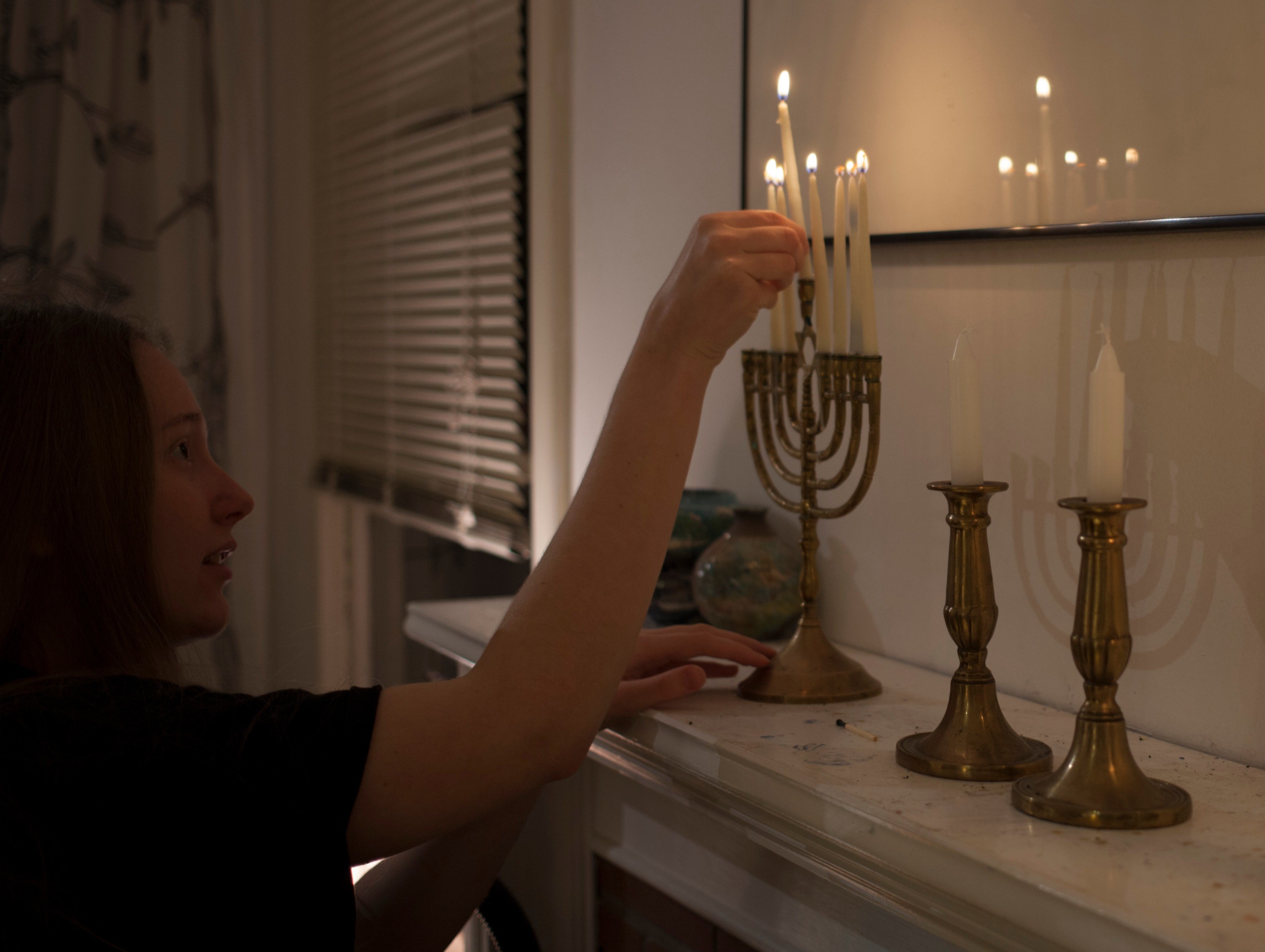
Ahead of Hanukkah, Rabbi Aaron Potek says he had endless discussions with the Sixth & I synagogue leadership team over whether to hold in-person events.
“The idea of having people stand six feet apart with masks, not really being able to talk to each other, standing in the cold while someone shouts at a distance — it didn’t ring true,” he says. “We found that the thing people are most looking for right now is just being able to connect with one another.”
Across the D.C. region, synagogues and churches are struggling with how to create Hanukkah and Christmas celebrations that feel authentic while adhering to public health guidelines amid soaring COVID-19 infections. Unlike Easter, Passover or this year’s Eid Al-Adha, the winter holidays are taking place as plummeting temperatures challenge outdoor celebrations.
Over the eight nights of the Festival of Lights, Sixth & I will instead hold virtual events including yoga, a discussion of Hanukkah in film, and a cooking class. The synagogue also is partnering with Turner Memorial AME Church in Hyattsville, Md., which used to pray in the Sixth & I building, to distribute groceries to those in need.
At Restoration Church near Tenleytown, Pastor Nathan Knight says his congregation is “stubbornly hopeful” it can continue its pandemic-appropriate outdoor services into Christmas. He says there will also be an option to live-stream services at home, and some members of the church can tune in via radio from the church’s parking lot.
Still, Knight says he is adapting his work for those braving the winter weather.
“I’ve tried to condense my sermons to make them a bit shorter,” Knight said. “Instead of singing five or six songs, now we’re singing maybe three or four songs.”
Knight says he’s also designed his services with health rules in mind: D.C.’s pandemic restrictions exempt churches from a cap on 25 people gathering outdoors. The city’s newly tightened guidelines limit houses of worship to only 50 people indoors or 25% capacity, whichever is lower.
“God does call us to gather. However, at the same time, we recognize there are seasons, like the one we’re in, wherein we think it best to love our neighbor as ourselves and not gather in the same ways we normally would,” Knight says.
In Cleveland Park, the Adas Israel Congregation will host nightly drive-in outdoor prayers and candle lightings during Hanukkah, with options for attendees to walk through, as well. Rabbi Sarah Krinsky says she’s also encouraging synagogue members to focus on the good in their lives by filling out a “miracle” card they can place in the windows of their home — families can search for each others’ miracles in a scavenger hunt.
“Hanukkah is about light in dark times, right? Every tradition in the world, essentially, has some sort of light-filled holiday this time of year to kind of rejuvenate our souls and to light the internal spark when the world feels dark,” Krinsky says. “Never in my lifetime has it felt as needed as it does right now.”
The Alfred Street Baptist Church in Alexandria is an institution on the D.C. holiday calendar, ordinarily performing a Christmas choral concert at the Kennedy Center. The 10,000-strong congregation was founded by formerly enslaved people more than two centuries ago. Assistant Minister Rev. Marc Lavarin says with this year’s performance canceled, the church will re-air its 2018 program online.
“Whatever you’re doing with the family, while you’re opening Christmas gifts … it’s just a great thing to have on in the back,” he says.
Lavarin says there will be no in-person services, but the church will hold a singing and caroling event aimed at millennials on YouTube on Dec. 22 and an animated Christmas show for children on Dec. 23.
Alfred Street, among many congregations, has seen an outpouring of donations even as it has canceled in-person events.
Lavarin says contributions soared when it pledged in March to give away a minimum of 1/10th of any contribution it received. In October, the church announced it had distributed $1 million to charities including hospitals, shelters and food pantries. Lavarin says Alfred Street will continue its philanthropy into the holiday by handing out gift cards, rather than the usual Christmas presents, to families in need.
“One of the very first things our pastor realized is that COVID was impacting Black communities disproportionately,” Lavarin says. “So we wanted to make sure that we were giving to organizations, specifically organizations that were helping Black and Brown people.”
At Mt. Olive Baptist Church in Arlington, Va., Rev. Dr. James Victor says church members have raised more than $35,000 throughout the pandemic to distribute boxes of produce to those in need. Most of the vegetables and meat are from Black farmers on the Eastern Shore, he said. Victor says the church will likely hand out 200 boxes of food for Christmas.
Victor says he stopped holding in-person services in mid-March; he plans to hold a remote eggnog and apple cider holiday party, as well as a remote Christmas production, in addition to streamed services.
Pastor John Jenkins of the First Baptist Church of Glenarden says he’s felt the impact of the pandemic in the church he has led for 31 years. The Prince George’s County, Md., megachurch averages around 11,000 attendees on a normal Sunday, and its Christmas productions are seen by upwards of 16,000 people each year. This year he made all of the church’s programs online-only for the congregation’s safety — a mission he takes personally.
“My wife, herself, has had three [family] members die from COVID,” Jenkins says. “I’m funeralizing a pastor next week, who had COVID … It has ravaged through the African American community.”
Going online has had its upside, he says. The church’s “computer ministry” has offered lessons for members who are less familiar with the ins and outs of Zoom, and Jenkins says the church expanded its reach by opening its membership to worshippers from out of state.
“If churches need a physical worship building to do the work of ministry, they need to reevaluate how they do in ministry because the church is not the building,” says Jenkins.
At least one house of worship says it will keep holding services inside. In Falls Church, Va., Father Konstantinos “Costas” Pavlakos says his Saint Katherine Greek Orthodox Church restricts attendance to try to mitigate health risks and spaces congregants six feet apart, with masks on. Pavlakos says the church is also adjusting its usual Christmas morning youth volunteer program to meet pandemic safety guidelines: this year, St. Katherine will use its spacious gymnasium as a staging ground for bagging food to distribute to people experiencing homelessness.
Pavlakos said two retired cooks who usually prepare Greek food to distribute to a local shelter stepped back from the project during the pandemic. Instead, Pavlakos stepped in, drawing on his experience growing up in his father’s Greek restaurant.
One ritual that will not go away in the pandemic is sharing the same Eucharistic spoon, he says. In the Greek Orthodox Church, a priest uses a single spoon and cup to administer Holy Communion — the wine and bread representing the blood and body of Jesus Christ — to the entire congregation.
“Nobody ever died from taking communion,” he says. “Going through smallpox and the plague and all kinds of things — God has a pretty good track record.”
The Centers for Disease Control and Prevention and World Health Organization warn against using shared eating utensils to prevent the spread of COVID-19.
Debbie Ezrin, executive director at Temple Beth Ami in Rockville, Md., says her synagogue found a way to spread holiday cheer from a distance last weekend: the temple invited all of its congregants to drive by and collect individual Hanukkah gift bags with candles for the holiday.
“For a lot of people, that was joyful, even though it was this small little thing,” she says. “It was probably the largest gathering of our community on this campus in nine months, even though it was just a drive-by, spread out over hours.”
Potek at Sixth & I says people who want to celebrate Hanukkah and don’t have the requisite nine-branched candelabra, called a Hannukiah, should not stress. Instead, they can make their own lamps, and light candles, with one on the first night, two on the second, up until eight candles are lit on the last night of the holiday.
“I, myself — a rabbi — did not own a Hannukiah until I made one out of a combination of corks and bolts and plywood,” he said. “When people are in their homes, looking for things to do, there is no better project.”