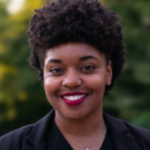
 Aja Beckham
Freedom Futures Collective is debuting a visual album this month titled We Keep Us Safe, a body of work featuring local intergenerational artists and activists who want to “reimagine public safety.”
The collection of music and film explores “complicated questions,” says OnRaé LaTeal, the organization’s founder.
“What does it mean to be in a world without police terror? What does it mean to be in a world without law enforcement?” she says. “We’re trying to figure out what that looks like. We’re trying to figure out who we call when in trouble … Who is going to be able to come and support us without us being afraid to call?”
The album isn’t about officers alone.
“What do we need to hold ourselves accountable when someone does mess up? When someone does make the wrong decision or does something that is harmful?” she says.
LaTeal says these questions guided the direction of the project.
D.C. area activists and artists “use music and film to portray … what it means to live in that type of world in D.C,” says LaTeal.
Some of those featured on the three-part visual album, LaTeal says, dedicated their contributions to Southeast D.C., a community that protested about the murder of Deon Kay, an 18-year-old who was shot and killed in Congress Heights by a D.C. police officer after allegedly pulling out a gun.
LaTeal uses sounds “sounds of the movement” such as call and responses and chants in her music.
One of LaTeal’s songs includes chants from a vigil for Kay. “I captured one of his family members that was chanting … and getting everyone else to say, ‘Say his name. Deon Kay,’” she says. “You can feel the hurt. You can feel just the emotion, the pain in this young man’s voice.”
We Keep Us Safe is the debut project of Freedom Futures Collective, which LaTeal started over the summer amid nationwide protests following the police killings of Breonna Taylor and George Floyd. The multi-media collective is designed to foster music and film education “to fight for the freedom of ALL Black lives,” according to the group’s social media.
LaTeal, who calls herself a “liberation music maker,” says it all started this past summer. In June, she was DJing at a protest in honor of transgender women who were victims of violence. She says while at the protest she was approached by a Open Society Foundations sponsor who told her, “I see your work. I want to support it.” (Open Society Foundations is a one of the largest philanthropic human rights organizations in the world.)
LaTeal secured a grant for her idea to create a visual album featuring local intergenerational artists and activists.
For the past five months, LaTeal and other artists and activists have developed the project, set to premiere during a virtual watch party on December 18. It includes six songs by LaTeal, short clips featuring activists who talk about their work to abolish police, and original protest songs and music videos created by Freedom Futures Collective interns during an eight-week summer internship.
One of those interns, Darius “BLKLITE” Scott, says he’s had police in his schools since middle school.
“My middle school taught me that this police officer is my friend. He’s just here to help me. So that was the feeling that I just went along with,” says Scott, 17. He says throughout his high school experience, however, he’s “only seen police officers arrest students and had friends that don’t want to come to school because they’re afraid the police officers are going to arrest them.”
In 2019, 92 percent of school-based arrests in D.C. were Black students, according to D.C. Fiscal Policy Institute.
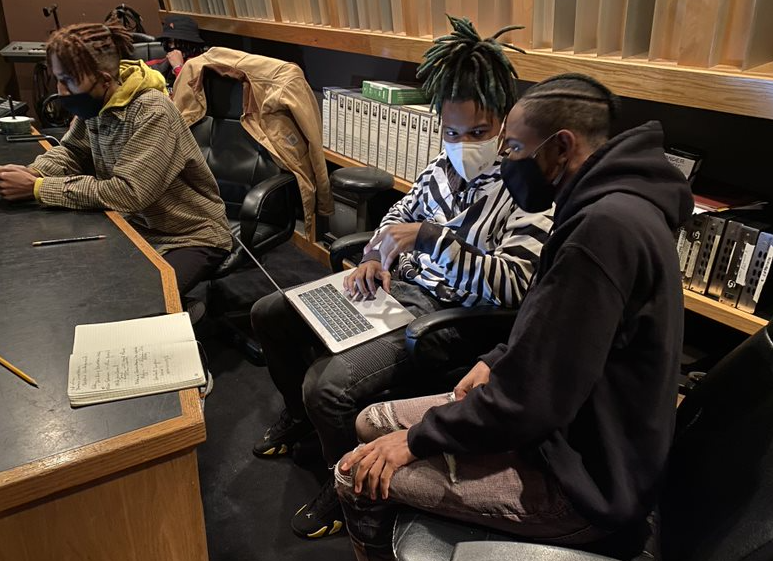
Scott directed the music video for the song “Black in Peace,” written and performed by another intern, Bernard “Tréology” Myers, that explores the impact of policing on Black communities.
“I want to be Black in peace / Not carry the Blackest piece,” Myers writes in the song. “Go ahead and pull a gun on me / Don’t you don’t know I have a wife, daughter, and son to see.”
“All we are armed with is our fist. But no matter what, [police] see a weapon, they see a gun, they see a threat,” says Scott, reflecting on what those lyrics mean to him.
Some parts of the music video were shot on the train tracks at Dupont Underground, “in a setting that’s much more dark and heavy,” than the rest of the album, says Scott. The set portrays the “tragedies … that the world puts on Black people from a local to a global scale,” he says.
The visual album also features activists including Samantha Davis, founder of Black Swan Academy, a Southeast-based organization that advocates for police-free schools.
In one of the short clips Davis speaks about the organization, which educates students “that the history of policing is rooted in the enslavement and the capture of Black people. And that the history of policing within our schools is rooted in the suppression of youth voices,” she says in the clip. “We [don’t] get into police reform, like they need more training, or we should build trust or all those things.”
This album comes after a summer of protests in the District and across the country demanding racial justice. Black Lives Matter D.C. was among the groups demanding that police be defunded. In June, the D.C. Council approved bills reducing the Metropolitan Police Department’s budget, and approving sweeping police reform measures, including banning chokeholds and requiring body-camera footage to be made public more quickly after a police shooting. Last month, the council followed it with another bill increasing oversight of police overtime. Meanwhile, a 20-person Police Reform Commission is expected to deliver recommendations for policing in the District by the end of the year.
LaTeal says police should be completely abolished and mutual aid groups should replace them, and Davis agrees.
“When I imagine safety, it’s the idea of being around family and people who care about you, who want to see you do better,” Scott says. “Art is a tool in order to start that conversation … [that] is where you start those relationships.”
For LaTeal, the album is a chance for the public to hear these local artists’ visions of safety in their communities.
“For some of our kids [safety] is their family … their art … their mentors,” she says. “You’ll have a chance to see what public safety looks like for our kids and to hear what it looks like to them on the album.”
The “We Keep Us Safe” album watch party is on December 18. Tickets are free and available here. The album will be available on OnRaé LaTeal’s Youtube channel following the event.