Jacob Fenston
How does one Maryland county of 1 million people reverse course on 250 years of dependence on fossil fuels — and do so in just 15 years?
This week, Montgomery County officials started charting their course towards fulfilling that ambitious goal. They released a draft of the county’s plan to get to zero carbon emissions by 2035. Zero carbon emissions would mean no natural gas stoves or furnaces, no gasoline-powered cars or trucks, no electricity produced by coal. Houses, business and vehicles would be powered by the sun and wind, not by burning fossilized creatures that died millions of years ago.
“We knew we set incredibly ambitious goals,” said County Executive Marc Elrich at a virtual meeting on Tuesday night, where he and county staff presented the plan to residents. The plan lays out 87 actions that would get Montgomery County close to zero emissions.
“It’s a milestone for the county,” said Elrich. “It gives us a road map to real actions to get the county to reduce our greenhouse gas emissions.”
Many of the proposed changes would hit close to home. They would change how residents heat and cool their homes, cook their meals, and get around. The proposed actions range from banning natural gas in new construction and requiring new buildings to produce as much energy as they use to implementing congestion pricing and transitioning to electric buses.
The climate action plan was spurred by a county council resolution passed in December 2017 declaring a climate emergency and setting the zero-emissions goal for 2035. The resolution also established a shorter-term goal: cutting emissions by 80% by 2027. By comparison, between 2005 and 2018, Montgomery County cut emissions by 19%. Much of that reduction came from a national trend: switching from one fossil fuel (coal) to less polluting alternative (natural gas) for generating electricity.
“Montgomery County has been a national leader in responding to the challenge of climate change,” the resolution said, but it said the county now “needs to do much more, much faster.”
Climate change is already hitting the mid-Atlantic region with hotter summers, milder winters, more rain, and more extreme storms. Historically, there were an average of four days a year above 95 degrees in Montgomery County. According to the county’s climate projections, that could rise to 60 days a year — much of the summer, a never-ending heat wave — by the end of the century if emissions are not cut.
The three-year process to come up with the action plan involved more than 150 residents who volunteered on various working groups and generated more than 800 possible actions to reduce emissions. County staff and technical consultants reviewed the ideas and scored them, determining which would have the biggest impact. The most impactful ideas were included in the draft plan.
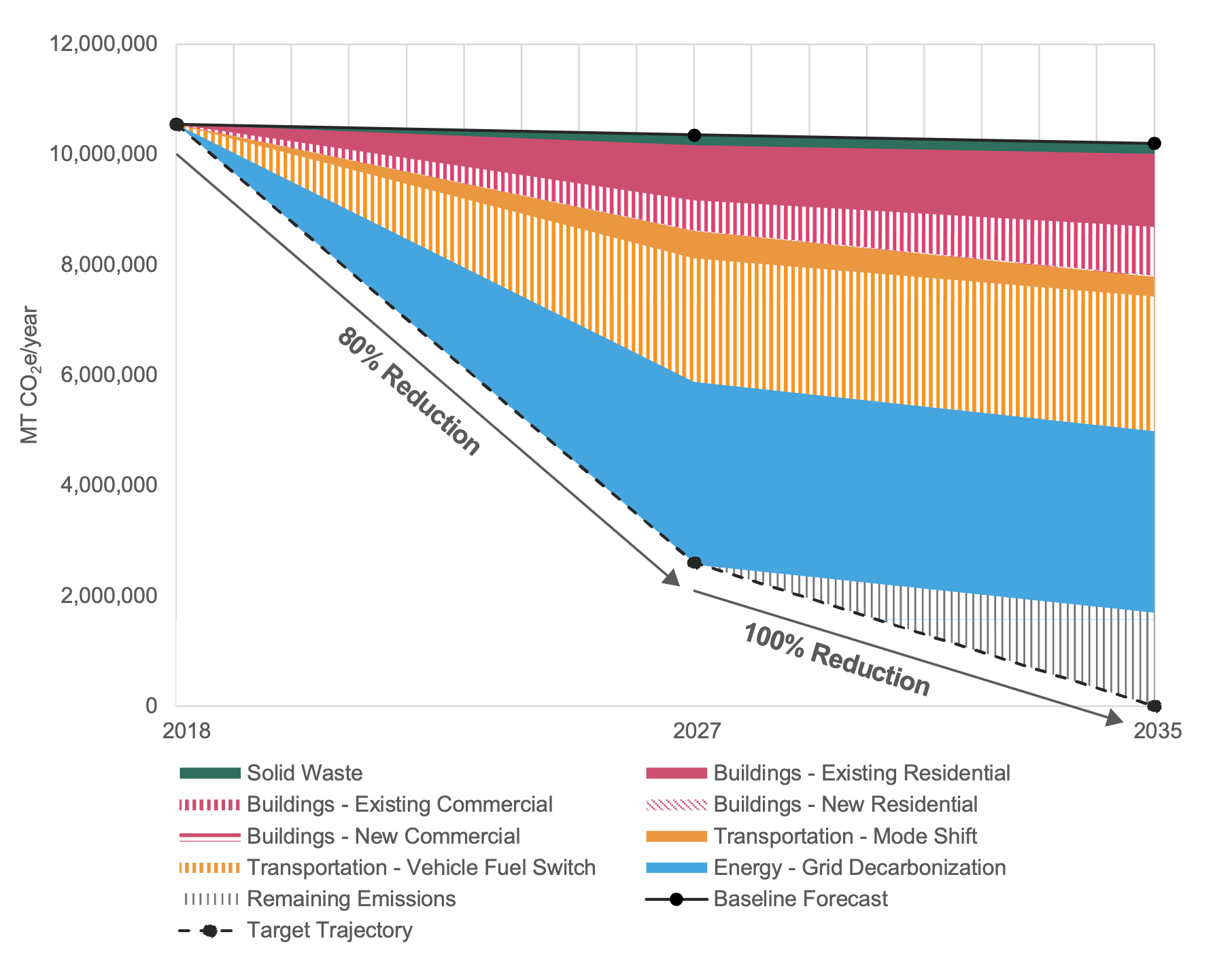
The single action that would cut emissions the most would be making renewable energy the default electricity service in the the county. Currently, residents can choose to pay extra to buy power from wind and solar sources, but many people don’t know about the option or don’t want to pay more. The climate action plan recommends flip-flopping this program — residents would have to actively opt out if they wanted to buy Pepco’s cheaper traditional electricity, powered mostly by natural gas, nuclear, and coal. As with many proposals in the plan, the county would need authorization from the Maryland General Assembly to make this change.
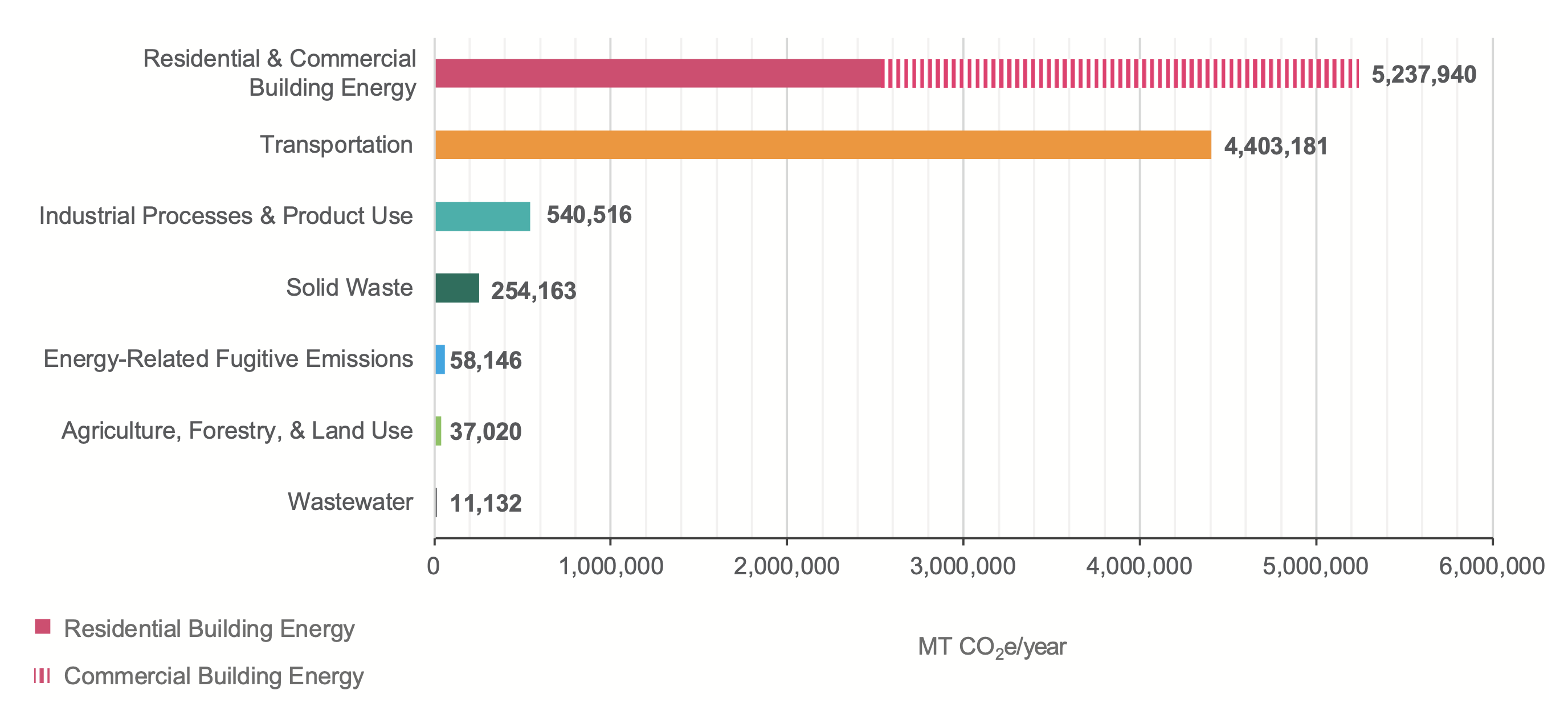
The next most impactful proposals all have to do with electrifying buildings, whose energy use accounts for more than half of greenhouse gas emissions in the county. The plan notes that the county cannot require homeowners to immediately replace their natural gas appliances. However, the plan recommends implementing point-of-sale or point-of-lease ordinances, requiring electrification when a building is sold or leased. The plan recommends “equity-enhancing measures” to make sure these sorts of requirements are not a burden to residents. These could include full or partial subsidies to pay for electrification.
In transportation, the county plan again runs up against the fact that local government has limited power to dictate how people live.
“As vehicle choice is personal and cannot be regulated by the County, electrification will be difficult,” the plan notes, “unless its promotion is coupled with both large incentives and disincentives.” The action plan proposes hefty rebates for electric vehicles, on a sliding scale based on income, as well as fees to discourage driving “fuel-inefficient” cars.
Wendy Howard, executive director of the nonprofit One Montgomery Green, participated in one of the working groups to create the climate plan, with an eye to making sure equity was always a part of the discussion.
“We wanted to make sure that a lot of these great and grandiose plans for changing to clean energy actually took in mind people who are not always able to afford that,” Howard said. “We can’t just assume everybody can get an electric vehicle. We have to think of ways to make sure that’s affordable to all.”
During the virtual meeting on the plan this week, some residents were critical of the county’s pace, saying three years to draft a plan was too slow to confront the climate emergency. Mike Tidwell, executive director of the Chesapeake Climate Action Network, echoed those concerns in an interview with DCist/WAMU.
“I was hoping Elrich would come out with a set of three or four actual laws that he wants to pass in the first half of 2021 that could achieve this climate action plan, because otherwise we’re just continuing to talk and talk and talk about the problem — which we’ve done for the last three years without doing anything substantial,” he said.
During the meetings one resident had a similar criticism, saying the 87 actions proposed amounted to a “menu of options” rather than a plan.
Adriana Hochberg, Montgomery County’s climate changer coordinator, disputed that characterization.
“We’re going to need to take all of those actions and more, because even doing all of those still does not get us to zero by 2035,” said Hochberg. “So in that sense, it’s not a menu of options. It’s, ‘We need to do all of them.'”
Hochberg acknowledged many of the proposals would have a high up-front cost and that the plan comes at a time — in the middle of the pandemic and associated recession — when budgets are tight.
“While the costs of implementing the [climate action plan] are high, the cost of inaction on climate change will be even higher,” Hochberg said.
The plan does not include an estimate of total cost.
The county is taking public comment on the plan through Feb. 28, 2021, and plans to release a final plan sometime in the spring.