Martin Austermuhle
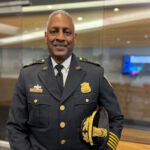
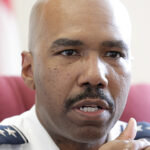
Mayor Muriel Bowser has nominated longtime police official Robert J. Contee III to lead the Metropolitan Police Department in the wake of Chief Peter Newsham’s planned departure for the Prince William County Police Department.
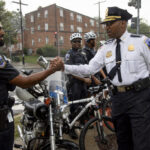
Contee, who joined MPD in 1989, is currently the department’s Assistant Chief of the Investigative Services Bureau. According to his official biography on the department’s website, Contee, who was born and raised in D.C., served as a patrol officer and led three of the city’s seven police districts during his 31-year time on the force.
The news of Contee’s nomination, which was announced on Tuesday, was first reported by the Washington Post and independently confirmed by DCist. He starts Jan. 2.
During a press briefing on Tuesday, Contee, now 48, recounted his upbringing in Ward 5, detailing his father’s struggle with drug addiction and said life was “not easy” in his neighborhood.
“Many of the challenges and traumas experienced by so many young people today were very real and present in my community, but also in my home,” Contee said, noting that crime, poverty, and educational and health disparities were all present in his community.
Contee worked a series of jobs as a teenager, and took part in the Marion Barry’s Youth Leadership Institute, and eventually becoming a D.C. police cadet at 17 years old, which he called a “pivotal moment.”
“It changed my entire life,” he said Tuesday, noting that those experiences will help him lead the department. “It was these and other opportunities that helped shape the man I am today.”
In picking Contee, Bowser opted for staying within the department, just as she did when she picked Newsham in 2017 and when former mayor Adrian Fenty selected Cathy Lanier in 2007. Contee will also be the city’s first Black police chief since Charles Ramsey in the early 2000s. He will have to be confirmed by the D.C. Council, and will make $270,000 annually, slightly less than Newsham’s $283,000.
“There is no one more apt to fill the position,” tweeted the D.C. Police Union, which represents rank-and-file officers, on Tuesday morning.
D.C. Attorney General Karl Racine also voiced his support for the choice in on a statement on Tuesday.
“Chief Contee knows from growing up in the District and serving in the Metropolitan Police Department for over 30 years that community trust is critical to reducing crime,” he said. “He cares about strengthening ties between MPD and the District’s communities. To that end, I am confident that he will directly engage with District residents to learn about their hopes and needs.”
But with the relatively rapid selection, Bowser also largely spurned calls from activists and advocates who said Newsham’s departure amidst a time of national reckoning over police brutality and racial justice presented an important opportunity to rethink policing in the nation’s capital.
Earlier this month, the D.C. Police Reform Commission, which was created by the D.C. Council over the summer to recommend changes to how MPD operates, called on Bowser to “implement a robust plan for community engagement” to select a new chief, and asked that a selection panel “take special consideration of the communities who have the most contact with [police],” namely those east of the Anacostia River.
The ACLU of D.C. similarly asked Bowser to consider candidates who would reconsider how MPD engages with residents and communities.
“Our next chief must understand that de-centering police — removing the law enforcement response to behaviors that are better addressed by a public health or community intervention — is critical to making our communities safer and stronger,” said Monica Hopkins, the group’s director, in a letter. “D.C’s next police chief must tackle the District’s most urgent problems with an approach unhindered by MPD’s failed practices and culture.”
Bowser said Tuesday that she decided to start the search with MPD because “what was most important to me is that we had solid and steady leadership at the Metropolitan Police Department and not a prolonged human resources process.”
She added, “I think it is my job to make sure that one of the largest and most critical agencies in our government has a leader and that’s why I’m nominating the chief today.” Bowser said she did not interview any other candidates.
Despite being supportive of Contee’s selection, Racine did say in an interview with DCist that he wished more people had been consulted. “I do believe the community should have been engaged in the process, and that we missed an opportunity to actually have a conversation with the community as to how they want to be policed,” he said. “I hope that can occur outside of the selection process.”
Contee will have to face a nomination hearing and vote in a council that has become more assertive on policing matters since George Floyd’s killing earlier this summer. While Newsham faced little opposition when he was confirmed — only one councilmember voted against him — Contee is expected to face tougher questions from lawmakers on the police department’s budget, tactics and relations with the communities it serves.
Outgoing At-Large Councilmember David Grosso, who voted against Newsham’s confirmation, said some of the council’s questioning of Contee — and his support in the city’s communities — could be fueled by the way he was selected.
“Conducting a public search process that sought meaningful community engagement on a nominee would have gone a long way to build critical trust in D.C.’s next police chief. The mayor’s decision to ignore calls for such a process will only make the next chief’s job more difficult,” said Grosso in a tweet.
Ward 6 Councilmember Charles Allen, who chairs the council’s judiciary committee, congratulated Contee on his nomination but also foreshadowed possible questions that may be directed at the nominee when he comes up for confirmation.
“This moment demands someone prepared to tackle systemic racism in the District and within policing culture, repair relationships in the communities served by MPD, advance a public health approach to eliminating violence, and use the law and Constitution to demonstrate empathy, humility, innovation, and vision,” said Allen in a statement.
While some policing experts say that MPD has reformed and improved significantly over the last three decades — officers all use body-worn cameras now, and have undergone specialized training in conjunction with the National Museum of African American History and Culture — a new generation of racial justice activists say that traditional policing strategies are failing to prevent violent crime and homicides, which are currently at a 15-year high in D.C. There has been a push to expand two violence interruption initiatives and redirect police funding to other services.
Regarding any changes he might make to extend an olive branch to those who have questioned the department’s conduct, Contee said Tuesday, “I think it’s important to ensure that the community is part of the conversations that will take place regarding public safety.”
This story has been updated to include statements from Attorney General Karl Racine and Ward 6 Councilmember Charles Allen, as well as information from Mayor Muriel Bowser’s press conference.