Martin Austermuhle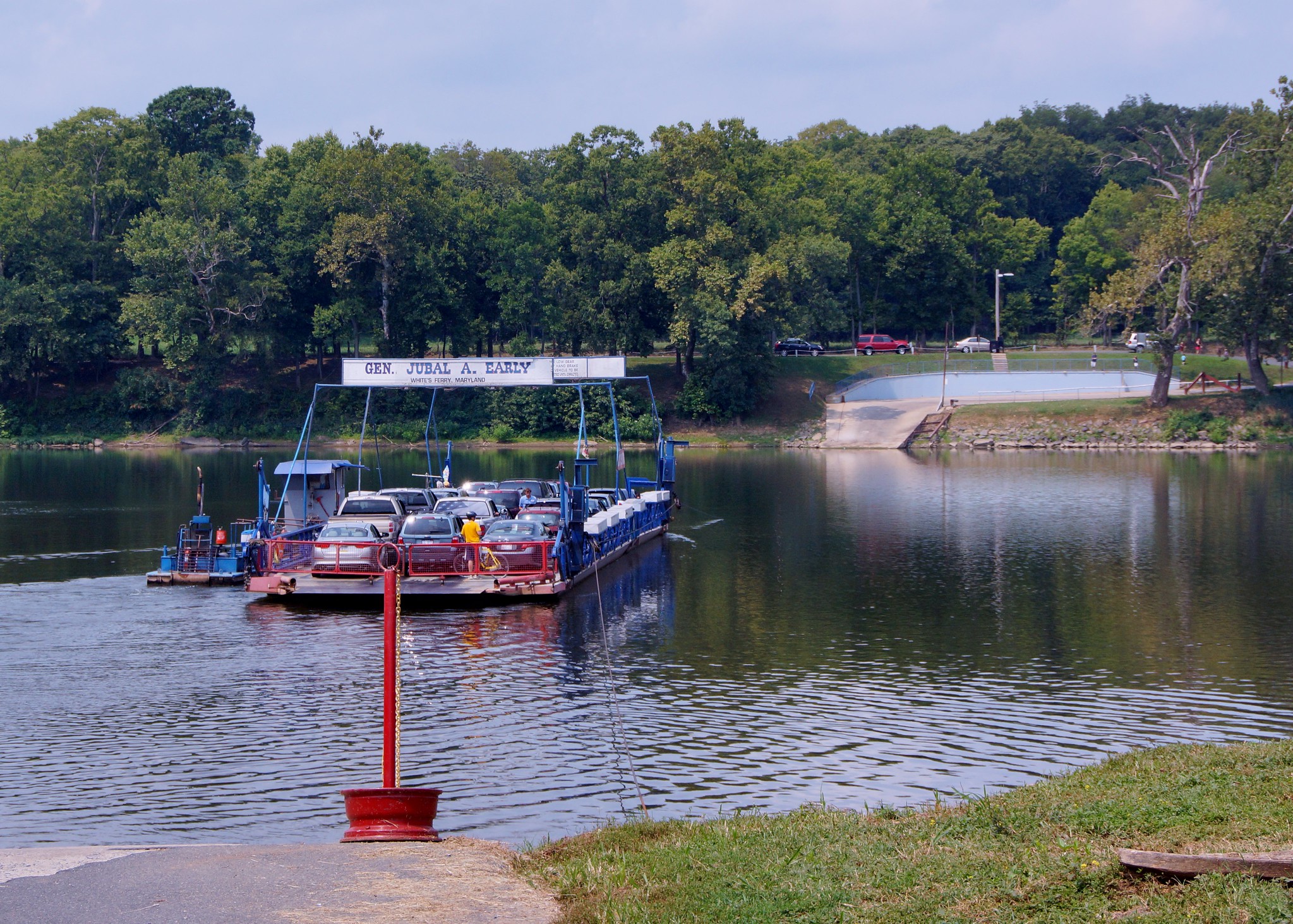
The last remaining ferry boat to shuttle traffic across the Potomac River announced on Monday it would immediately cease operations due to a centuries-old legal dispute over its landing on the Virginia side of the river.
On its Facebook page, Historic White’s Ferry, which has run ferry service between Montgomery County on the Maryland side and Loudoun County on the Virginia side since the late 1700s, said that a Virginia court had ruled that “no public landing exists on the Virginia shoreline at White’s Ferry Road and the ferry is prohibited from landing at that location in Virginia.”
The legal conflict between Rockland Farm on the Virginia side and the Maryland-based ferry — one of the 100 that used to cross the Potomac River — revolves around a dispute about the exact location of the landing. In 1871, Loudoun County gave land to the ferry for the landing, but failed to appropriately mark it on a map. Rockland Farm claims part of the now-landing is on its property.
The farm and ferry negotiated an arrangement for use of the landing in 1952 for $5 a year, but in 2009 a conflict emerged over the ferry company’s efforts to expand the size of the landing. That prompted a lawsuit that slowly made its way through a Virginia court.
Late last month, a judge in Loudoun County sided with the farm, saying there was no certainty that the long-used landing was actually on public land.
“Evidence that the ferry landing has been in ‘the same place’ for a long period of time, even back to 1871 may have persuasive value on the broader issue of location but does not provide reasonable certainty regarding the more specific issue of that location,” wrote Judge Stephen Sincavage.
“We couldn’t prove the landing is where it is right now, is my understanding of the case,” said Herb Brown, whose father purchased and restarted the cable-drawn ferry in 1946 after it had ceased operating for almost a decade because of a flood. (Earlier this summer, the family removed the name of Confederate Gen. Jubal A. Early from the ferry boats.)
Brown said the family made the decision to stop the ferry’s operations immediately because a court order mandating that would have kicked in next week; the ferry had already been sidelined in recent days because of high water and debris on the Potomac River.
“We knew there was injunction coming that we couldn’t land in Virginia so we made the decision. It would make no sense in opening up for a week,” he says.
The ferry’s Facebook posting drew more than 1,000 comments only hours after the announcement, and in a statement the town commissioners of nearby Poolesville, Maryland said they would work to restart ferry service — the only connection between the Virginia and Maryland sides of the river between the American Legion Bridge and the Point of Rocks Bridge more than 40 miles to the north.
“The closing of this important transportation link will have a massive impact upon countless commuters, surrounding communities, and alternate routes of travel,” said Commission President Kerri Cook in a statement. “Also, the western part of the county is identified by a rich history and unique character and White’s Ferry is an essential element of that Montgomery County history.”
Del. Danica Roem, who represents a portion of Prince William County in the Virginia House of Delegates, also weighed in on the closure.
“This needs to fixed immediately. White’s Ferry keeps so many vehicles off of 15, 495 and 270 each day. It’s an important part of our transportation infrastructure,” she tweeted. It’s 26.4 miles from Leesburg to Poolesville via U.S. 15 in Virginia and Route 28 in Maryland (the other Route 28, not VA’s Route 28). That same trip is 12.4 miles via White’s Ferry. Do the math on wasted fuel and time per trip and multiply it by 600 vehicle trips per day.”
On Monday afternoon, Loudoun County said in a statement that while it was not involved in the lawsuit, “the county remains concerned about the outcome from a regional transportation perspective. We recognize that any impact to ferry service may impact our residents and people who work in Loudoun County.”
But Libby Devlin, one of the owners of Rockland Farm, says they never intended for the ferry to shut down, and actually made multiple attempts before, during, and after the trial to renegotiate an agreement with the ferry for use of the landing.
“We were open to several different arrangement to keep the ferry going so long as Rockland Farm was compensated fairly,” says Devlin, whose family has owned the farm as long as the ferry has been in operation. “The owners decided they would just walk away from the business. We did not shut down the ferry. We tried everything to keep it running.”
Devlin said she even offered to buy the ferry and its land on the Maryland side outright. “All Rockland wants is a fair deal so that the ferry can remain in uninterrupted operation,” her attorney wrote in a Dec. 23 letter. “The ball is in your court.”
Brown won’t say if he thinks the ferry will ever run again, but said his family rejected an offer from Rockland Farm for an agreement for use of the landing that would cost the ferry roughly $18,000 a month because it was too expensive.
“It just made no sense,” said Brown of the farm’s offer. “We as a family are devastated we had to do this.”
This post was updated with statements from Rep. Danica Roem and Loudoun County.