 Daniella Cheslow
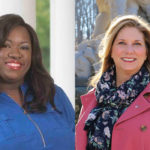
Voters in Northern Virginia chose Democrat Candi King to replace Jennifer Carroll Foy, who left her seat in the Virginia House of Delegates to focus on her campaign for governor. King’s win provided blue continuity in a district where Democrats have consolidated power during the Trump Administration.
King, 38, a nonprofit program manager and education advocate from Dumfries, defeated Heather Mitchell, 50, by a margin of 263 votes, according to unofficial results from the Virginia Department of Elections. The Virginia Democrats have claimed victory in the race.
Only a few thousand people turned out to vote, a stark contrast to the November election when Virginia early voters lined up for hours to cast their ballots for U.S. president.
With Tuesday’s vote, Democrats kept their comfortable 55-45 margin in the House of Delegates, days before the upcoming General Assembly session begins Jan. 13.
King campaigned on a platform of inclusive rebuilding after the pandemic and improving transportation, and was endorsed by labor unions, abortion rights advocates, and immigrant gro
“Top of mind for my neighbors and for folks in the community is COVID recovery,” she told DCist/WAMU on Election Day. “Support for families, support for small business, as well as support for our teachers and students as they prepare to safely return to school.”
She pledged to carry on her predecessor’s work in pushing for police accountability and uprooting Confederate symbols in Virginia. Carroll Foy was particularly outspoken about allegations of racism at her alma mater, the Virginia Military Institute, which in December removed its statue of Confederate General Stonewall Jackson amid a state investigation of its campus culture. King supported that investigation and changes to the military college.
“I believe that Confederate statues have a place and it is not in our institutions of higher learning,” King said. “If we want to create a Virginia that is inclusive for everyone, we need to stop idolizing the racist imagery of Confederate statues and flags, so get rid of all of it.”
On other issues, like ending the qualified immunity that offers broad legal protections to police officers, King did not take a stance.
“Qualified immunity is problematic. Should it be reduced or should it be completely eliminated is not something that at this moment I can say definitively without further research,” she said. Her position was informed by being married to a Fairfax County law enforcement officer, she said, adding that she understands “the sacrifices that good law enforcement officers make,” while more work needs to be done to prevent abuses.
Prince William County has seen a transformation in recent years, from a bastion of conservatism to a springboard for Democratic political activism.
Mitchell, a Republican, campaigned on the message that Democrats in Prince William ignored the more rural Stafford County, where she lives. It was her second attempt at the seat — she lost her earlier 2019 run to Carroll Foy.
“We’ve not had representation in the Second District since 2015,” she said. “Our former delegate, I can say with certainty, we never saw her in Stafford County.”
Mitchell served as a senior aide to former Prince William County Board Chair Corey Stewart, a Trump supporter who vociferously defended Confederate monuments and denounced moderates in his party as “toilet paper Republicans” who he said were “just as soft, just as weak, just as pathetic, just as flimsy.” Stewart left politics in 2019 after he lost a Senate race to Democrat Tim Kaine.
Mitchell drew endorsements from pro-gun and anti-abortion organizations, as well as sheriffs in Stafford and Prince William County. Like Stewart, Mitchell supported cracking down on immigration, and opposed a June 2020 move to end a Prince William County agreement to screen all people booked into the county jail for their immigration status, and hold undocumented immigrants under a request from U.S. Immigration and Customs Enforcement.
On other hot button issues, Mitchell declined to take a stance. On VMI’s Confederate monument, she said only, “I don’t have a comment on that right now, I’ve been focused right now as to the needs in the Second House District.”
She also declined to comment on far-right protesters who streamed into D.C. Tuesday to support President Trump’s unproven claims of voter fraud in the 2020 election. Some Republicans in the commonwealth have supported those false claims, including Virginian Del. Dave LaRock (R-Loudoun County), who was among three GOP delegates who asked Vice President Mike Pence Tuesday to nullify Virginia’s certification of its election results.
“I haven’t really been following any politics,” Mitchell said.
In a second special election in southern Virginia, voters chose Angelia Williams Graves to succeed fellow Democrat Joe Lindsey, who resigned his seat representing Norfolk to become a judge.
Virginia’s next major election landmark is primaries for governor, lieutenant governor, and attorney general. In that vote, Democrats from Prince William County will compete against each other; Carroll Foy faces fellow Democratic Del. Lee Carter of Manassas, along with former Gov. Terry McAuliffe, state Sen. Jennifer McClellan (D-Richmond), and current Lt. Gov. Justin Fairfax. So far only former Republican House Speaker Kirk Cox and state Sen. Amanda Chase (R-Richmond) are contending for the GOP ticket.
Del. Elizabeth Guzman (D-Prince William) and Del. Hala Ayala (D-Prince William) are among eight candidates vying for the Democratic nomination for lieutenant governor.
Former Republican delegate David Ramadan, an adjunct professor at the Schar School of Government at George Mason University, said low turnout worked in Mitchell’s favor even though “the wind remains to be on the Democratic side in Virginia.”
“In a November standard race, her chances are null to nothing,” he said. “In a special election, it is a slim chance.” That slim chance ultimately didn’t pan out.