Margaret Barthel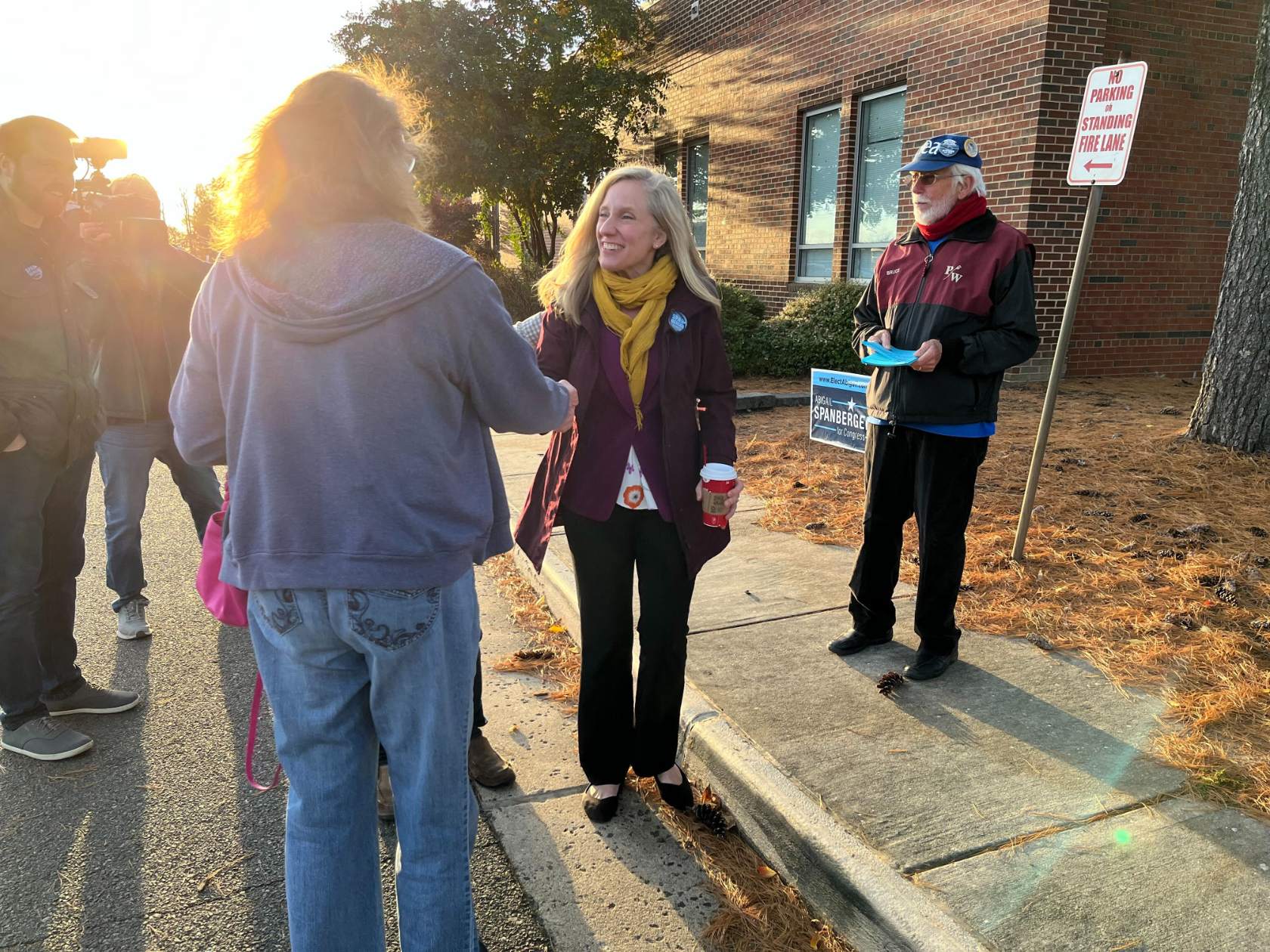
With control of Congress hanging in the balance, Virginia Democrats managed to hold the line in two key congressional districts based in Northern Virginia. Incumbents Abigail Spanberger in the 7th District and Jennifer Wexton in the 10th District won third terms in office — an early positive sign Tuesday night for Democrats. The party sustained losses, including in Virginia’s 2nd District, but appeared to fend off the Republican sweep some had predicted.
Post-election analyses are just beginning, but Wexton — and particularly Spanberger — appear to have succeeded in a bad environment for Democrats nationally by marking out a moderate path that emphasized policy solutions over fear and negativity. The results also emphasize Virginia’s modest but consistent lean to the left — particularly as Northern Virginia’s suburbs and exurbs become even more solidly Democratic territory. And it raises questions about whether the commonwealth is still, in fact, a swing state, and thus a political bellwether for the rest of the country.
The Northern Virginia exurbs and adjacent rural areas in the Piedmont are still competitive, but the results further cement the blue trend of the area, even in the face of significant national headwind and redistricting that dramatically changed the 7th district. Heading into Election Day, most analysts saw the 7th as a toss-up, and suggested the 10th would be close but ultimately was a good bet for Democrats.
“It was a win for the Democrats, even though they lost a member of the delegation to Washington, because the expectations were that they were going to lose multiple seats,” said David Ramadan, a professor of practice at the George Mason University Schar School of Policy and Government. “Spanberger survived what supposedly was going to be a red wave.”
Spanberger defeated her opponent, Republican Prince William County Supervisor Yesli Vega, by about 4 points — a margin that emerged as election officials counted early votes from Prince William County, which accounts for about a third of the 7th District’s voting population. Republican Gov. Glenn Youngkin won voters in the 7th District by about 5 points in the 2021 gubernatorial race, estimates suggest, but redistricting experts say the district slightly favors Democrats, 52% to 47% on average.
Analysts and local Democrats involved with the race praised the outcome as an example of winning messaging and tireless engagement on the campaign trail, even in rural areas where Democrats usually trail Republicans.
“Rep. Abigail Spanberger (D-VA)’s victory is significant,” tweeted Larry Sabato, the director of the University of Virginia Center for Politics. “She was dealt a bad hand by redistricting, but her campaign was top-flight and her energy and savvy were extraordinary. More Democrats across the nation should study how she did this.”
‘She just focuses on results’
In a victory speech on Tuesday night, Spanberger called for unity to heal partisan divisions — a sentiment in keeping with the way she positioned herself on the campaign trail, as a candidate who was eager to work across the aisle. She touted several endorsements from prominent Republicans and local law enforcement leaders in television ads.
Ramadan, who formerly served in the Virginia House of Delegates, thinks Spanberger’s status as a moderate who has historically been unafraid to fence with the progressive wing of her own party over issues like defunding the police echoes “where Virginia and Northern Virginia is” politically.
“Spanberger crafted a spot for herself in the center,” he said.
Her campaign also focused on Democrats’ accomplishments like the Inflation Reduction Act, which curbs drug prices for seniors and lowers healthcare premiums for low-income people. And she explained how money from federal infrastructure investments could come home to the 7th District.
That focus on policies and solutions resonated, per Del. Candi Mundon King, who represents parts of Prince William County and Stafford County in the General Assembly.
“She does not give you the answer that is just a good soundbite,” King told WAMU/DCist. “She actually knows policy. She knows what she’s talking about. She knows how things work. And she doesn’t try to oversell or give people false promises. She just focuses on real results.”
Positive ideas, rather than personal attacks or fearmongering, prompted turnout, King believes. She said she spent Election Day talking with voters at seven different polling places across her district.
“I heard from a lot of independent voters that they were voting for Spanberger because she was someone who was bringing forward ideas and not just trying to scare people or demonize one group of people over another,” King said, contrasting that focus with Republican Yesli Vega’s rhetoric about crime and immigration.

Spanberger faced a particular challenge following redistricting: The 7th District shifted significantly north, from the Richmond suburbs up to Prince William County and Fredericksburg and west to Culpeper County. That change pushed the partisan make-up of the district slightly bluer, but also meant that she was introducing herself to most district voters for the first time, losing some of an incumbent’s natural advantage
King praised Spanberger for working hard to integrate herself into the civic life of her new district, which is very diverse politically, geographically, socioeconomically, and in terms of race and immigration status.
“We love our community. We are fiercely protective of our community,” King said. “She was willing to learn us, learn what was important to us and to take the advice or even criticism that we may have had.”
King highlighted the incumbent congresswoman’s attempts to introduce herself to local West African diaspora communities, who she said were very engaged in the campaign
King also noted the new district boundaries meant a much more significant presence of federal workers and union workers, requiring Spanberger to master issues specific to those groups.
“She would show up and have those conversations with us about supporting workers and living wages and those types of things are really important for us,” she said. “They may have been newer issues for her to tackle, but she really brought together a broad coalition of support from businesses to unions to community organizations.”
Del. Elizabeth Guzman, another Prince William County Democrat, was heavily involved in getting out the Latinx vote in both the 7th and 10th District races. Latinx voters are a major part of the voting population in the county, and Guzman praised both campaigns for their outreach efforts on Spanish-language media and on the ground.
“[Neither] of the candidates took the Latino vote for granted,” she said.
Guzman recalled hosting a town hall event in the 7th District, in which voters could have conversations in Spanish with Spanberger, who speaks the language. Voters at the event wanted to hear about “protecting women’s reproductive rights, fighting for common sense gun safety, including safety in the schools,” Guzman said, noting some incidents of violence in local schools that provoked community concerns.
She also said voters talked with Spanberger about “bread and butter issues” like the cost of living and inflation, and immigration positions on a pathway to citizenship for Temporary Protected Status beneficiaries and Dreamers.
That combination of ideas, she said, was appealing to voters whose doors she and other organizers knocked on.
“What we emphasized at the door was to look at the candidate’s policies and their record and decide if those candidates were supportive of Latino communities,” she said. “I think that the decisive vote came with Democrats running on things like lowering health care costs. That’s a message that resonates with our community.”
King and Guzman said Democratic organizers in Prince William County deserve a great deal of credit for Spanberger and Wexton’s successes, particularly for getting people to the polls during early voting (the Prince William County early vote count is what finally tipped the scales in Spanberger’s favor on Tuesday night).
Abortion was arguably one of the most potent issues for Democrats nationally — and that held true in the 7th District. In interviews, many Democratic voters cited defending reproductive rights as a key reason they came out to vote.
“I have heard a lot of personal stories about women’s right to choose,” said Zoe Vitter, an 18-year veteran Democratic volunteer in Prince William County who was handing out literature to early voters at the Woodbridge DMV. “I’ve had women cry this year. That’s never happened before. I’ve never had a voter cry on me.”
For her part, King is already looking ahead at how abortion access as an issue will play in the 2023 General Assembly session, where Republicans are expected to propose a bill restricting the procedure, and the November 2023 election, where all seats in the General Assembly will be on the ballot.
“I’m the policy lead for reproductive health, for the House Democratic Caucus, and we spent this morning not just looking at Abigail’s race, but also looking across the country at how these attempts to restrict or eliminate abortion access … failed all over the country,” she said. “This will be a top issue going into 2023.”
‘They played to the far right’
But a good ground game and messages that turned out Democratic voters may not have been the only aspects of the races that broke Democrats’ way.
David Ramadan, at George Mason University, believes the Republican candidate in the 7th District, Yesli Vega, ran much too far to the right to appeal to the centrist tendencies of the district. Vega, who was endorsed by Trump in the final days of the race, has previously questioned the results of the 2020 election and has defended January 6th insurrectionists.
“Trumpism in general never played in Virginia. He never won any election in Virginia. And anybody who’s going to carry on Trumpism in Virginia is simply not reading the facts, not seeing reality,” Ramadan said. He called Trump’s endorsement of Vega “the kiss of death,” especially in Northern Virginia.
In the wake of the midterm results, Del. Tim Anderson, a conservative Republican, posted a call on Facebook for the Virginia GOP to “divorce” Trump in the next presidential race.
“There’s no chance we’re going to sway light blue Democrats our way ever again if we’re going to be wearing red Make America Great Again hats,” Anderson told The Virginia Mercury. “It’s just never going to happen.”
Vega and her counterpart in the 10th District race, Hung Cao, both come from immigrant backgrounds (Vega’s family is Salvadoran, and Cao’s is Vietnamese). But both embraced a “hard core stance” on immigration, Ramadan pointed out.
“It doesn’t matter that the candidate is an immigrant…he or she is not going to really gain the immigrant vote if that person is claiming that grandma does not belong in this country,” he said. “Grandma is a red line.”
“They played to the far right of the party. And that hurt them in the general election,” he said.
Following Republican Gov. Glenn Youngkin’s win in the gubernatorial race last year, Virginia Republicans — and Republicans across the country — hoped his campaign could provide a path forward for the party to appeal to voters in the suburbs and exurbs while also turning out deep-red Trump supporters. But that dynamic is difficult to replicate, Ramadan said.
“[Youngkin] was able to attract the Trump voters and whisper to them things that they want to hear without overtly being Trumpy,” he said. “It’s worked for him. It’s worked really well for him and his campaign, but it’s not necessarily something that you can repeat.”
Youngkin campaigned extensively with Vega and Cao, hosting near-daily rallies towards the end of the race and wrapping them both in his trademark red vest — which Vega wore to greet voters on Election Day. But efforts to boost their campaigns with his own personal political brand fell short. (Youngkin also took his message on the road, campaigning for GOP gubernatorial candidates across the country, many of whom faced defeat or whose races are still too close to call.)
That left Republicans in Virginia to settle for flipping just one congressional seat, in a razor-thin contest in the 2nd District won by Republican Jen Kiggans.
In a statement following the election results, Youngkin touted that victory and emphasized the competitiveness of all three races.
“We’ve always said the House majority would run through Virginia and it looks like that’s exactly what may happen after flipping the 2nd congressional district,” the emailed statement reads. “The 7th and 10th congressional races were tight and tough races. Let’s get to work to bring people together and deliver results for Virginians and Americans. We must continue to work to address those kitchen table concerns with common sense solutions.”
An increasingly blue ‘bellwether’
While Democrats nationally faced headwinds in the midterms, the result of a flagging economy and an unpopular president, the party in Virginia has arguably had the wind at their backs for years. Ramadan believes that the results of the congressional races reinforce the idea that Virginia is trending bluer, despite Youngkin’s success in the state last year.
“Virginia today is a center-left state that’s no longer really a bellwether state,” Ramadan said. “Even though Governor Youngkin won last year, even though it trended more to the right, even though the House moved back to the Republican side — I think if you look at the delegation today to Washington with six Democrats, five Republicans, that is absolutely a very telling representation of where Virginia stands.”
That’s especially true of the 10th District, which Wexton flipped blue in 2018 but which Ramadan now believes is essentially a safe seat for Democrats, owing to Loudoun County’s move left in recent years.
“The [House] minority leader, [Kevin] McCarthy was in the 10th the night before the election. The governor was there. Everybody tried,” Ramadan said. “It’s not a winnable seat at this point.”
An analysis from the Virginia Public Access Project estimated that 10th District voters favored McAuliffe over Youngkin by about 2 points in last year’s gubernatorial race, and Youngkin’s Democratic predecessor, Ralph Northam, by 10 points in the 2017 contest. In Loudoun, the anchor county in the district, Joe Biden beat Donald Trump by more than 20 points.
Del. Candi Mundon King believes that the midterm results also help cement the importance of Prince William County — which is split between the 7th and the 10th districts — in Virginia politics. It’s one of the most populous jurisdictions in the commonwealth, and like Loudoun, it has grown and diversified rapidly in recent years, becoming a bluer and bluer area.
“I think the county is changing in a lot of ways, and I think what Abigail Spanberger and Jennifer Wexton did last night was solidify that we are a county that supports working families and democratic values,” she said.
Campaigning with Spanberger at a polling place in Woodbridge on Election Day morning, U.S. Sen. Tim Kaine reflected on the political shifts in his home state since he got into state politics more than two decades ago.
“We were redder than red, overwhelmingly,” he said. “The 21 years since that race for lieutenant governor has seen us get more competitive and battleground, then battleground trending blue.”
But, “[Democrats] can’t be complacent about anything,” Kaine said. “We’ve got to produce results for people. That’s what got us here, and that’s what will keep us in a position where we win more than we lose.”
King took away a similar set of lessons, looking ahead to the General Assembly session in January — and then statewide legislative elections in November 2023.
“I think we can learn a couple of things,” she said. “Don’t feed the trolls, don’t feed the negativity, bring ideas, bring solutions to people, keep your head down and do the work. I think that’s what these two campaigns showed.”