 Jordan Pascale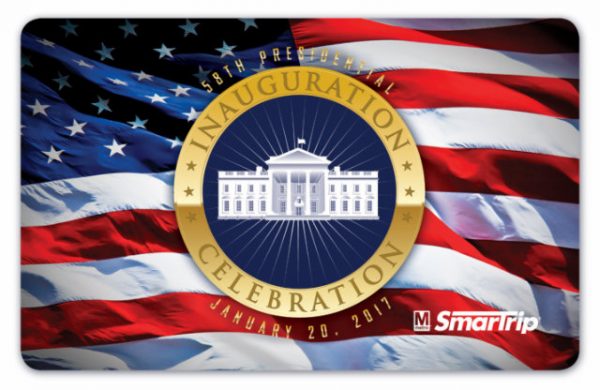
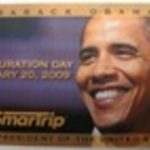
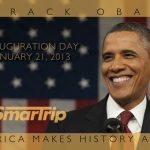
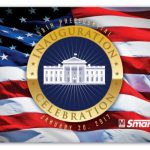
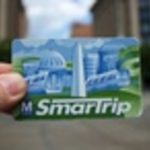
As the pandemic and last week’s attack on the U.S. Capitol continue to complicate Inauguration Day plans, another tradition is canceled: A Metro spokesperson says the agency isn’t creating a commemorative SmarTrip card this year for the Biden inauguration as it has for presidents Bill Clinton, Barack Obama, and Donald Trump.
Metro did not give a specific reason why, but we’ve asked for more information. Because much of the Inauguration will be virtual, and officials are asking visitors to watch from home instead of traveling to the District, many aren’t expecting the usual fanfare and influx of fans of the new president.
Last year, Metro also announced mobile fare passes, which allow riders to use their phones to scan into the transit system, which reduces the need for a physical card.
WMATA is also facing an unprecedented budget crisis. While the agency will get $610 million in federal aid from Congress, Metro is still predicting needs for service cuts in 2022 if more help doesn’t arrive.
Metro has created numerous commemorative SmarTrip cards for events like its 40th anniversary; the Washington Nationals winning the World Series; and the Washington Capitals winning the Stanley Cup. The Inauguration cards usually come preloaded with a one-day pass for unlimited trips on Inauguration Day.
The inauguration cards have featured Bill Clinton and Al Gore’s signature in 1993, Barack Obama’s face on the 2009 and 2013 cards, and a generic design with the White House for Trump’s 2017 card. A sleeve with Trump’s face was issued along with the card after they got permission from the Inaugural Committee to use one. George W. Bush didn’t appear on then-paper farecards, apparently because there wasn’t a “large public interest in” his inauguration, according to news reports from the time. Generic designs of the White House were created.
Metro typically plays a large role in Inauguration plans.
For the last Inauguration in 2017, Metrorail opened an hour early at 4 a.m. and ran near-rush-hour service on all lines until 9 p.m. It also closed Pentagon, Smithsonian, Federal Triangle, Archives and Mt Vernon Square stations near the event. The White House later shared incorrect Metro ridership figures to argue about the size of Trump’s inauguration. It turned out to be about 572,110 rides. That was dwarfed the next day by the Women’s March which drew 1,002,000 station entries Saturday.
This year, Metro isn’t running any more service and is preparing to close some stations at the request of the Secret Service, which is in charge of inauguration security. Last November, Metro said it planned to halt some construction work around Inauguration week, but it’s unclear if that’s still happening.
Metro says they are finalizing closures and service plans in the coming days. Much of the core of the District will be subject to road and garage closures later through Inauguration Day.
The transit agency saw its highest Metrorail ridership day ever in 2009 when 1,120,000 rides were recorded for Obama’s inauguration.
Clinton’s first inauguration in 1993 drew 811,257 rides, his second in 1997 had 454,918. President George Bush’s inauguration in 2001 had 601,839 rides and his second in 2005 had 575,069 rides.