Margaret Barthel
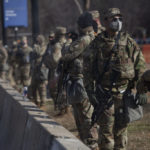
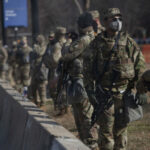
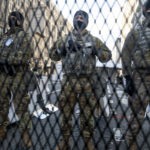
Thousands of National Guard troops from across the country descended on D.C. this week to support heightened security measures during the presidential inauguration. They’re staffing security checkpoints, protecting congressional leaders and helping with crowd control. Their constant presence prompted some of them to even nap on the floor of the Capitol in the days after it was breached by far-right extremists.
While some GOP House members complain about having to walk through metal detectors, National Guard troops spent night sleeping on marble floors of the Capitol. pic.twitter.com/7odvIkoBOQ
— Greg Miller (@gregpmiller) January 13, 2021
The soldiers — more than 21,500 of them— come from all 54 guard services in the states, territories and District of Columbia, according to Maj. Matt Murphy, a spokesman for the National Guard Bureau.
For some residents, the mobilization raises public health concerns, as the region and the country deal with the coronavirus pandemic. The United States passed 400,000 deaths from the coronavirus on Tuesday, including more than 13,000 in the D.C. region.
Are the thousands and thousands of national guard members practicing safe social distancing in DC? Wearing a mask or two? Were they all tested before arriving? Are they sanitizing the tanks, weapons, ammo, etc? Asking for a friend
— Kelly Dyer (@KellyDy31987183) January 19, 2021
@NationalGuard in DC not wearing masks should be ashamed! When I asked a group on MA Ave NW “you don’t wear masks?” They laughed and said”No.”Our mayor @MurielBowser stresses the importance of mask wearing yet only some are wearing them.They should be doing their job safely.
— ella mcbride (@ellamcb4448) January 19, 2021
The convergence of so many people from out of town could present a coronavirus risk, says Dr. Leana Wen, an emergency physician and visiting professor of public health at the George Washington University.
“There’s so much virus spread happening all over the country, and it’s very likely that of the tens of thousands of individuals who are going to be guarding the Capitol, there will be individuals who don’t know that they have coronavirus, who are asymptomatic, who already are infected,” Wen told WAMU/DCist. “By the time that they arrive, if they are then gathered in close quarters with others, there’s a chance that they could transmit coronavirus to one another, not know it, and then go back to their home communities and spread it to colleagues, family and friends.”
Wen said she worries less about people catching COVID-19 in formal settings like staffing a security checkpoint — and more about informal ones, like hanging out in a hotel bar after hours.
Murphy said in an email that National Guard members are “encouraged to follow and adhere to CDC guidelines, wear masks and practice social distancing when the mission dictates.” Though he noted that in some cases the work the soldiers are tasked with may “limit social distancing.”
He also said that coronavirus testing and treatment is available at the many military medical facilities in the D.C. region, should any National Guard member become sick. The National Guard is not performing COVID-19 surveillance testing on soldiers arriving in D.C.
“We appreciate everyone’s concern over the health and well-being of our soldiers and airmen. We want to be as safe and careful as possible,” Murphy said. “At the same time, it’s our sworn duty to answer the call when our citizens and our nation needs us.”
Prior to their deployment in D.C., the soldiers are expected to follow local public health guidelines, Murphy said. When they arrive in the District, they answer questions designed to screen for coronavirus symptoms and have their temperatures checked.
Those precautions may help discover symptomatic infections, but wouldn’t find asymptomatic ones— which represent “more than 50% of the spread,” according to Wen.
Wen said she understands that the speed of the National Guard’s deployment to the District after far-right extremists stormed the Capitol building made strict adherence to coronavirus precautions impossible.
“It’s really hard because ideally, if people are going to be traveling from other places and then gathering, everybody should go through testing, a quarantine period and ideally another test,” she said. “That’s not feasible or practical in this case.”
But she still hopes the soldiers can adhere to public health travel guidance after their trip to the District.
It is not clear how many National Guard soldiers currently deployed in the District have received a COVID-19 vaccine. Murphy said the bureau can’t release personal medical information for soldiers.
The public health effects of the National Guard deployment or inaugural crowds on the D.C. region community won’t be immediately clear, given the length of time it takes for people who get infected to begin showing symptoms. And even then, according to Wen, it may be difficult to link new infections with the inauguration because the spread of the coronavirus is so uncontrolled.
“There is so much spread happening all over the country. We also have these new variants that appear to be even more contagious, thus increasing the chance of coronavirus infection,” she said. “So I’m not sure that we can tell at this point exactly how much of the overall infection was due to what contribution from one event.”