Elliot C. Williams
 Jordan Pascale
The acting chief of the Capitol Police apologized on behalf of the department to Congress on Tuesday, outlining the department’s security failures during the Jan. 6 insurrection at the Capitol.
In a private meeting with the House Appropriations Committee, acting chief Yogananda Pittman said the department “failed to meet its own high standards as well as yours.” Pittman was not the acting chief during the attack.
According to testimony obtained by the New York Times, Pittman said that about 1,200 officers were on duty during the attack on the Capitol, a number she said was “no match for the tens of thousands of insurrectionists.”
The Capitol Police knew in advance that the attackers planned to be armed, according to the testimony.
“By January 4th, the Department knew that the January 6th event would not be like any of the previous protests held in 2020,” read Pittman’s testimony. “We knew that militia groups and white supremacists organizations would be attending. We also knew that some of these participants were intending to bring firearms and other weapons to the event. We knew that there was a strong potential for violence and that Congress was the target.”
Following the closed-door briefing, House Appropriations Committee Chair Rep. Rosa DeLauro said in a statement that the attack was preventable.
“The law enforcement agencies tasked with protecting the Capitol did not act on this intelligence or adequately prepare for the looming threat,” DeLauro said. “There were also profoundly troubling lapses in coordination, particularly as it relates to the deployment of the National Guard, which prevented a speedy response once the threat materialized.”
The Capitol Police Board, a panel that oversees the department, declined an initial request for support from the National Guard days before the attack, and took more than an hour to approve Guard intervention the day of the attack, the Times reported.
Two of the three voting members of the panel resigned following the insurrection. Only one member hasn’t resigned – the Trump-appointed Architect of the Capitol, J. Brett Blanton.
Maj. Gen. William Walker, the commander of the D.C. National Guard told the Washington Post that the Pentagon restricted his authority ahead of the attack. The new restrictions required him to get the highest-level approval before dispatching troops to the Capitol, costing precious time on Jan. 6., he said.
Steven Sund, who resigned as the Capitol Police chief following criticism about his handling of the events, said his requests for additional National Guard support were denied as well.
It’s unclear what exactly the future of security at the Capitol will look like. But both Pittman and the Acting House Sergeant at Arms are pushing for more physical security at the complex. Beyond the unanswered requests for more support, Pittman said the department was underprepared for the violence on a structural and staffing level. The Capitol campus is open and welcoming to visitors by design, she said in her statement, making it “difficult to fortify.”
“I believe the multiple reviews, after actions, and investigations currently underway will conclude that the Capitol’s security infrastructure must change and that the Department needs access to additional resources – both manpower and physical assets,” Pittman said
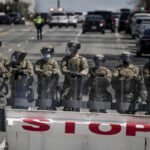
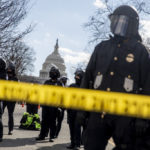
In the weeks that have followed the attack, downtown D.C. remains militarized, as thousands of National Guardsmen are scheduled to remain in the city through March. The fence surrounding the grounds, erected on Jan. 7 and now supplemented with razor wire, will be up until at least February 7, but will likely remain longer as the Capitol has faced new threats coinciding with the impeachment trial of former President Trump.
The security cordon remains, barbed wire and all, around the U.S. Capitol. #rundc #bikedc pic.twitter.com/M6JOuFU440
— Edward Russell (@ByERussell) January 26, 2021
With Democrats in control of Congress and with Biden in the White House, calls for D.C. statehood have increased – especially in the aftermath of the insurrection, as local residents are reminded of the limited power D.C. officials have to intervene during demonstrations on federal property. (D.C. Mayor Muriel Bowser, who does not have control of the D.C. Guard, requested additional troops, but federal authorities delayed the response.)
Many residents argue that law enforcement misjudged the mob’s intentions based on their race and that the Capitol grounds should not become a fortress because of those failures. In other words, locals say they are being made to pay for the federal government’s gaps in security.
Bowser has opposed more fencing but says the District will need to grapple with a “new posture” on security after the attack on the Capitol.
An Advisory Neighborhood Commission in the Capitol Hill area is calling for the removal of the fences.
Meanwhile, increased fencing and security at the White House remains more than six months after the protests after George Floyd’s killing. Authorities closed off Lafayette Square in response to the demonstrations.
In response to a question about when or if the perimeter around Lafayette Square will come down, the U.S. Secret Service said in a statement that it does not comment on its methods.