Every January, a phalanx of volunteers heads out into the night to find people experiencing homelessness. The annual point-in-time count, which happens across the country, helps inform the decisions that policymakers and social service providers make as they work to solve the homelessness crisis.
But as with everything else, the pandemic dramatically reshaped this year’s count. The annual kick-off event was canceled and instead smaller groups of fewer than 25 people met up in their respective neighborhoods. Volunteers were required to take safety precautions — wearing face masks, shields, and gloves. They carried extra masks to hand out to people. Their surveys now included questions about vaccines.
It has also made the count more important than ever.
“We’re experiencing a housing crisis,” says Leta Davis, outreach manager at Pathways to Housing DC. “We’re also on the edge of a precipice, with the potential for the eviction moratorium to be lifted [it was recently extended through March 31]. So I think it’s really important to get accurate information around what people’s experiences are now and our baseline as we might be seeing the housing crisis deepen.”
The 2020 count found that the overall number of people experiencing homelessness in D.C. had decreased by 2.2% from 2019. But the survey took place just a few weeks before COVID-19 reshaped every conceivable aspect of life, and last year’s report immediately warned that homelessness in the region was likely to see a sizable increase amid the ensuing economic crisis.
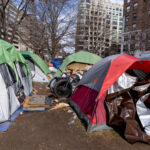
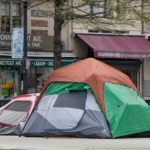
Meanwhile, life on the street has been made even more unbearable by the pandemic. Unhoused Washingtonians no longer have access to libraries and other public spaces that have offered services. There are fewer passersby offering assistance. The stresses and indignities of the city’s homeless shelters are now compounded by fears of contracting the coronavirus.
The city will begin rolling out vaccines in low-barrier shelters on February 1, and volunteers with the point-in-time count were instructed to ask people if they would like to get the injection. They asked for contact information for organizations to follow up when the vaccines become available.
The annual survey, which is required by the U.S. Department of Housing and Urban Development for any entities that receive federal funding for homeless assistance, also includes questions on demographic information, experiences with the justice and child welfare systems, experiences with violence, mental health and substance use, as well as veteran status.
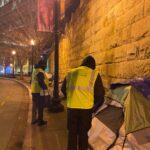
At the Latin American Youth Center drop-in center on 15th St. NW, a group of approximately 15 volunteers arrived just past 8:30 p.m. to pair up and receive a map of the streets they’d be surveying.
There, program manager Andrea Bernad Barnola gave the group supplies, including snacks to hand out and $10 Visa gift cards to offer to people for taking the survey, as well as flashlights, which she discouraged volunteers from flashing into people’s tents.
“That’s their home,’” she said. “Never shake a tent. Just say ‘hey, hello, are you there?
She encouraged people to call her if they came across someone who would not wake up or did not look warm enough on a night where temperatures dipped into the 20s, warning of the signs of hypothermia. She also told volunteers not to perform a survey if someone refused to wear a mask.
Alexandra Bobak, Eskayra Pagan, and Ann Hoffman were assigned to the Columbia Heights area. They stopped to talk to people sitting on steps, in alleyways, and at bus stops along 16th St. Of the roughly 10 people they surveyed in an hour, all were people of color, mainly Black or Hispanic.
Davis, of Pathways to Housing DC, says 85% of the non-profit’s clients are African American.
“People of color are absolutely disproportionately represented amongst people experiencing homelessness,” she says. “Which is absolutely a reflection and a reminder of the inequalities and systemic racism.”
At one point, Hoffman, Bobak, and Pagan offered to call the emergency shelter hotline for a man experiencing homelessness, who declined to give his name to DCist. When the hotline told them the option available tonight was a recreation center, he declined. There have been multiple outbreaks of COVID-19 in group settings, and residents experiencing homelessness have experienced disproportionately high rates of cases.
Data from this year’s count won’t be available until April or May. But, for Bobak, who works for Ward 1 Councilmember Brianne Nadeau, taking part in the survey was a way to get information that policymakers, including her office, can use to better provide services.
Elisabeth Young with the Community Partnership for the Prevention of Homelessness, which leads the count, echoed that point.
The data collected Wednesday, “bubbles up into conversations at those policy tables and really influences the direction that some of the policy work takes,” Young says.