 Daniella Cheslow
 Margaret Barthel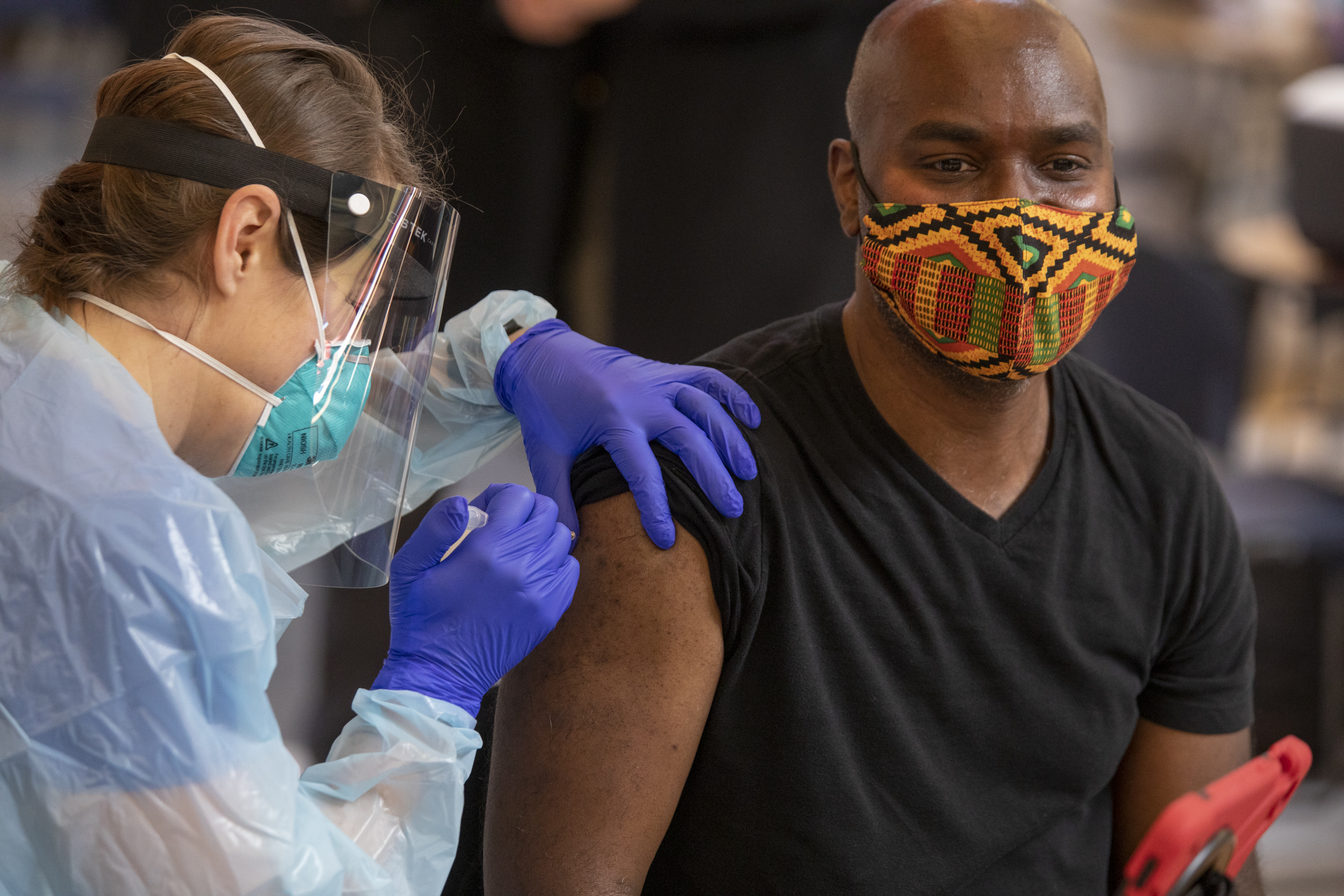
In mid-January, Kripa Patwardhan of Herndon, Va., signed up for a vaccine appointment, like thousands of other Fairfax County educators. Hers was slated for early February. This week, Patwardhan, 34, learned her appointment was canceled when she read an announcement from Inova Health System.
“It was just a mass announcement that said everybody who hasn’t already gotten their first shot, your pending appointment is canceled,” she recalled.
Her experience is one of many snags in Virginia’s vaccine rollout, which has lagged behind other states in getting doses into arms. More than half a million doses appear to be sitting unused, according to Centers for Disease Control and Prevention data. Demographic data from the Virginia Department of Health suggests that the majority of doses are going to white patients despite the high infection and death rates among people of color, though thousands of other vaccinations didn’t report any demographic information. Waitlists are ballooning, web sites are crashing, and local leaders say they need more help.
Virginia Gov. Ralph Northam says he hopes to harness more doses and financial support from the federal government, together with improved state management, to create a smoother path going forward. Northam acknowledged the “bumpy” vaccine program on Wednesday.
“I feel the frustration out there. I also, as a medical provider, I feel the urgency,” Northam said.
He announced several changes: first, the federal government would increase Virginia’s doses by 16%, a boost he said would be locked in weekly.
To help move vaccines more efficiently within the state, Northam said VDH would soon unveil a centralized signup via phone and web, and he urged hospitals to release extra doses they were holding onto for second shots. With these changes, Northam said the state would soon ramp up shots from 26,000 to 50,000 per day and will be on track to vaccinate its entire population by the end of summer.
“It will take time to reach everyone, but we are reaching more people every day and the pace is increasing,” Northam said.
An ‘incredible demand’ and a limited supply
Kripa Patwardhan’s experience in Fairfax County underscores the challenges in Northern Virginia. She is now on a waitlist of more than 160,000 people eligible for vaccines in her county — that’s more than the number of doses the entire state receives each week. Neighboring counties, too, have thousands of people waiting for shots and only a trickle of daily doses to offer.
The Prince William Health District says its waitlist is at least 25,000 people long. Loudoun County’s waitlist is double that, according to a county spokesperson. Alexandria’s exceeds 20,000 people, said Natalie Talis with the Alexandria Health Department, and a jump in federal supply will only translate to an additional few hundred doses per week.
“It certainly helps but doesn’t match the incredible demand of eligible residents that we’re experiencing,” Talis wrote DCist/WAMU.
Jeff McKay, chairman of the Fairfax County Board of Supervisors, said the long waitlists are themselves a symptom of a problem. In early January, he joined other Northern Virginia leaders to ask for permission to open vaccines to people 75 years and older. However, he said the state expanded eligibility to people 65 or older just a week later — causing a “huge compounding effect” on the vaccine waitlist.
“It doesn’t do me any good to make more people eligible if they don’t have the vaccine to administer to them,” McKay told DCist/WAMU. “We expected that there’d be better coordination between when new phases begin and availability of vaccines.”
Northam said the county-level confusion had roots in federal policy. In mid-January, the Trump Administration told states to open eligibility to anyone at least 65 years old. Northam suggested he had no choice.
“Fifteen days ago, the outgoing secretary of health told states, ‘Open up eligibility to everyone 65 and over. We’ll send more doses. If you don’t expand eligibility, we’ll reduce your supply,’” Northam said Wednesday. “Then two days later, states learned that there were no more doses to release. That made a confusing situation even more confusing across the entire country.”
As waitlists grew, the Virginia Department of Health changed its distribution of vaccines. Where it initially channeled federal supplies to both hospitals and local health districts, the state ended its supplies to hospitals last week. This impacted thousands of educators in Fairfax County, including Patwardhan, along with 10,000 people in neighboring Arlington County.
Efforts continue to vaccinate teachers, but they are piecemeal. Inova announced it had secured “a limited number” of vaccine doses and would work with the Fairfax County Health Department and the school board to give the vaccines to some educators through the weekend.
“Unfortunately this limited supply allocation will not cover everyone who is currently in an eligible group,” the hospital system said in a statement.
Patwardhan said she still has not heard about her appointment being rescheduled. She said was disappointed, but acknowledged that her work as a homebound teacher put her at less risk than some of her colleagues.
On Wednesday, Prince William County announced it would vaccinate 2,400 teachers over the weekend.
‘Get them out and get them into arms now’
In addition to the boost in federal supplies, Northam estimated that Virginia could quickly give out an extra 40,000 shots over the next few days by “shifting inventory around” at hospitals. That’s because most Virginia hospitals succeeded in giving their workers a first dose of vaccine, Northam said.
“There’s no excuse for first doses to be sitting unused. Get them out and get them into arms now,” he said. “We’re also working with hospitals and local health districts to make sure they’re not holding on to too much supply of second doses, especially if they won’t need it for several weeks.”
Additional changes Northam announced this week will have a more lasting impact. He unveiled a new dashboard tracking vaccine distribution; as of Thursday, Virginia has received almost 1.2 million doses of the coronavirus vaccine, but only about 600,000 of those have been delivered. Virginia’s percentage of doses administered has consistently ranked low nationally, though on Thursday it had improved to 28th place, ahead of Maryland and behind D.C.
With the new dashboard will also come clarity about why so many vaccines are unused. The state’s vaccine coordinator Dr. Danny Avula said about 260,000 of Virginia’s unused vaccines are second doses awaiting people’s return appointments. Others have been set aside for long term care facilities, Avula said, and some may have been administered, but not yet reported to the state.
“We’re closing that gap and catching up,” Avula said.
Another hole in Virginia’s state health data is information on the race or ethnicity for more than half of the people who got shots; among those who reported their demographics, about 72% are white. Northam said Health Commissioner Norman Oliver contacted health districts to implore them to collect race and ethnicity data. Northam also pointed to an emergency bill moving through the General Assembly that requires health providers to collect demographic data on vaccine recipients. It also allows for medical students to administer vaccines, given appropriate training, which should help ramp up shots.
Additional help is coming from the federal government. Virginia Sens. Tim Kaine and Mark Warner, both Democrats, announced Tuesday that the Federal Emergency Management Agency would provide $2.3 million to support COVID-19 vaccine distribution in Arlington County. In a statement, the senators said Arlington was the first of Virginia’s counties to apply for and receive federal dollars for vaccine support.
Separately, U.S. Reps Don Beyer, Gerald Connolly and Jennifer Wexton, all Democrats, asked FEMA to set up a community vaccination site in Northern Virginia as part of the Biden Administration’s plan to create 100 mass vaccination sites across the U.S. They noted a study from Carnegie Mellon University that found some 92% of Arlington residents would get a vaccine, with similar enthusiasm in neighboring Northern Virginia jurisdictions.
“Our localities are eager and ready, and they have the capability to vaccinate thousands more people than they currently have vaccine supply for,” the three said. “Staffing is not the limiting factor, supply is.”
Virginia’s road ahead
Given the supply bottlenecks and confusion that have plagued the vaccine rollout so far, University of Virginia health business expert Vivian Riefberg urged people to be patient. She noted that the vaccine rollout is “one of the greatest mass mobilizations we’ve ever had.”
She said a successful Virginia vaccine program would depend on tight coordination between federal, state and local authorities; it would require smooth statewide vaccine distribution, and it would need a robust reservation and communication system. Ideally, that system would notify patients when they were eligible and allow them to book their slots weeks in advance, while tracking whether they followed through. Riefberg stressed that Virginia would need a system that adapted to its diverse populations.
“Rural Virginia…may have a different configuration of where they need to be than in Arlington, Virginia, outside of Washington, D.C.,” she noted.
Virginia’s woes are hardly unique; however, some states, including neighboring West Virginia, have gotten more of their doses out faster. Epidemiologist Amira Roess at George Mason University credited West Virginia’s small population and focus on small, independent pharmacies that understood their local populations.
Roess hesitated to speak ill of Virginia’s vaccine efforts.
“Like many, Virginia is learning and responding as it moves forward, making errors along the way,” she wrote to DCist/WAMU. “Given the history of public health support in this country unfortunately this was unavoidable.”
In the meantime, vaccines remain a coveted rarity. One employee of Fairfax County Public Schools told DCist/WAMU she signed up for an appointment for a vaccine at Inova in early January after she heard education workers would be eligible as essential employees. Shortly after, the web site crashed. Many of her colleagues who secured slots later saw their appointments canceled, but this worker said she got her first jab on Jan. 16 and will soon receive her second. Then she asked not to use her name.
“I don’t even want to say it out loud, that I got the shot,” the woman said. “I don’t even want to share that with my coworkers. I don’t want them to feel a certain way.”