Martin Austermuhle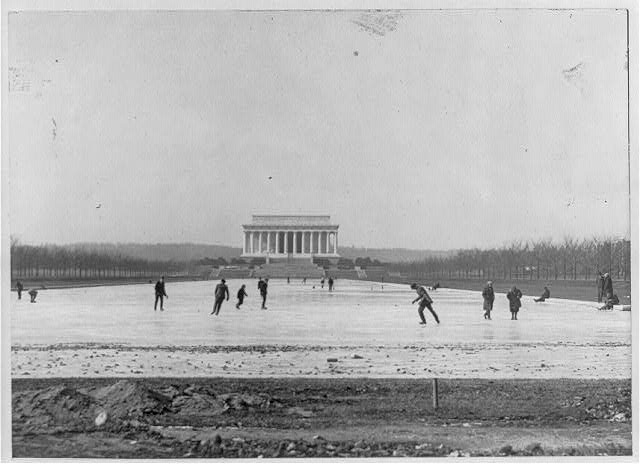
Last weekend’s snowstorm marked the return of a winter wonderland to the Washington region, which has gone largely snowless since at least 2019. The pent-up snow energy was evident: Kids went sledding on just about any incline they could find (except on Capitol Hill; thanks, insurrectionists!), people built snowmen and women, and there was a massive snowball fight on the National Mall.
But in the midst of it all, the National Park Service reminded everyone of one thing that didn’t happen: ice skating on the Lincoln Memorial’s Reflecting Pool. “It’s not allowed anymore, but people used to skate & play hockey on it. At 2,030 feet long & 167 feet wide, that’s a really big rink!” tweeted NPS.
Indeed it is. And at one point many years ago, there actually was a push to turn the Reflecting Pool into a permanent ice-skating rink every winter. But before we get to that, let’s take a glide down memory lane to a simpler time when Washingtonians would freely ice skate on the Reflecting Pool.
In 1925, The Washington Post reported that the federal government organized an ice-skating carnival on the Lincoln Memorial’s Reflecting Pool, taking inspiration from a similar gathering that had taken place six years before on the Tidal Basin and attracted 15,000 people. The carnival on the Reflecting Pool, which was filled with water just as the city suffered through a cold snap, was to feature more than just ice-skating.
“As an added feature… a baseball game will be played on the ice between the Polar Bears and the Snow Birds, two organizations that played years ago,” the Post reported. “The grand climax will come… with a great costume carnival in which prizes will be awarded for the best, most unique and funniest costumes.”
But the carnival didn’t go smoothly, according to a followup story from the Post.
Anticipating the return of winter sports in Washington, hundreds of ice-skating fans mushed through the slush to the Lincoln Memorial reflecting pool yesterday only to learn the scheduled ice carnival had to be postponed because of the soft ice … In the morning the ice was solid and smooth, and many came to practice, but by the afternoon, when the events were to start, the sun had played havoc with the surface.
That was a consistent issue in years to come: If the weather wasn’t cold enough for long stretches of time, ice-skating on the Reflecting Pool (or any other body of water; officials had to specifically ban skating on the city’s reservoirs) could be a dangerous undertaking — particularly if large crowds turned out, which often happened.
But in 1964, then-Secretary of the Interior Stewart Udall decided to think big: He supported a proposal from a pair of D.C. architects for $3 million in upgrades that would allow the Reflecting Pool to be turned into an ice-skating rink — the largest in the world, no less — every winter. The rink would be the centerpiece of “an annual winter festival that might include pavilions along the Mall for restaurants, skate rental services and other facilities,” per the Post. (An alternate proposal would have seen eight to 10 hockey-sized rinks built across D.C. for the same price.)
That proposal proved, well, somewhat controversial. In a letter to the Post, one D.C. resident declared that any such rink would “desecrate the Reflecting Pool” and serve as a clear sign of the capital’s “deathly surrender to a tyrant materialism which worships only the functional purpose” instead of the symbolic value of the city’s monuments and memorials.
Udall’s rink never came to pass. A feasibility study was delayed, and there were concerns over the method of actually freezing the water to create ice. (It would have employed massive air-conditioning units from nearby federal buildings.) The idea to build a 50,000-square-foot rink at the foot of Capitol Hill was scuttled, too. That one was sunk by the U.S. Commission of Fine Arts, whose chairman declared that people shouldn’t have fun anywhere near Congress. “It would come to have the quality of an amusement area in what is essentially a monumental area,” he was quoted as saying.
These days, when it does get cold enough for the Reflecting Pool to actually freeze over, some people still try to skate on it — and they’re promptly chastised and chased away by U.S. Park Police. The closest option is the small rink at the National Sculpture Garden (which remains closed because of the pandemic), or rinks at the Georgetown Waterfront (also closed) or Capitol Riverfront (you guessed it: closed). If it gets cold enough for long enough, many Washingtonians still make their way to the C&O Canal, where it is legal to ice skate — though at your own peril.