 Mikaela Lefrak
The protests for racial justice that swept across D.C. last summer marked a new period of concentrated Black activism in the city. Watching the protests, historian George Derek Musgrove knew it was time to get to work.
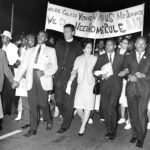
Musgrove is the co-author, with Chris Myers Asch, of Chocolate City: A History of Race and Democracy in the Nation’s Capital. On Monday, the first day of Black History Month, Musgrove launched a new website that explores an antecedent to today’s Black Lives Matter movement and push for racial justice — the Black Power movement.
Musgrove wanted to tell the story of how the District became a national center of Black Power organizing, just like New York, Los Angeles, Newark, and Chicago. At times militant, local Black Power activists organized marches and civil disobedience campaigns and pushed a different vision for urban renewal than the one espoused by conservative politicians at the time.
Their activism led to real social change in the city. By the early 1970s, many Black Power activists like Marion Barry had become elected officials, business owners or nonprofit leaders. Though the term “Black Power” can encompass many forms of activism, Musgrove defines it by its three core tenets: Black self-determination, self-love and self-defense.
His new website grew out of a need he noticed when he and Asch were giving book talks for Chocolate City. Their audiences had what Musgrove calls “an immense hunger” for stories from the early 1960s through the late 1990s.
“The reason D.C. became the Chocolate City in the local and national imagination was because there was a group of talented activists here who transformed the numbers of the Black majority into actual Black political power,” he says. “And no one had ever written a standalone study of it. So I said, okay, let’s see if this could work.”
Musgrove’s project features a lengthy introductory essay and four interactive maps of the city. Visitors can explore 185 different pins on the maps; each one tells a story about the city’s Black Power movement.
Many of the best-known stories of Black activism and culture in the second half of the 20th century tend to center around certain hubs, like the U Street Corridor and Howard University. Through the use of maps, Musgrove hopes to show visitors how the Black Power movement touched every corner of the city, from Malcolm X Park in Northwest to Barry Farm in Southeast.
“There’s all these really important groups that operated east of the river,” Musgrove says, tossing out names like the African Heritage Dancers and Drummers and the Southeast Neighborhood House. “I wanted to make sure they were part of this conversation.”
But mapping social movements isn’t as straightforward as, say, mapping a bus route. Many of the radical organizations Musgrove studied didn’t have a fixed address. Take the Zulus, a militant group that burned businesses along U Street following Martin Luther King Jr.’s assassination in 1968. The underground group never had a public central gathering place, so Musgrove dropped a pin for them right in the middle of U Street. “There are a lot of organizations that, quickly frankly, don’t want to be found,” he says.
The Black Power movement gained steam in the 1960s and reached the peak of its influence early in the following decade. Some of the movement’s leaders organized shootings and bombings when their demands went unaddressed.
Then, in the mid-’70s, a massive economic recession hit. Black Washingtonians saw the jobs and political sway they’d fought so hard for begin to slip away. Meanwhile, their conservative opponents from the previous decade were gaining national power. President Ronald Reagan opposed D.C. self-determination and strengthened policing and prison programs to combat the crack epidemic.
“Many of those old activists dusted off their old marching shoes and restarted their organizations and got back out in the streets,” Musgrove says. His research on this second stage of activism forms the basis of his forthcoming book on the resurgence of Black activism in the 1980s and 1990s.
“There are activists in the streets today who are looking for models for how to bend the society to their needs,” he says. “I’m hoping that local Black Lives Matter activists will look at this and do a compare-and-contrast, and take the good and leave the bad of this previous movement.”