Jacob Fenston
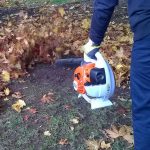
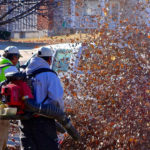
In leafy neighborhoods, it can be an almost ever-present soundtrack: at any given moment, somewhere nearby, someone is probably blowing leaves or grass clippings with a noisy gas-powered leaf blower. Stuck at home during the pandemic, residents say it’s even more noticeable.
“It’s been infuriating,” says Chris Homan, who lives in Bethesda, with two kids in remote learning. “Sometimes it’s two or three blowers in the same property for over an hour,” he says. “They’re blowing all day. They start in the mornings, they go in the evenings. It’s ridiculous.”
Homan is one of the Montgomery County residents behind an effort pressuring county officials to ban gas-powered blowers. They’ve launched a petition, gathering nearly 3,000 signatures, and created a website. They’re inspired by neighboring D.C., which passed a ban on gas-powered leaf blowers in 2018, though it doesn’t take effect until 2022.
It’s not just about the noise, Homan says. He cites a statistic from the California Air Resources Board, frequently mentioned by leaf blower opponents: one hour of use of the best-selling gas-powered leaf blower produces the same amount of air pollution as driving a Toyota Camry from Los Angeles to Denver (a 15-hour drive, depending on traffic). In fact, the agency estimated that in the early 2020s, pollution from leaf blowers and lawn mowers would surpass pollution from passenger cars in Southern California, as newer, more efficient cars hit the road.
Leaf blowers use two-stroke engines, which are smaller and cheaper than the four-stroke engines used in cars, but more polluting. Leaf blower exhaust contains carbon dioxide, contributing to climate change, as well as high levels of cancer causing compounds such as benzene, and the chemicals that form smog.
Montgomery County Council President Tom Hucker was initially skeptical of the movement to ban leaf blowers.
“I’ll confess, I thought was sort of a first-world issue,” says Hucker. “The fact that they have both environmental and health consequences obviously makes it a little more compelling and more urgent.”
Hucker says county staff is looking into the issue, though no legislation has been proposed. “I’m sure we will go in this direction at some point. Question is, through what process and how quickly,” says Hucker.
Hucker says he wants to also hear from landscaping business owners about how a ban would impact their businesses. During debate over D.C.’s leaf blower ban, some landscapers and industry representatives said the law would cripple the industry, raising costs for consumers and creating a labor shortage as non-gas alternatives are more labor-intensive.
Richard Bajana, who owns a landscaping business in Montgomery County, offers both traditional gas-powered landscaping as well as organic service, using electric equipment. He says he charges 20% to 25% more for the electric service, depending on the property, because of the additional labor that’s needed.
Bajana says he supports a ban on gas-powered equipment. “I think this is the right way to to go,” he says.
But he doesn’t see it as a complete solution to residents’ complaints about noise: powerful electric leaf blowers can be almost as noisy as gas-powered ones, he says. And they don’t do quite as good of a job. “The final product, the final service is not as detailed,” says Bajana.
Bajana also worries unscrupulous landscapers could take advantage of a ban, offering cheaper service while not following the rules. “There are some landscapers, they don’t have any license, and they just go with a pickup truck and they can do the work in a very shady way. Maybe it’s going to be an issue for contractors like us — we have a license, we pay insurance and we comply with the law,” he says.
Two jurisdictions have already passed bans on leaf blowers — Chevy Chase Village and the Town of Chevy Chase. Meanwhile, in D.C., some residents are pushing for a temporary ban on all leaf blowers, including the electric variety, during the pandemic.