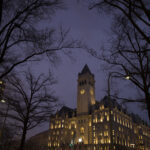
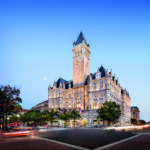
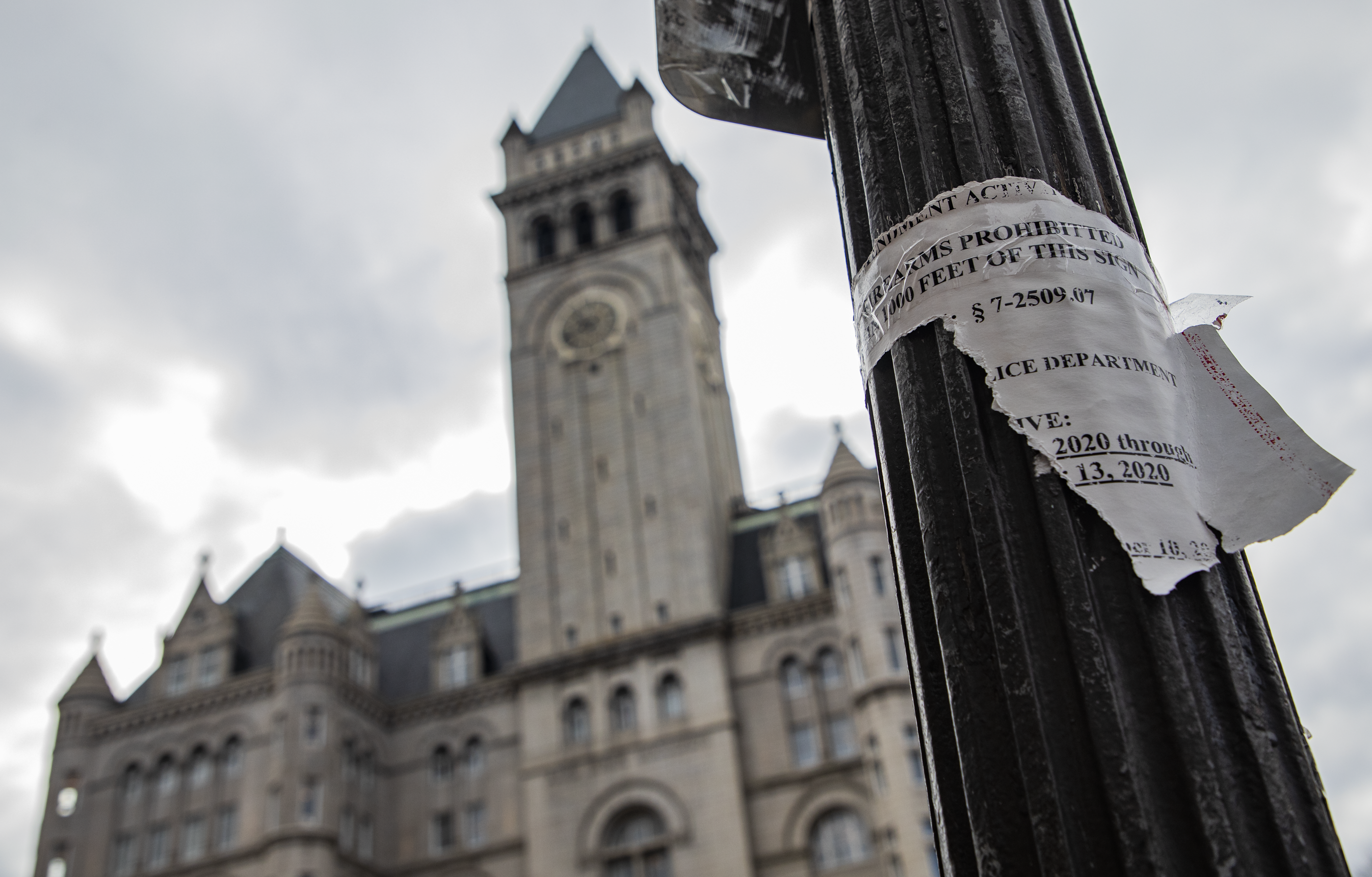
A valet watched as a lone black SUV pulled out of the driveway and onto Pennsylvania Avenue. On a nearby lightpost, a tattered police flyer from an old protest read “First Amendment Activity Area”. Behind the 263-room luxury hotel’s barricaded entrance on a recent morning, hardly a soul lingered outside the Trump International Hotel.
Donald Trump has decamped from the District, but his flagship hotel in the historic Old Post Office building remains, an ever present reminder of the former president’s fraught relationship with local Washington. Yet as the hotel struggles with dwindling income amid the pandemic and an apparent loss of allure after its owner’s exit from the White House, its future is unclear.
Financial disclosure reports filed last month show the hotel took a 63% hit to its revenue in 2020, dropping to roughly $15 million.
The organization has tried to sell the hotel’s lease, but the effort was put on indefinite hold last year after reportedly failing to draw any bids close to the asking price of roughly $500 million. Experts say it’s unlikely Trump will find a buyer at that price, meaning his options are either to sell the lease at a deep discount or keep trying to turn a profit.
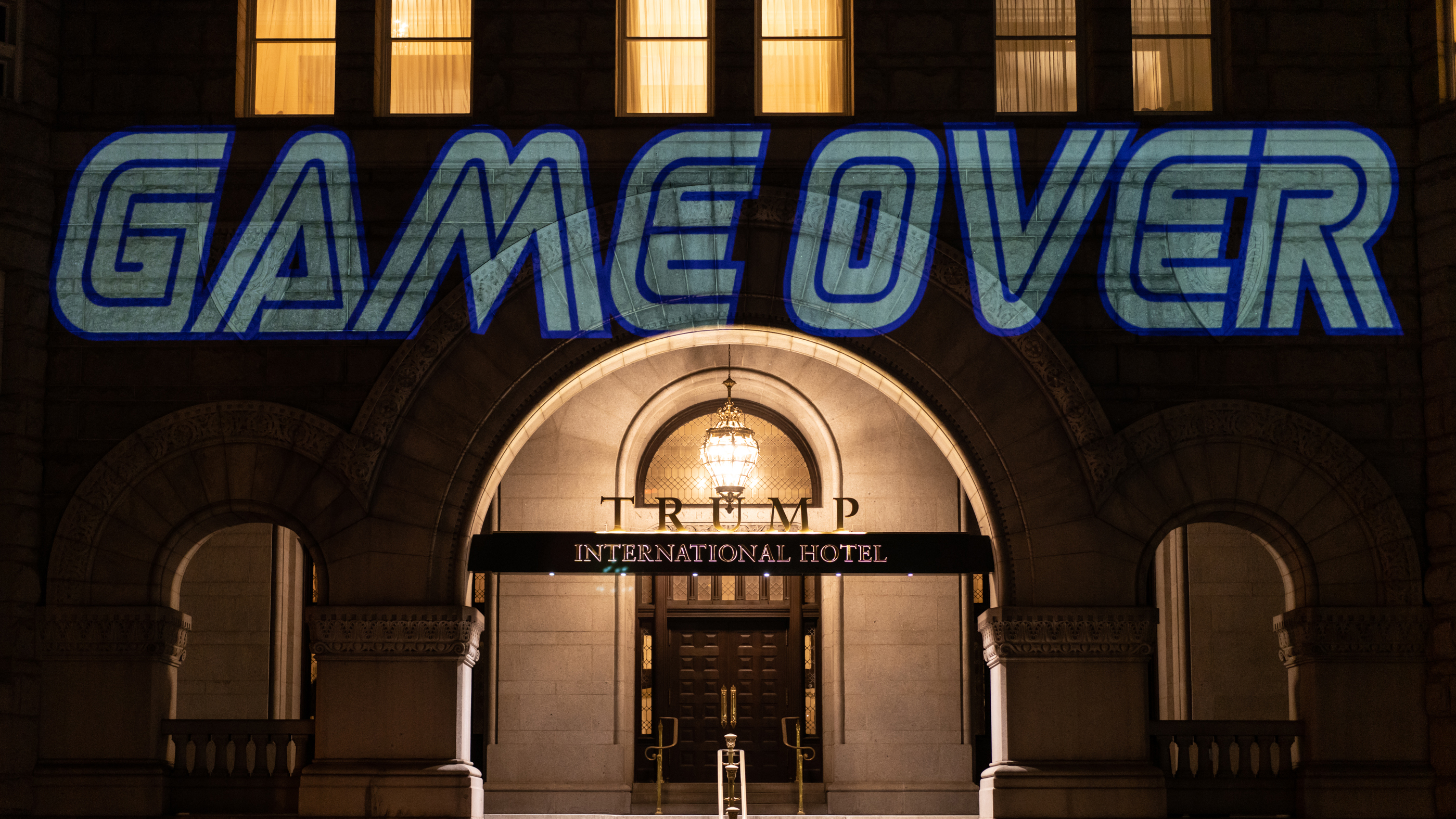
For the past four years, the site has been as much symbol as hotel, a remarkably straightforward physical manifestation of the extreme poles of the Trump presidency. It not only served as a gathering place for MAGA-hat wearing fans and rotating administration officials alike, the steakhouse inside was literally the only D.C. restaurant that Donald Trump dined at over the past four years. On the flip side, the hotel was a magnet for the president’s many local detractors. It was not only a regular stop for sign-wielding protesters, the building became a literal canvas for the projection of anti-Trump messages.
But with a new administration in town and Trump ensconced in Florida, the hotel has lost its gravitational center.
“It feels like a ghost town,” Anne, a nearby resident who declined to give her full name because she wasn’t authorized to speak on the record by her employer, told DCist as she walked past the hotel on Wednesday morning. “We’ve got to use this space and bring some good energy in.”
In her opinion, the hotel’s opening in 2016 marked the beginning of a dark era in the District. “It became a visual metaphor of [Trump] manspreading and trying to mark his territory,” she said. “Now that he has left, it no longer has that same power.”
A D.C. turf war
Even before the hotel began welcoming guests, the plaza and sidewalk became a hot spot for anti-Trump demonstrations, setting off a turf war that pitted activists against hotel management and law enforcement.
The area outside is a patchwork of jurisdictions –– the General Services Administration controls the plaza, the National Park Service runs the sidewalk, and the D.C. government owns the street. Around the time of the 2016 election, security officials closed off the sidewalk and plaza, and demonstrators were told they needed permission from the Trump Organization to protest there.
The move drew criticism from advocates who said the government was giving Trump preferential treatment by giving him control of public space outside his hotel.
“People really could not exit or enter from the front of the hotel because they essentially locked it down against the public,” says Mara Verheyden-Hilliard, executive director of the Partnership for Civil Justice Fund. The group sued the GSA, NPS, and D.C. for delegating the use of public land to the Trump Organization, and for refusing to disclose details on the arrangement.
In her view, the hotel is a symbol of the government’s infringement on people’s rights. “It became a barricaded fortress, and very iconic in that way, because it was clear how removed that entity –– as is everything else about the nature of the Trump administration –– was from the people,” she says.
She worries it sets a bad precedent, and that parts of the Old Post Office could remain closed off to the public if the lease is sold to another private entity. “This is Pennsylvania Avenue –– it’s America’s main street,” she says. “It shouldn’t be divvied up and sold off to the highest bidder under the guise of a public private partnership.”
Still, the barriers didn’t stop protesters from gathering outside, a regularstop on a roving circuit from the White House to Freedom Plaza to the Capitol and other federal buildings, throughout more than four years of large-scale demonstrations.
And in many cases, the hotel was the primary destination.
Demonstrators lined up “body bags” filled with paper to protest the administration’s response to the coronavirus pandemic. Human rights protesters came to the site wearing masks of leaders like Vladimir Putin and Kim Jong-un and carrying marionette puppets of the president. A street artist covered in gold paint posed as a “living statue” of Trump clutching a teddy bear in front of the hotel. He called the work “The Bunker.”
Meanwhile, local artist Robin Bell projected dozens of messages onto the president’s prized property, among them “PAY TRUMP BRIBES HERE”, “FELONS WELCOME HERE”, and “EXPERTS AGREE: TRUMP IS A PIG.”
After four years of resisting, “I’m tired physically and mentally,” Bell told DCist recently. “We just dealt with some maliciousness over the last four years. We’re going to spend a long time processing that.”
Endless controversies
During its namesake’s four years in office, the D.C. hotel regularly hosted lobbyists, GOP donors, and foreign officials hoping to gain influence within Trump’s administration. Even before Trump was inaugurated, a lobbying firm for the Kingdom of Saudi Arabia spent more than $270,000 at the hotel to lodge U.S. veterans sent to Capitol Hill on a crusade against a law opposed by the Saudi government. The lobbyists claimed they chose the hotel for its discounted rates.
It was only the beginning of the controversies that swirled around the hotel. In January of 2017, Trump charged his own inaugural committee $2,000 per night to stay there, nearly six times the average cost for a single basic room, according to Citizens For Ethics.
Within a year of the hotel’s opening, D.C. Attorney General Karl Racine sued Trump in an effort to prevent him from violating anti-corruption laws by receiving payments from foreign governments through the business. The lawsuit ended last week after becoming moot when Trump left office.
Members of Congress have made a total of 344 visits to Trump’s properties since he took office, including 284 visits to his D.C. hotel, according to a tally by Citizens For Responsibility and Ethics in Washington, a government corruption watchdog group.
The Trump hotel has also been sued by a Logan Circle wine bar for having an unfair business advantage and by a couple who claimed the hotel discriminated against them for being Black. A federal judge sided against the wine bar, but the discrimination lawsuit is still ongoing in D.C. Superior Court.
A dramatic shift in relations
But when the General Services Administration signed the Old Post Office’s lease over to the Trump organization in 2013, few could have imagined what was in store. The historic property, which was largely used as office space for federal agencies, was in dire need of a makeover, and Trump had yet to reveal his presidential ambitions. When GSA announced the deal, the agency said the lease would “serve the local community.”
Indeed, D.C. officials were on board. Long before she became a fixture of the resistance, D.C. Mayor Muriel Bowser tweeted a picture of herself grinning alongside Trump himself at the 2014 groundbreaking ceremony. “Can’t wait 4 DC Trump Hotel in ‘16,” the tweet said.
The consensus was that a new luxury hotel would be a boon for the District’s economy, generating tax revenue, boosting tourism, and reinvigorating a sleepy stretch of Pennsylvania Avenue.
Rebecca Miller, executive director of the D.C. Preservation League, says no one could have predicted this outcome. “The real estate folks, the GSA, were looking at certain criteria when they were looking at the proposal, says Miller. “They weren’t necessarily looking at whether or not the lease holder was going to be running for president.”
Still, some expressed concerns that a deal with the Trump Organization could come to a bitter end. In 2012, a D.C.-based development group that was competing for the bid to redevelop the Old Post Office warned GSA against working with the Trump Organization. “The public record reveals that Trump projects often fail, and fail with a great deal of negative publicity,” said BP-Metropolitan Investors in a protest that was later rejected by GSA.
D.C. Delegate Eleanor Holmes Norton, who spent 15 years advocating for the redevelopment of the Old Post Office building, tells DCist she was initially “very enthusiastic” about the deal.
“I had no idea that [Trump] would essentially convert [the hotel] into a place for out-of-town conservative organizations to meet,” she says.
When her office announced the redevelopment in 2013, Norton even gave a personal shout-out to Ivanka Trump, calling her a “remarkable young woman” in a press release.
Norton maintains she had a “good relationship” with Trump’s oldest daughter, who helped orchestrate the deal as executive vice-president of development and acquisitions for the Trump Organization. “My goal was to get this thing done, and that’s what she wanted –– to get it done,” Norton says. “So we were in sync at the beginning.”
Campaign finance records showed the Trumps also expressed an interest in local politics at the time the hotel deal was ironed out. Ivanka Trump made at least three contributions to Norton’s campaign: one in 2012 for $2,500, and another two for $2,600 in 2013 and 2014, according to data from OpenSecrets.org. And for her 2014 mayoral run, then-Councilmember Muriel Bowser received a check for $2,000 from both Ivanka Trump and her brother Eric, according to filings for the D.C. Office of Campaign Finance.
But within a few years, local officials had a very different type of relationship with the Trumps.
In December, D.C. Attorney General Karl Racine questioned Ivanka Trump under oath for several hours as part of a probe into the Trump 2017 Inaugural Committee’s alleged misuse of funds.
Despite the growing number of lawsuits and accusations swirling around the hotel, Norton says it’s unlikely the Trump Organization could be forced to surrender the lease to the Old Post Office.
“This is a capitalist economy,” she says. “You’d have to have cause to somehow take back or violate his lease.”
She doubts Congress could act to end Trump’s lease agreement with GSA, and has no plans to introduce legislation to that effect. “I don’t see a legislative recourse, not in an economy like ours,” says Norton.
The best possible outcome for the District, she argues, would be for the Trump Organization to sell its lease to another hotelier, and for Trump’s name to be removed from the building.
Originally the city’s main post office and later a federal office building, the Romanesque Revival structure survived two attempts at demolition. In fact, the D.C. Preservation League, formerly known as Don’t Tear It Down, launched in 1971 with the goal of saving the Old Post Office.
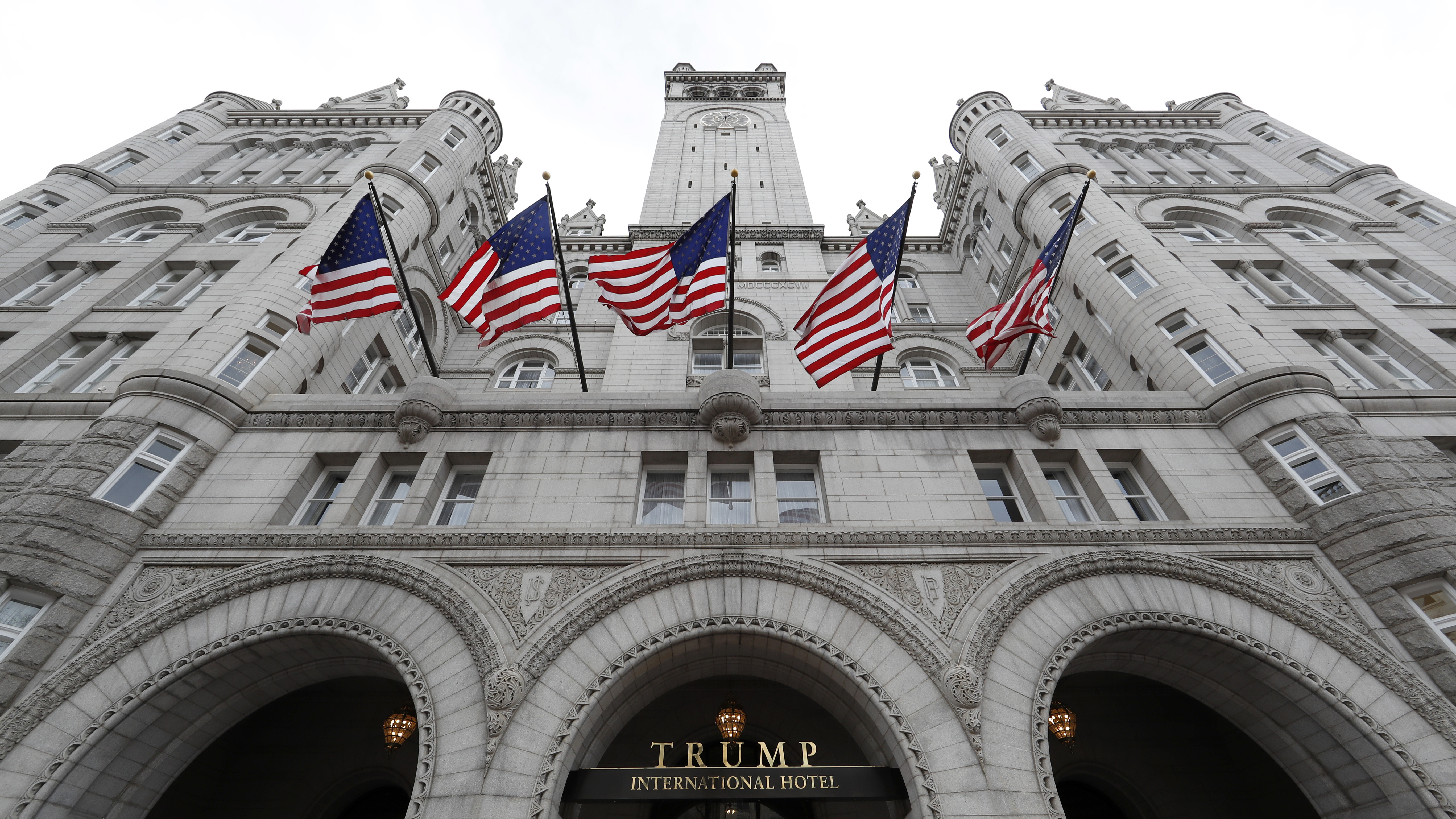
Politics aside, Miller says the Trump Organization did a great job renovating the building while preserving its most important historic features, like its arched windows and 315-foot clock tower. “They had a really skilled architect working with them on the property,” she says.
The hotel’s interior decor, replete with massive chandeliers and gold paint, has been called gaudy by some. But Miller says the core elements of the building were renovated following strict standards for historic preservation. “I think that any hotelier who takes it over has a very sound project and space to work with moving forward.”
A hotel, one way or another
The Trump Organization pays more than $3 million a year in rent to the GSA, but rooms were running nearly half empty even before the pandemic hit, according to financial disclosures from the attempted 2019 sale.
The hotel’s struggles only add to the financial pressure on the Trump Organization, which lost 38% in overall revenue last year.
If the hotel continues to underperform, experts say the company could be forced to default on a $100 million loan it got from Deutsche Bank for renovations, and to hand back the keys to the Old Post Office.
Thus far, the GSA says that the group has made payments consistent with its lease. The Trump Organization did not respond to a request for comment by DCist.
Under the terms of the current agreement, the Old Post Office building can only be used as a hotel, whether or not the lease is sold, according to GSA.
Before the sale was put on “indefinite hold,” the bids came in far short of asking price — some by more than half, according to CNBC, citing people familiar with the talks.
Local developer Brian Friedman, whose real estate company owns the Line Hotel in Adams Morgan, was among those who made an unsuccessful bid to acquire the property’s lease.
“It’s the nicest hotel in Washington, D.C., but there’s an issue with that brand,” Friedman told the Commercial Observer earlier this month. “There’s such a stigma.”
Indeed, Mike Shankle, the commissioner for the area’s Advisory Neighborhood Commission, says he refuses to step foot in the Trump hotel due to “everything that the administration has represented.”
Shankle says the Trump hotel “has come up a number of times” at local ANC meetings in the last few years. In 2019, a group of local residents tried to get the city to revoke the hotel’s liquor license, citing a D.C. law that states applicants should be of “good character.”
Still, Shankle says that renovating the Old Post Office was a positive step for the District. “The redevelopment of that building was fantastic,” says Shankle. “It was in dire need of repair and revitalization.”
Under different ownership, Shankle says the hotel could benefit D.C.’s economy and its residents, though the agreement may need to be revised. “I think there needs to be some better structuring of what the public-private partnership looks like, and how the city can benefit from that as well as the residents,” he says.
A spokesperson for Ward 2 Councilmember Brooke Pinto told DCist the councilmember has not engaged in any discussions regarding the potential sale of the Trump Hotel. “We are confident that if and when the time comes, our ANC, other community stakeholders, and government leaders will gather to determine the best use for any vacant spaces in the downtown area,” the spokesperson said. “Our goal will be to identify the best course of action for Ward 2 residents and our entire city.”
For the time being, and whether D.C. residents like it or not, the Old Post Office building will continue to bear Trump’s name in his signature gold font. It’s not clear when the fences outside will come down.