 Aja Beckham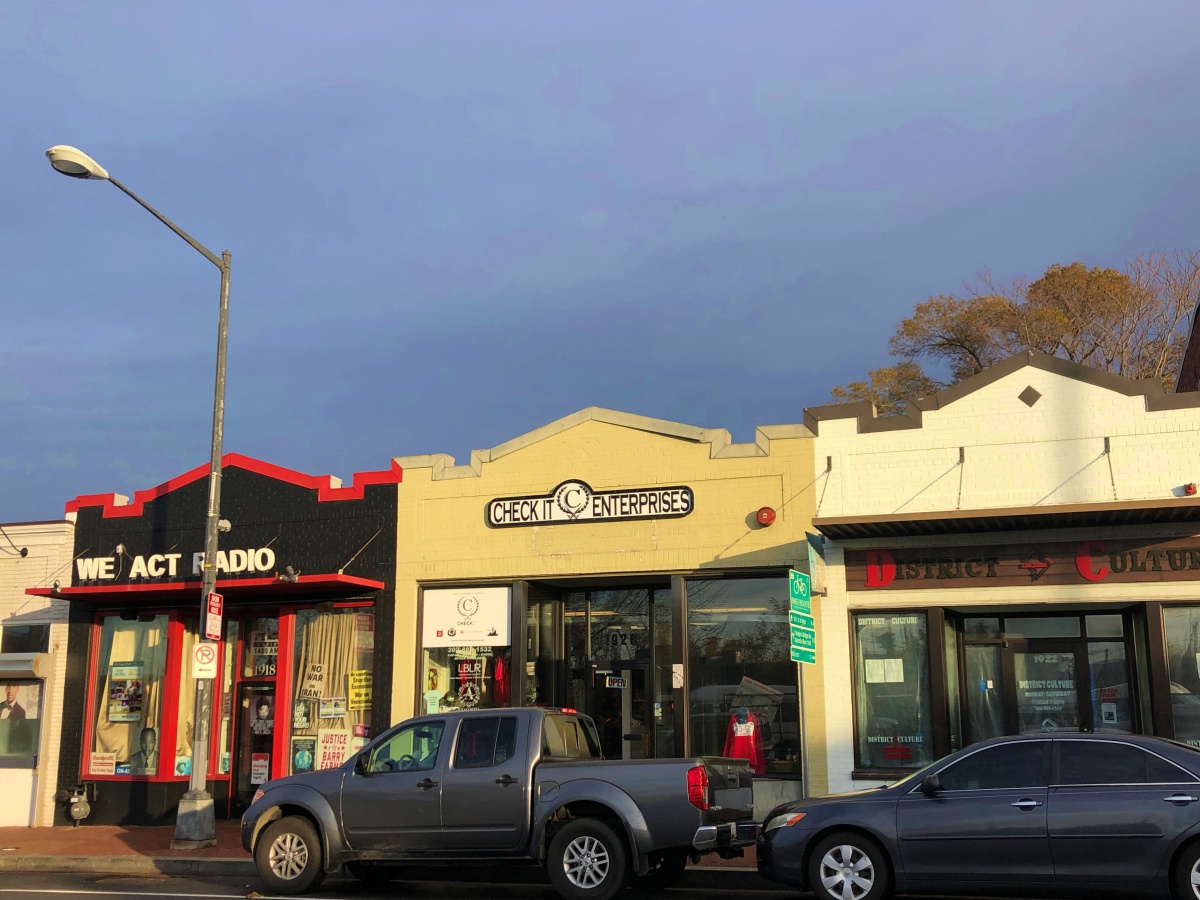
A prominent D.C. developer, Douglas Jemal, has decided to end a months-long legal battle with Anacostia’s Check It Enterprises, a go-go clothing store, and gift it a beloved community garden.
On Monday, Jemal and Ronald L. Moten, co-owner of Check It Enterprises, announced in Bundy’s Secret Garden that Jemal had donated the outdoor property to the store.
Jemal has argued for about a year the Check It staff has been using outdoor space without his authorization. Last October, Jemal’s attorney sent a letter to Check It, demanding staff “cease and discontinue its unauthorized use” of the garden, District Dig reported in November.
Jemal owns both the outdoor space and a vacant storefront property at 1916 Martin Luther King Jr. Avenue S.E., just two doors down from Check It Enterprises, which is located at 1920 Martin Luther King Jr. Avenue S.E. Both storefronts can access the land, a 3,900-square-foot outdoor space known as Bundy’s Secret Garden, from their back doors.
The property was once rat infested, but Moten says it’s been cleaned up and became a community space partially because of his store: Check It, a city-funded venue, was started by a group of former LGBTQ gang members who became entrepreneurs, selling clothes out of the storefront. Check It hosts go-go performances and awards shows, vigils, peace rallies, and other community gatherings in Bundy’s Secret Garden. (The garden is named after Southeast D.C. businessman Alexander “Bundy” Mosby, who was shot and killed in 2018. Mosby owned District Culture, adjacent to Check It.)
Jemal, an influential local developer, helped restore and erect major new developments in Chinatown, H Street NE, Shaw, downtown D.C., and Ivy City. In 1995, Jemal was indicted for allegedly bribing a D.C. official with expensive gifts. Jemal was acquitted on six of the seven charges filed against him, but he was convicted of wire fraud and eventually fined $175,000 and put on probation.
Before leaving office, President Donald Trump granted clemency to 143 people, including Jemal.
After Trump pardoned Jemal, Moten co-launched a #pardonthegarden campaign, which included a video campaign and digital campaign on Change.org that received 1,161 signatures. Moten says the outdoor space behind the store is an asset to the business as it often hosts community events — particularly during the pandemic, as businesses comply with restrictions on indoor gatherings.
Last week, Moten says that he got the call from Jemal to meet at Jemal’s Northwest office.
“[Jemal learned] about what the property meant to the community and decided to meet in person and talk about it,” says Moten. “It didn’t take five minutes to meet. … He was like ‘I’m giving [Check It] the property’ … He wants to see the go-go museum be successful, Check It be successful, and the community to enjoy the garden forever.”
“There’s nothing that we can’t resolve, if we sit down, we talk, and we work together,” said Jemal during Monday’s announcement. (Jemal did not respond to DCist’s multiple requests for comment.)
Their conflict over the garden began last March, when Jemal’s attorney, Andrew B. Schulwolf, called Moten saying “that it was [Jemal’s] land, and we needed to leave it because it wasn’t ours,” says Moten. Check It and We Act Radio — a progressive community radio station broadcasted out of Anacostia adjacent to Check It — had been using the space as a community garden and event space, even building a stage for performances.
Kymone Freeman, who opened the doors of We Act Radio in 2011, told DCist in early December when the legal battle was ongoing, that “it’s been a vacant lot for decades, and we invested in it for the past 10 years and built it up. This dude wants to come back now that it’s valuable and hot property. [Now] it’s an issue.”
Jemal continued to pursue the property; in the cease-and-desist letter to Check It his attorney sent in October, Jemal also asked that Check It remove the deck and other property from the outside area.
This isn’t the first time that Jemal and Moten have quarreled.
In 2019, Jemal backed out of an agreement to lease an empty building in Northeast D.C. to CORE DC — a nonprofit that operates residential reentry centers in the Northeast region and supports returning citizens with job training skills. Jemal’s building would have also become a halfway house and provided reentry services.
Moten told DCist in December that he was frustrated that Jemal backed out of that commitment.
“He had an agreement for … the halfway house to be in Ward 5, and then he came back and said he’s not going to do it,” said Moten, a returning citizen. “We got brothers in Baltimore, Delaware, and Virginia in prison during COVID because [Jemal] pulled the lease on a deal that was for people coming home from prison, but he always [talks about] being a returning citizen.”
On Monday, Moten says that he saw Jemal in a new light, and that he was reasonable after they spoke with one another.
“You try to work things out and you explain yourself. You give people a chance to understand,” said Moten during the announcement. “And when we talked, we understood each other right away.”
Freeman told DCist, “Jemal’s not the bad guy that I thought he was.”