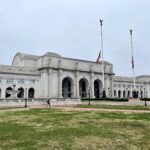
Transportation Secretary Pete Buttigieg thanked frontline bus and rail workers at Union Station on Friday during his first official public event since his swearing-in on Wednesday.
Buttigieg took about 20 minutes to greet about a dozen workers on an Amtrak platform before he spoke to the media. He reinforced the federal government’s new mandate for masks to be worn at all times on public transit, in airports and airplanes and trains, calling it the best way to slow the spread of new COVID-19 variants and save lives.
The secretary wore two masks while not at the podium.
Buttigieg also gave transportation leaders from WMATA, VRE, MARC and Amtrak the assurance that the Biden administration is fully behind coronavirus relief funding for public transit.
“[Transit agencies] are being asked to work miracles with the resources they are given in the best of times, and now have faced the enormous challenge of sharp drops in farebox revenue,” Buttigieg said.
Metro is facing severe budget and service cuts in 2022 if more federal funding doesn’t pass before then.
“We’ll build back better than before,” Buttigieg continued. “We’ll sustain the basics and go beyond the basics.”
The topic of mask enforcement also came up as transit agencies around the country grapple with how to keep both workers and riders safe. Many transit agencies across the country are providing masks, and have now said they’ll refuse riders service if they don’t wear a mask while riding to comply with the new mandate.
Metro has taken a bit of a different stance, with General Manager Paul Wiedefeld saying that he doesn’t think it’s right to put the onus on bus operators and other frontline workers to police masking.
Wiedefeld has said having bus drivers enforce the rule would potentially put in them in conflict with riders and create unsafe conditions. He wants Metro Transit Police to be called if a situation arises. Metro drivers have been assaulted for asking riders to pay fares and a number of other reasons.
Buttigieg seems to agree with Widefeld’s position.
“We need to support them,” Buttigieg said of frontline employees. “We need to make sure as much as possible that we do not put these employees in the position to ask or to remind [riders to wear masks], though they are prepared to ask or remind when necessary. Let’s make it easier for the people who make it easier to get around this country and get through our day.”
Raymond Jackson, president of the transit worker union ATU Local 689, also got time with Buttigieg, telling him about the need for more funding for the transit system and about the assaults on regional transit workers.
“You just want him to be aware of that,” Jackson said.
Jackson said asking bus operators to enforce mandates is a tough position and says it should be up to transit and other police departments to help enforce the policy.
“But, if that’s what the President of the United States says we must do, then that’s what we must do,” Jackson said.
During his visit, Buttigieg also reminisced about school trips to D.C. when the Union Station food court was the coolest thing and about taking the Red Line as an intern during college.
“I love being here at Union Station,” Buttigieg said, calling it the beating heart of the region for transportation. “It’s a fitting place for me to visit out and about as secretary.”
Buttigieg visited the Metro station manager kiosk at Union Station and took photos in the mezzanine, though he did not go into the station itself. When asked by WAMU and DCist if he’ll take Metro to work at the U.S. Department of Transportation in Navy Yard, Buttigieg replied, “I hope to!”
Buttigieg has a fervent following from his presidential run. Several of his fans have dedicated themselves to transportation issues and watching his every move, tweeting their support from the #TeamPete hashtag.
The new secretary has limited transportation experience from his time as mayor of South Bend, Indiana, but has promised that all his work at the Department of Transportation will be focused on equity, climate change and building safe, new infrastructure.
After the event, Union Station’s train waiting areas were filled with a few dozen people. At least five people were not wearing masks or were wearing them below their nose. Police did not appear to approach people to put on a mask, even as an automated reminder about masks played on a speaker overhead.

 Jordan Pascale