Colleen Grablick
D.C. Mayor Muriel Bowser issued a new order Wednesday, declaring gun violence a public health crisis and pledging $15 million to a new initiative aimed at decreasing violence in targeted neighborhoods.
The mayor’s action comes after the city recorded 198 homicides in 2020 — the highest count in 15 years, and up 19% from 2019. Already in 2021, homicides are outpacing last year, with 25 recorded as of Feb. 17 — a 14% increase from this time in 2020. D.C. Councilmember Trayon White called on the mayor earlier this year to declare a state of emergency to combat gun violence.
Bowser’s order is a part of a larger initiative announced Wednesday called Building Blocks D.C., a network of government resources and services that will be tasked with addressing gun violence in concentrated blocks of the city. As a part of the initiative, the mayor’s office is opening a gun violence emergency operations center located in Anacostia, which will be staffed with personnel from across District agencies.
The Building Blocks initiative will be spearheaded in part by the city’s new Director of Gun Violence Prevention Linda Harllee Harper — a role Bowser added to her cabinet last month in response to calls for action from violence prevention advocates.
“Building Blocks D.C. serves as the foundation of citywide efforts to work with Washingtonians as partners in reducing gun violence in our city,” Harper said at a press conference announcing the initiative on Wednesday. “Building Blocks D.C. will be talking a whole government approach in partnership with our most impacted communities to address the urgent needs of our residents.”
The program will focus on 151 city blocks most impacted by gun violence, beginning with three in Anacostia. According to a data analysis of 2020 crime reports presented Wednesday, 151 blocks — only 2% of all blocks in the city — accounted for 41% of violent offenses with shots fired.
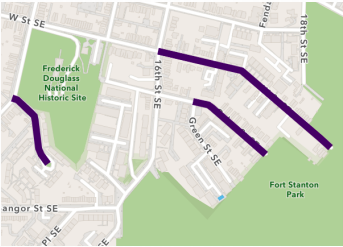
Officials from several agencies will focus on providing trauma, housing, and employment services in these areas, working primarily with individuals who have been arrested for gun-related offenses, victims or others directly impacted by gun violence, and those currently under the supervision of the Department of Youth Rehabilitation Services.
A $15 million “down payment” for the program will be built into the District’s fiscal year 2021 budget. The money will go toward several areas including job readiness and training, violence prevention, trauma services, and housing.
In addition to collaboration with District agencies like the Office of Neighborhood Safety and Engagement and the Department of Behavioral Health, two advisory boards will guide the methods of the program as it rolls out. One group will be co-chaired by Manonne Butler, the current director of the city’s Criminal Justice Coordinating Council, and Rev. Dr. Roger Mitchell Jr, a D.C. faith leader and the city’s former chief medical examiner, who recently left that post for a position at Howard University. A community advisory group will be co-chaired by community advocate and re-entry expert Tony Lewis and Rev. Donald Isaac, the director of the city’s Correction Information Council.
During a press conference announcing the initiative, Bowser said the emergency framework established by the city’s COVID-19 response has guided the creation of Building Blocks D.C. and the emergency operation center.
“We have a lot of programs in the district, the district isn’t lacking for programs, but we don’t feel like we’re getting the impact from all of those programs that we need,” Bowser said. “Our experience with how effective the government can operate in an emergency posture with dedicated individuals on a single issue has been instructive for us, quite frankly. And so I think that we will put that same kind of apparatus energy funding, leadership, behind ending gun violence.”
Bowser indicated that the District will launch a regularly-updated dashboard to track the effectiveness of the program, similar to the city’s current COVID-19 website, but could not provide further detail on what data points would be included. The city will also be releasing a full map of the 151 targeted blocks, according to Bowser.
Speaking Wednesday morning, Councilmember White praised the city’s plan, while noting that a comprehensive violence prevention strategy from the city was “long overdue.”
“I’m excited about the inclusivity of this process, and looking forward to saving lives because at the end of the day, we know it’s affecting Black people in this city,” White said. “I’m tired doing the vigils, and the funerals every other day in the city that raised me, because I think to myself, one day it may be me or my child.”
According to an analysis of 2020 gun violence presented on Wednesday, 95% of the city’s homicide victims were Black, and 95 gunshot victims were juveniles, with 9 juveniles killed in the last year.
White also added that de-centering the city’s police department in violence reduction efforts and instead working with community-based advocates who are already engaged in that work is key to decreasing gun violence.
When asked during the press conference if Building Blocks D.C. would also involve a larger police presence in the targeted neighborhoods, acting D.C. Police Chief Robert Contee said it could be possible, as the department works to define its role in collaboration with other agencies.
“It depends, in some areas they could call for [an increased police presence],” Contee said. “Some residents may respond to some of the initial efforts that take place, but certainly if there’s continued gun violence and there’s a requirement or need for law enforcement or additional law enforcement presence, some neighborhoods may see an increased presence.”
This post has been corrected to reflect that Rev. Dr. Roger Mitchell Jr. is the city’s former chief medical examiner.