Jacob Fenston
The last time periodical cicadas emerged in Washington, blanketing sidewalks and lawns with their large shiny bodies and creating a deafening chorus, John Kerry was running for president, Barack Obama was an obscure state senator, and Donald Trump was praising Democrats on CNN.
Now, underfoot, billions of cicada nymphs are once again preparing to emerge from the earth and take to the treetops of D.C., Maryland and Virginia. The world has changed a lot since the last time these periodical cicadas emerged — and the cicadas themselves may be changing too, driven by climate change.
The periodical cicadas that will emerge this year are Brood X (pronounced 10) — one of the largest groups of periodical cicadas in the world.
“This is our Super Bowl, absolutely, for entomologists, we’ve been looking forward to this,” says Mike Raupp, professor emeritus at the University of Maryland, also known as “the bug guy.” He plans to document the emergence on his blog. It will be, he says, a “spectacular event.”
The insects have been quietly waiting for 2021 to roll around for almost two decades.
“Remember, these are just teenagers and they’ve been underground for 17 years,” Raupp says. “It’s been a dismal existence. They want to come up and party.”

Exactly when the creatures will crawl out of to ground and head for the treetops to mate depends on the weather and the ground temperature — the ground needs to be about 64 degrees, and a little rainfall can help trigger the emergence. Raupp estimates, based on previous years, the first few cicadas may come out in late April, but the bulk of the emergence will likely happen in the second half of May. In 2004, the emergence began around May 13.
Periodical cicadas are not to be confused with annual cicadas — the noisy creatures that create our region’s late summer soundtrack every year. Periodical cicadas live most of their lives underground, sucking sap from tree roots. Then, every 17 years, they emerge en masse. (Some broods, elsewhere on the East Coast and Midwest, emerge after 13 years).
Why 17 Years?
To understand periodical cicadas’ periodicity, and the strangely specific number of years they stay underground, Raupp says you have to consider cicadas’ survival strategy. It’s something called predator satiation.
“In other words, they’re going to emerge synchronously in such massive numbers, they fill the bellies of every predator that wants to eat them,” Raupp explains.

Periodical cicadas, unlike their annual counterparts, are slow, awkward fliers. They don’t even try to evade predators, but rather overwhelm them. But for this satiation strategy to work, cicadas have to all emerge the same year — in overwhelming numbers. If just a few come out, on an off year, Raupp says, “They are eaten into oblivion.”
As for the number 17 (why not 12, or 9?), Raupp explains that cicadas favor prime numbers. Emerging in prime number intervals helps different broods on different schedules avoid each other. Interbreeding could mess with those precisely timed schedules, leading to smaller numbers of cicadas emerging more often, making the satiation strategy ineffective.
Cicada In The Coal Mine? Canary In The Cicada Hole?
Lately cicadas schedules seem to be changing — particularly in the D.C. area.
John Cooley has been studying cicadas since grad school in the ’90s. He’s now a professor at the University of Connecticut. When he started his research, he says, there were no good maps of cicada broods. Existing maps were at the county level, and were not backed up by rigorous research. So he and a colleague started a project mapping cicada broods.
“We started before we had GPS units, so we actually had high quality road atlases — those red ones you get that have the the topography and all the little roads on them,” Cooley recalls.
 Whenever a brood starts emerging, Cooley and his colleagues spend weeks driving around with the windows down.
“Kind of putter along a little bit slowly — you’re not flying down the road at top speed.”
They listen for cicadas, and map what they hear. In recent years they’ve been hearing something unexpected — cicadas emerging years early, off schedule.
And, he says, it could be because of climate change.
“It is an absolutely intriguing possibility that as global climate change, it’s throwing the cicadas off the cycle that they’re supposed to be on and causing them to make mistakes,” Cooley says.
When cicadas make mistakes, they tend to do so in four year increments. (So coming out after 13 years — remember, they like prime numbers.) And indeed, 4 years ago, a large number of cicadas emerged early — especially in the D.C. area.
Cooley says another possibility is that cicada behavior has remained the same, but humans are acting differently. Armed with smartphones and the internet, we may be reporting unusual cicada emergenges more often than in the past.
Embrace Your Inner Entomophile
It’s hard to know exactly where cicadas will emerge, unless you were in the same spot 17 years ago. If you’ve moved since 2004, ask your neighbors.
Cooley’s maps are unfortunately not helpful on a neighborhood level. He says mapping urban areas with bad traffic is not practical — researchers would waste precious time in gridlock.
“Sitting in traffic means you are not getting data,” says Cooley. “So what that means is, ironically, urban areas are under-sampled in our dataset and rural areas are oversampled.” Chicago, New York, and D.C., all have unreliable maps. And forget about Philadelphia. “To get in there is to just get tied down for a couple of days.”
To help fill in data gaps, Cooley’s team solicits data from citizen scientists. Previously, people would report cicada sightings through the mail or by phone. Then over email. Now, there’s an app for iPhone or Android.
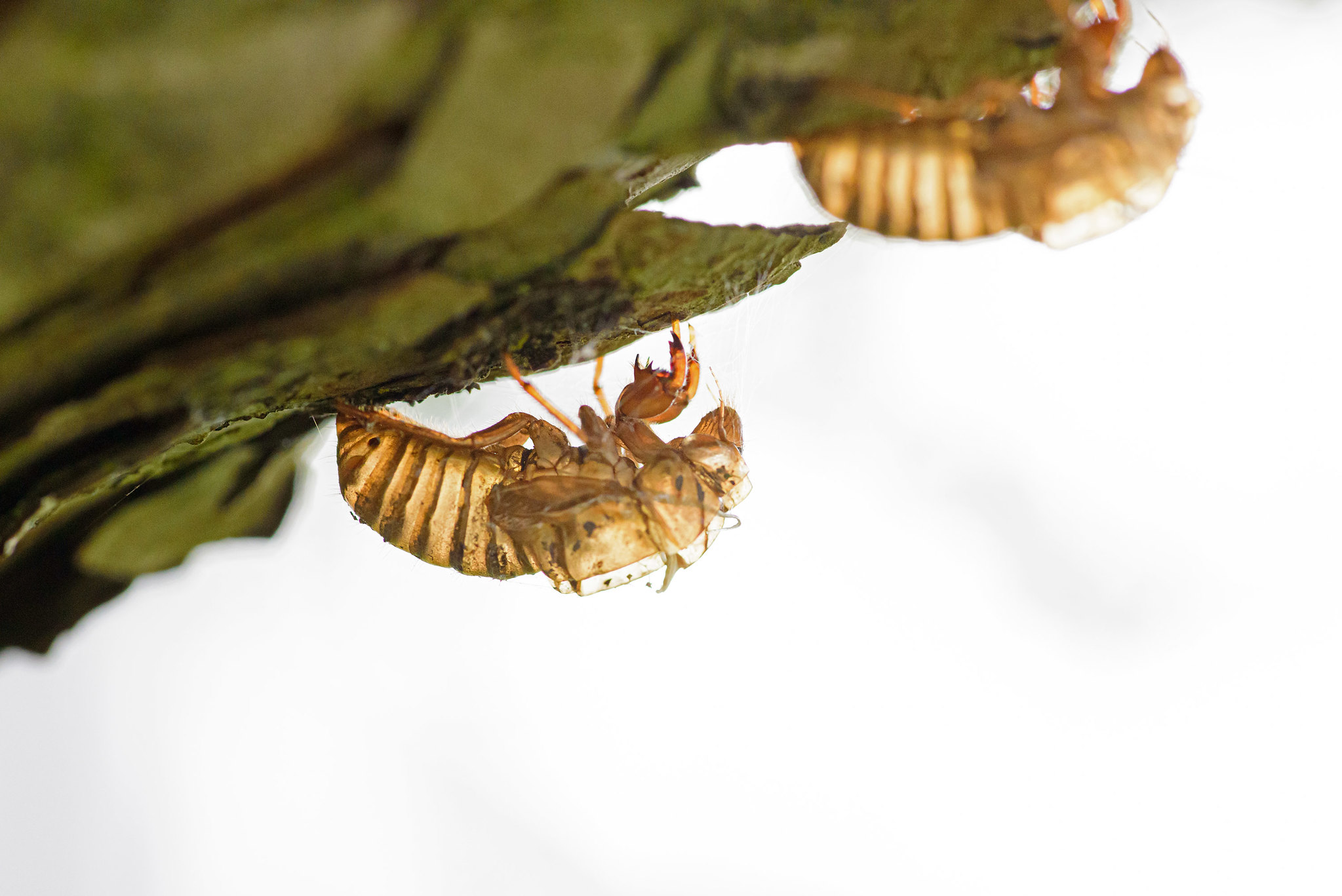
If you want to find cicadas near you, you can start looking for early signs of them. In early April you may find little holes around the trunks of trees — about as big your index finger. These are the cicadas’ escape tunnels, as they prepare to climb out, shed their exoskeletons, spread their wings and begin their brief adult lives aboveground.
In early March, you may see signs of animals digging around under trees. Mike Raupp says the animal world is getting ready to feast.
“Raccoons and skunks about this time of the year know that cicadas are just about ready to make a jailbreak and they’re already beginning to excavate the ground to eat the young nymphs,” says Raupp.
While the skunks and raccoons and entomologists are excited, entomophobes may be having a hard time. Cicadas, though ugly to some, are harmless.
“For folks that are concerned about cicadas, please understand that they don’t bite, they don’t sting, they’re not going to carry away dogs and small children like the monkeys in The Wizard of Oz.”
John Cooley wants people to appreciate the emergence as the unusual event it is. After all, periodical cicadas, emerging in such massive numbers, are unique to the eastern United States.
“They really are kind of one of the biological wonders of the world,” Cooley says. “This is something that, at this scale, there really isn’t anywhere else on the planet where something like this happens.”
In the midst of what’s been a terrible 12 months for most humans, the emergence of the periodical cicadas is a moment to pause, and marvel at nature.
After all, who knows what life will be like in 2038.