Ally Schweitzer
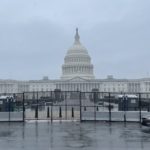
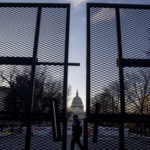
The forbidding fencing that has surrounded the U.S. Capitol since the violent Jan. 6 insurrection is expected to shrink in size starting this week, according to an internal email sent by the House Sergeant at Arms to members of Congress.
The email details plans to begin “reposition[ing] the inner perimeter fencing around Capitol Square” over the course of this week, according to a portion of the email tweeted by NBC 4 reporter Scott MacFarlane on Monday. “The new positioning will move the fence closer to the Capitol building and will provide access to the avenues and some of the sidewalks,” the email says.
The Architect of the Capitol and U.S. Capitol Police plan to begin dismantling the fencing’s outer perimeter in the coming days, reopening Independence and Constitution avenues to traffic, the email says. Officials also expect to reduce the National Guard presence at the Capitol earlier than planned, according to the message.
A USCP spokesperson did not immediately return a request for comment.
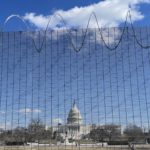
Workers were downtown Saturday trimming back some of the barbed wire that topped one stretch of fence, Fox 5 reported.
Police are considering replacing some of the fence with “bike racks positioned in double rows outside some areas” to “create a barrier between police and potential threats, giving officers more time to react effectively,” CNN reported. Capitol Police continue to believe the building could face a threat from violent extremists, though the police force says it’s not aware of any known, credible threats at this time.
Good news: Barbed wire fencing around the US Capitol to be scaled back – Independence & Constitution Aves reopened – over the next 2 weeks to the area in red below.
Bad news: There will still be a fence closing off the Capitol grounds for some time to come. https://t.co/z0j8JxzQWl pic.twitter.com/wNozQdaemy
— Charles Allen (@charlesallen) March 15, 2021
The security measures put in place after a pro-Donald Trump mob violently stormed the building more than two months ago have increasingly attracted criticism from lawmakers and the local public. Over the weekend, residents gathered outside the fence, setting up lawn chairs and eating pizza in a nonchalant protest of the security perimeter, the Washington Post reported.
Capitol Hill residents have been leading the charge to remove the four-mile fence. D.C. Councilmember Charles Allen (D-Ward 6), whose ward includes Capitol Hill, said the measures are “not a good look for democracy.”
Del. Eleanor Holmes Norton, D.C.’s nonvoting representative in Congress, introduced legislation banning permanent fencing around the Capitol building. “There are ways to accomplish security without making it into a fortress,” Norton said.
The congresswoman’s bill is cosponsored by four Republicans and four Democrats. In a Washington Post op-ed, retired Army Lt. Gen. Russel Honoré wrote that the fencing “will do nothing to prevent another attack, or to help us understand the underlying failures that allowed the riot to happen.”
More than 2,000 National Guard troops are stationed at the U.S. Capitol until May 23, but USCP may reconsider that plan “about two to three weeks after the outer fence is removed,” CNN reports. Troops began to be drawn down Friday as the force dropped from 4,900 to 2,200 stationed personnel.
This story has been updated to include more information about plans to dismantle the fencing around the U.S. Capitol.