 Aja Beckham
A mobile recording studio is rolling through D.C.-area neighborhoods to provide a creative space for artists in search of a studio.
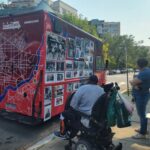
In its former life, Si Tha Vision Rolling was a regular passenger bus, gathering dust behind a daycare building in Virginia. One Craigslist sale and a remodel later, it’s creating an entirely new kind of experience for passengers.
The bus is completely decked out with equipment to make it a mobile music studio: two televisions, a sound proof studio, JBL speakers, a JBL monitor, Apollo Twin Audio interfaces, LED lighting, and more. The equipment was installed by a D.C. area contractor named Jessie Hoptiak.
“He pimped my ride,” says Sierra Cameron, a high school music teacher and the owner of the bus. Since October, Cameron has been driving her bus all over the D.C. region and parking in different neighborhoods, where residents can book time to use the equipment inside.
The idea, Cameron says, is that her bus can provide musical education and opportunities to people who might not otherwise get it.
“Not everyone has access to a studio,” says Cameron. “I want people to voice their feelings, thoughts, and experiences.”
Cameron had always had a passion for music, and one day she brought a new idea to the principal of Paul Public Charter School, where she was then working as a math teacher: She pitched the idea of becoming the high school music teacher instead. “I told my principal, ‘This is either going to happen here or it’s going to happen somewhere else, but [music] is my passion. If you guys aren’t going to be receptive to this [idea,] I know another school will be,'” she recalls.
Her idea was to buy a school bus and convert it into a mobile recording studio to use for both music classes at the school, and to start her own business.
In February 2020, principal Shalima Yarbrough and the charter school network approved the role, and in August, Cameron became the school’s music teacher. She used her savings to buy the school bus off of Craigslist, transformed it, and in October she opened it for recording sessions.
Because of the pandemic, students haven’t been able to physically use the bus as Cameron originally planned.
“Before COVID, the idea was that students could go outside on the bus and have a hands-on lab day to record, DJ, and engineer,” says Cameron, 30. Now, the best Cameron can do is teach class virtually from her mobile bus.
But even if things have changed for her students, Cameron’s business plan remains intact. After 4 p.m., the bus commutes to different neighborhoods where musicians have requested it, and the artists record. The service costs $200 if the artist has their own engineer, and $250 with an engineer that Cameron brings along.
Since October, Cameron has hosted about 15 events, mainly in Southeast D.C., and helped musicians create about 40 songs.
The bus is also providing an outlet for residents who need a creative outlet to express trauma, Cameron says.
In late February, The Alliance of Concerned Men paid to have the bus parked at Atlantic Terrace Apartments in Washington Highlands so that eight program participants living there could use music as an outlet. The Alliance of Concerned Men is a nonprofit organization that seeks to save lives in high crime areas by helping neighborhood rivals broker truces and providing outlets for expressing trauma.
“We asked [participants] what events would they be interested in for them to come out of the house,” says Jovan Davis, director of operations with Alliance of Concerned Men, who says that participants are spending too much time indoors due to the pandemic.
Davis says the mobile studio not only interested participants but also allowed them to communicate what’s on their minds instead of resolving issues in other ways.
“Instead of causing harm to someone, they can speak it out and release that trauma,” says Davis. “[Because of what] we do in the community and our mission, they knew not to make diss songs [and] they knew not to use so much profanity. But at the same time, we were able to see what they were going through [by] letting them vent … about the frustration, the anger, the paranoia, the insecurities, the disrespect, [or] any emotions that can lead to violence.”
During the event, he says five new participants who live at the apartment decided to sign up and join the Alliance of Concerned Men because they were interested in joining the mobile bus.
Davis says he’s seeking activities to further increase engagement amongst participants and help end gun violence. One of the ways he plans to do that is by having the bus come to the area once a month, if it feels safe enough. (Washington Highlands has experienced frequent shootings in the last year, including one that killed 21-year-old violence interrupter Lorraine Marie Thomas)
He says that Si Tha Vision Rolling is filling a gap in the community: He doesn’t know of any recording studios in the area, since one well-known music engineer and videographer, Eric “Boom” Byrd, died in 2019. Byrd, 34, was shot and killed across the street from U Street Music Hall.
“He was one of the ones that was helping the younger generation and some of his peers in the community with the music,” says Davis. “But after he passed away, I don’t really know who else has a [recording] studio in the area.”
Cameron says that she hopes to reach community organizations through her business.
“While booking artists is cool, community events feel more special [because] I can connect with the kids more and learn about … their area, that neighborhood, their culture, and what they’re interested in becoming career-wise,” says Cameron.
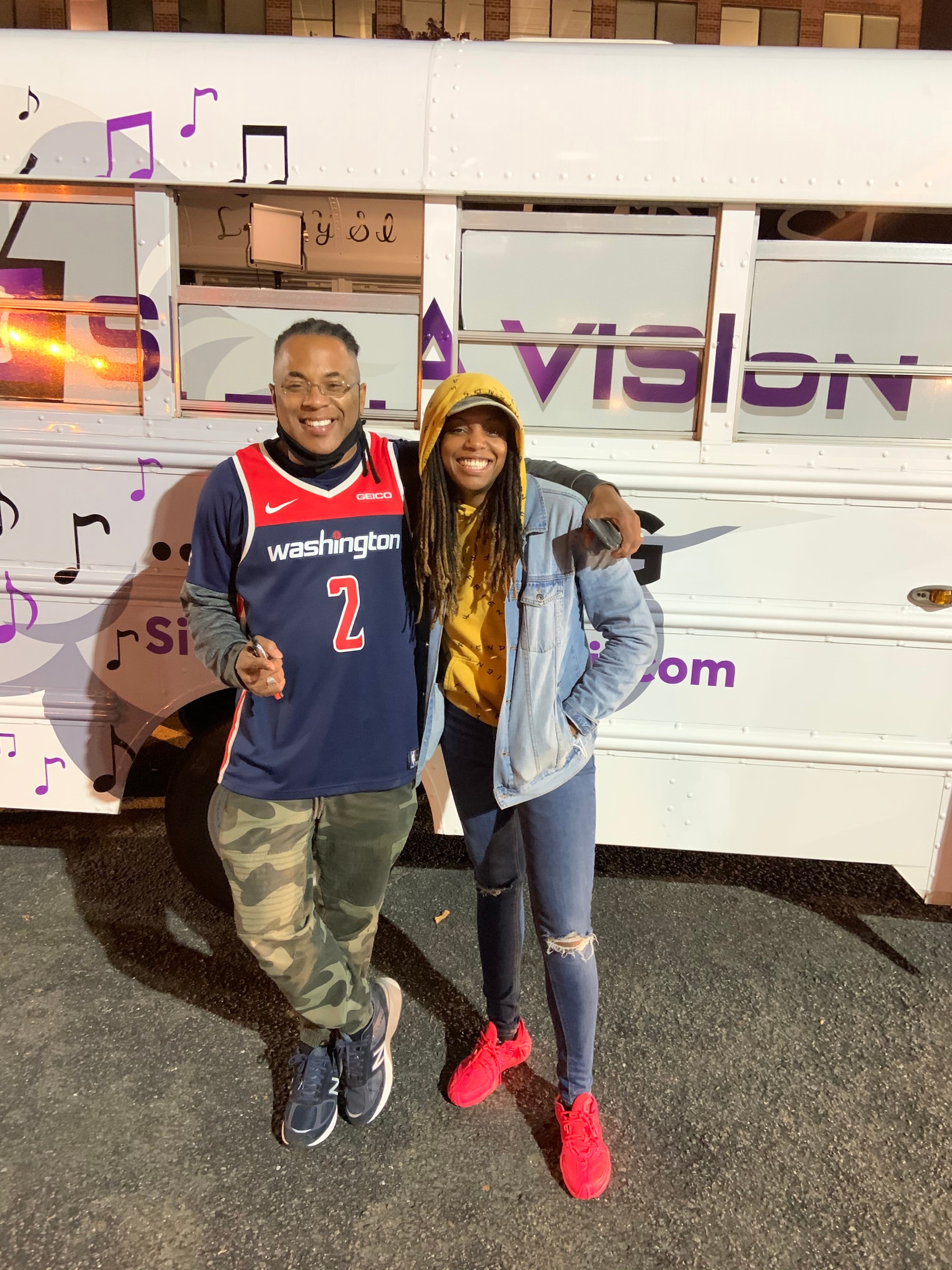
Her first event with a nonprofit was with the Music Industry Academy in November. The Academy educates aspiring artists — some of whom are “at risk” or returning citizens — about the music and radio industry, music production, and artist development strategies.
Last year, the school bus pulled up to Anacostia’s Big Chair and three Academy participants stepped in the bus and into the booth to record songs.
Okeyia Clayton, a 17-year-old student at Paul Public Charter School, was one of the participants who joined. When he got on the bus, he saw his music teacher for the first time since school closed in March.
He says that immediately made him more comfortable and “calmed his nerves” because it was only his second time recording. It was his first time ever performing in front of his teacher, since classes had been virtual.
But after the session, he says, “[Cameron] said it was good and amazing, so that made me feel more encouraged.”
In the booth, he recorded a song about “becoming famous and people expecting things.”
“People come and go for this lifestyle / Don’t give a fuck just tryna make ‘em smile,” he says in the song. Clayton says after the session, he received an email with the recorded song, but he hasn’t released it yet because he wants to perfect it even more.
He says he continues to write and aspires to become “a rock star.” Next year, he plans to attend college, study engineering, and take some electives that will allow him to continue making music.
Clayton says before senior year ends that he wants more opportunities to work inside the bus even if it’s after school. But it’s still not clear how the coronavirus pandemic will affect schooling in the coming year.
Yarbrough, the high school principal, says “that’s something that we will revisit in the spring, in terms of students coming back for after school programs, because right now we’re focusing on … academic needs.”
She says when the school reopens that the music class and bus will be a major asset to the school.
“We know that this could be one of our big selling points as a school for our kids to be able to do their class and experience [learning on] the bus,” says Yarbrough.
Cameron says that she looks forward to using the bus when the pandemic ends, and wants to continue to reach artists outside the school.
“When the world opens back up, I look forward to being a part of more community events, connecting with group homes, recreation centers, schools, and community-based non-profits in the DMV,” says Cameron. “I plan to connect with different groups … who have a heavy focus on inner city children who aren’t usually given many opportunities or outlets.”