Debbie Truong
 Ruth Tam
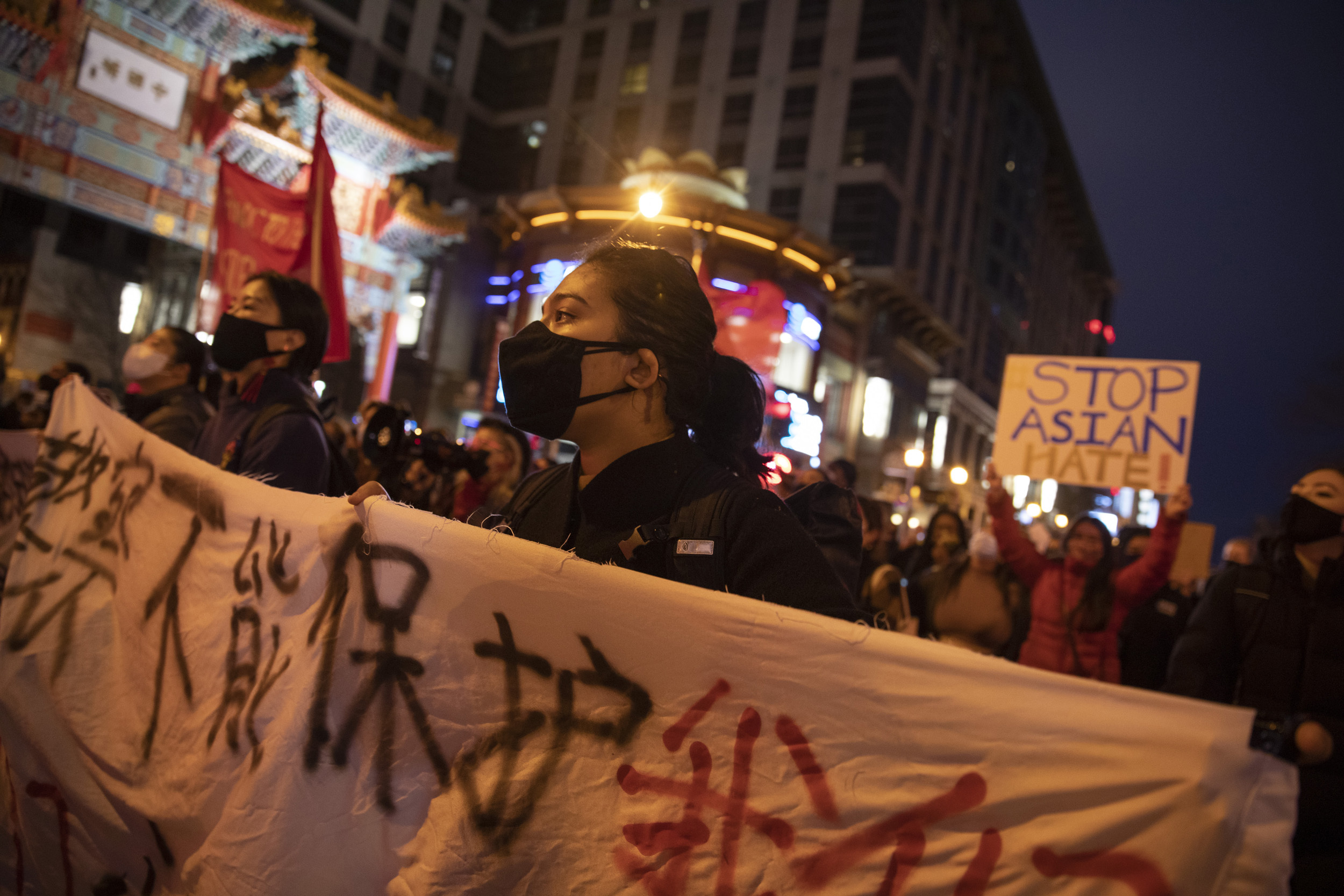
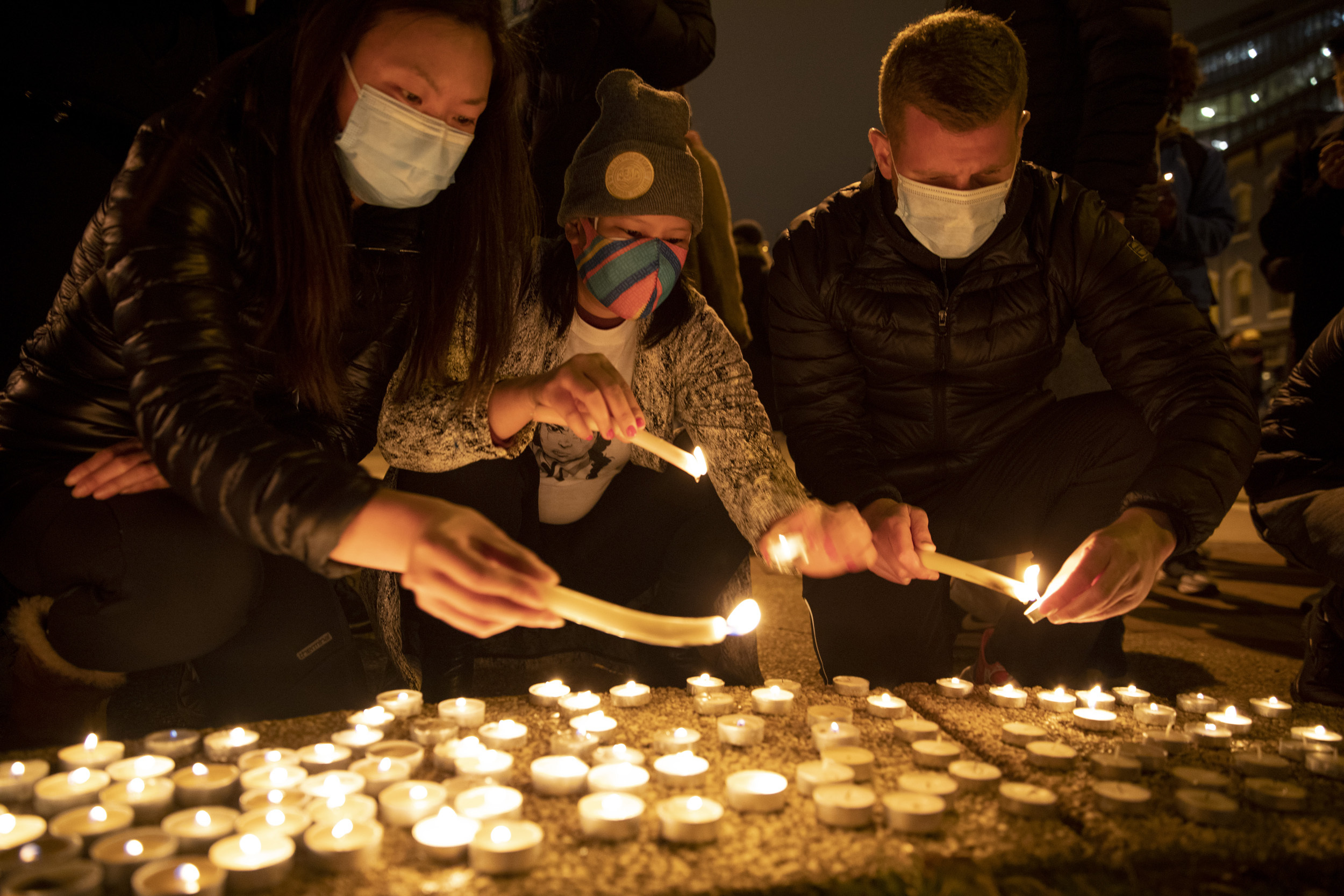
More than 100 people protested anti-Asian violence in downtown D.C. on Wednesday night, blocking streets near Chinatown as they called on the city to disband a police unit that activists say has failed to address issues in the Asian community.
The vigil and march happened a day after shootings at three spas in Georgia left eight people dead, including six Asian women. The shootings happened amid a national surge in hate crimes targeting Asian people, which advocates say are driven by xenophobia and a desire to find scapegoats for the COVID-19 pandemic.
The local activists gathered at Chinatown’s iconic Friendship Archway and marched north to the Washington Convention Center, demanding along the way that the Metropolitan Police Department disband its Asian Liaison Unit, a team of officers the city says is dedicated to addressing public safety needs in the Asian community.
The 25-year-old team is responsible for providing translation services and performing outreach. But organizers with Total Liberation Collective, a group started last year that provides mutual aid and education resources in the District, said the presence of police does not make people feel safer.
“It is proven time and time again that the presence of police does not prevent crime,” said River Chen, an organizer. “Where were the police yesterday?”
The Metropolitan Police Department did not immediately respond to a request seeking comment Wednesday night.
Danielle Kwon, a 25-year-old Korean American, said she feels resources spent on D.C. police could be directed toward addressing issues such as providing affordable housing. She noted the protest was held in Chinatown, an area that has gentrified over the last two decades, leading to the displacement of Chinese American residents and businesses.
Disbanding the Asian Liaison Unit is one part of defunding the police, said Kwon, who carried a hand-written banner that read in Korean, “Police do not prevent harm, we keep us safe.”
“We know, as Asian Americans, that the state and the police, are not there to keep us safe,” she said. “That time and time again, whether it’s through imperialism abroad or through police violence here, that they don’t keep us safe.”
Kwon, who grew up in a Georgia suburb, said the violence hit close to home.
After the shootings Tuesday, she said she called her mother and learned her father worked at a gas station decades ago in Acworth, Georgia where one of the spas is located. She said she learned a group of white men once pulled a gun and directed slurs at her dad while he was working.
“This morning I think I was bouncing between feeling very numb and just shock,” she said.
Janet Namkung, another organizer with Total Liberation Collective, called attention to the racism and misogyny Asian women face. Earlier in the day, the suspect in the Atlanta spa shootings told police he had a “sexual addiction” and wanted to eliminate temptation.
“They’re fetishizing our women and getting them killed,” she said. “I’m here for the Asian women who have time and time again, experienced never-ending harassment with the ‘love you long time,’ ‘happy ending’ and being told how much they love you for being domesticated, exotic.”
In addition to dissolving the Asian Liaison Unit, activists also called on D.C. schools to require Asian American and Black history as part of the curriculum, and urged unity among Asian and Black communities.
Asian activists acknowledged their community’s history with Black Americans is fraught. The day of the Atlanta shootings was also the 30th anniversary of the killing of Latasha Harlins, a 15-year-old Black girl who was shot by Soon Ja Du, a Korean shop owner in Los Angeles, speakers said. The shooting and Du’s lenient sentence has been cited as one catalyst of the 1992 Los Angeles riots that destroyed many Korean businesses.
Recently, perpetrators of several highly publicized attacks on elderly Asian Americans were identified by authorities as Black, leading some Asian people to request heavier police presence in their neighborhoods. Black Lives Matter activists say that undermines efforts to defund the police.
There have also been local conflicts between D.C.’s Black and Asian communities.
At the rally, activists emphasized that rebuilding trust and establishing solidarity with Black Americans was key to addressing white supremacy.
“Our struggles are not the same, but they are connected,” said Nathan Park, a Korean American.
Janae Brown, a Black woman who attended last year’s Black Lives Matter protests, said she did not need to have a personal connection to the shootings in Atlanta to join Wednesday’s events.
“I don’t like the narrative that, ‘Oh, because I have Asian friends, I need to come out and speak against it,’” she said. “Wrong is wrong.”
The District, Maryland and Virginia have recorded 140 instances of discrimination toward Asians since last March, including verbal harassment and physical assault, according to a report from Stop AAPI Hate, a coalition of groups representing Asian American and Pacific Islanders.
In one instance, a woman from Annandale, Virginia was on a Metro escalator when a man accosted her and her boyfriend, pretending to cough on them and shouting a racial slur, the report said. In another, a student in College Park, Maryland said a professor parroted former president Donald Trump as he spoke about the public health response to COVID-19, referring to it as the “China Virus.”
Across the country, there have been a total of 3,795 reported instances of harassment and violence toward Asian Americans in the last year, according to the report. Sixty-eight percent of people who filed a report were women.
The documented instances of harassment and violence are believed to represent just a fraction of the discrimination Asians have endured in the last year, according to the coalition, which started tracking the abuse after increasing xenophobia toward Asians at the start of the pandemic.
Brittany Tabora, an organizer with Anakbayan D.C., a group of Filipino youth in the U.S. that advocates for democracy in the Philippines, said she is still processing the violence that unfolded this week.
“I feel so much grief and so much rage,” she said. “And this is only one incident of a long string of anti-Asian violence that’s engrained in this country’s history.”