 Jenny Gathright
Complaints over working conditions for janitors at George Mason University have led a local service workers union to file four unfair labor practice charges, alleging poor working conditions and retribution for attempts to organize. They’ve also spurred a movement of university students and staff demanding policy changes.
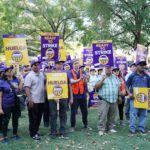
More than 220 faculty, staff, students, and alumni of the university have signed on to a petition supporting the janitors’ right to organize and demanding that the university improve their working conditions. The union, along with student and faculty groups, held a car caravan rally on Thursday to publicize their demands.
The petition urges the university to adopt a “responsible contractor policy” that would require improved working conditions for contracted workers — like higher wages, health care benefits, and apprenticeship opportunities. They are also demanding that the university provide janitors with personal protective equipment and ensure that they have access to coronavirus testing through the university.
The service workers union SEIU 32BJ has filed four complaints against L.T. Services, the contractor hired by George Mason for janitorial services, along with two of its subcontractors. The union filed its latest charge earlier this month, and two others have already been settled.
The latest allegations from the union say that employers have been “interrogating and intimidating workers” for their attempts to organize. In one case, the union says an employer deducted money from a worker’s paycheck after they participated in “concerted activity”— activities that are supposed to be legally protected against employer retaliation.
One of the settled complaints, filed in January by SEIU 32BJ, alleges that one subcontractor retaliated against workers who have been trying to unionize by “sabotaging their work areas, intimidating workers and making false accusations of theft, physically shoving a worker,” and refusing to pay workers on time.
Eugenio Gudiel, a janitor at the university, says a manager threw powder in an area he had already cleaned to claim that he wasn’t doing his work.
“During my 20 years here, I have never been treated like this,” he said in a statement distributed by the service workers union SEIU 32BJ.
According to the union, 40 janitors work at George Mason, employed through the contractor L.T. Services and 10 subcontractors. (A spokesperson did not respond to DCist/WAMU’s request for comment by press time.)
Two professors who are part of the group urging reform, Timothy Gibson and Bethany L. Letiecq, wrote an op-ed in the Washington Post last month tying these calls to action to a larger anti-racism and inclusion efforts that are underway at the university.
GMU President Gregory Washington, they wrote, “stated that his vision is to establish GMU ‘as a national exemplar of anti-racism and inclusive excellence in action.’ To advance this vision, Mason’s racial justice efforts must center on the margins, upholding the rights and dignity of workers who are keeping our campus safe and clean and helping us grow.”
“Many GMU contracted workers — janitorial staff, food services workers, building tradespeople — are immigrants,” said the op-ed. “Many are paid low wages and live in precarious circumstances, in overcrowded housing and in fear of detainment, deportation and family separation. They are vulnerable to employment abuses and exploitation.”
In a written statement in February, Washington wrote that the institution was “actively” seeking a resolution to the “troubling allegations” about L.T. Services and its subcontractors. In response to a request for comment, a spokesperson for the university directed DCist/WAMU to Washington’s February statement.
“The university has conducted an initial review of the complaints,” wrote Washington. “As a result, I have ordered an outside audit of the labor practices of L.T. Services and its subcontractors as they relate to their contract with Mason. The advisory CPA firm Baker Tilly will conduct the audit, and I look forward to learning the results of what I expect will be a thorough, fair, and thoughtful audit.”
Washington wrote at the time that the university would not be offering any additional public comment until the outside audit is done.
A statement from the SEIU 32BJ said the risks presented by the coronavirus pandemic have made the working conditions at the university even more dire. The union says Gudiel, for example, was sick with COVID-19 in November.
“The essential janitors, who are often single mothers, aren’t highly paid to begin with and do dangerous, life-saving work to disinfect GMU hallways, sinks, bathrooms, and floors during the COVID pandemic,” the union wrote. “Essential janitors are overwhelmingly immigrants who are sickened and dying from COVID-19 at vastly higher rates while being denied any extra compensation.”