Rachel Kurzius
Update: As of Wednesday, March 24, Capitol Police has resumed issuing special events permits, according to a department spokesperson. This week, the perimeter of fencing around the U.S. Capitol shrank significantly and the entire outer perimeter of the fencing had been removed as of Wednesday.
Original:
Progressive political strategist Melissa Byrne has been thinking about how protests around the COVID relief bill might have played out if the public had access to the Capitol grounds.
“You would have seen people on the grass outside of the Senate steps with like signs about raising the minimum wage to $15 an hour. You would have seen people talking about the importance of the $1,400 stimulus checks,” says Byrne, adding that there likely would have been artwork installed on the Capitol lawn, too.
But demonstrators couldn’t get that close. Instead, officials offered up the far side of Third Street, on the National Mall and across the street from the Capitol complex. It “didn’t have the sight and sound of electeds, [who] need to see the public. They’ve been in a very cloistered environment since January 7,” Byrne says.
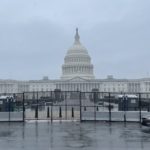
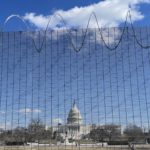
Ever since pro-Trump insurrectionists stormed the U.S. Capitol on January 6, more than three miles of tall fences topped with razor wire have surrounded the Capitol complex, much to the chagrin and inconvenience of nearby residents. Nearly 2,300 National Guard troops will remain in the District to help provide security at the Capitol until May 23.
But those aren’t the only security measures keeping the public out. Capitol Police has stopped issuing permits for special events on the grounds ever since the insurrection, preventing peaceful protesters from making their voices heard.
“Due to access restrictions, the permitting process is currently on hold,” a department spokesperson said over email.
“All of the public that normally does organizing has been shut out [of the Capitol] because of the police’s failure to respond to known threats,” says Byrne, referring to law enforcement’s inadequate preparation for January 6.
The U.S. Capitol is one of the biggest stages for protest in the city. Advocates and organizers say that choking off the public’s access has a negative impact on free speech and affects their ability to bring public attention to their causes.
There are a lot of reasons why activists favor the Capitol for their demonstrations. Some of them are logistical: the buildings are filled with lawmakers to persuade (or who may even swing by to show their support), as well as members of the national media, who can get out a group’s message with a single tweeted photo.
Those planning civil disobedience in the District often plan those actions at the U.S. Capitol. While D.C. police has a policy stating officers won’t arrest peaceful protesters, the Capitol Police does not—that means sit-ins at any of the buildings at the complex often lead to hundreds of arrests, bringing headlines and attention to causes like the Green New Deal or ending family detention.
And then, of course, there’s the symbolic value — it’s the architectural embodiment of American democracy. The U.S. Capitol was designed to be open, as was the street plan leading the way to the historic building.
“It’s a celebration of democracy to have people up there protesting,” says Congressman Don Beyer (D-Va). “I’ve always thought that it was a good thing when people show up to speak on Capitol Hill, regardless of where they are on the ideological spectrum — it shows great civic engagement.”
Robby Diesu, a longtime organizer for large-scale protests, says that the purpose of these demonstrations isn’t necessarily to change a lawmaker’s mind in that moment, but instead to influence the public perception of an issue over time.
“A member of Congress seeing people having a rally outside the Capitol when they’re going to vote may not change their mind there,” he says, but that’s not the intention. “Thinking about the long term of building political power, people demonstrating over a period of time helps shift the narrative.”
Before the pandemic shut down the complex’s buildings to visitors, anyone could enter to petition their lawmakers or watch proceedings as long as they went through a metal detector. Special permits weren’t required for groups of fewer than 20 people.
Until January 6, Capitol Police continued to issue special events permits for outdoor locations on the grounds, with a cap of 50 participants. (Another change: before the pandemic, people could only request a permit in person or via a fax machine. The office started accepting email requests last spring.)
Organizers continued to hold events and set up displays on the Capitol lawn. Progressive advocacy groups, unions, and healthcare organizations placed more than 1,000 signs depicting frontline healthcare workers in April, calling on the government to provide them with personal protective equipment. In July, National Nurses United placed 164 pairs of shoes on the lawn, to represent the nurses who had died of COVID-19 at the time.
Demonstrations like these aren’t allowed right now, and it’s unclear when they’ll be possible again.
Capitol Police announced on Monday that it would “continue to improve access around the U.S. Capitol” in the coming week but would “not provide a detailed timeline of specific, future changes,” citing security. Already, the fencing has shrunk.
While Acting Chief Yogananda Pittman has called for permanent perimeter fencing, the department’s statement this week referred to the current infrastructure as “temporary.”
Beyer, like the vast majority of officials representing the region, opposes permanent fencing around the Capitol complex. “I haven’t met anybody who likes it,” he says. “It is a walling off of the elected representatives from the people, and that’s a bad symbol.”
He’s also skeptical that permanent fencing would make the complex more secure. “You can make a pretty good argument that it wasn’t primarily the lack of defensive fortifications, but rather of the diminished imagination on the part of the U.S. Capitol Police leadership” and “absence of coordination between different law enforcement,” says Beyer. “It would be terrible to take this one insurrection … and generalize from that to a need to shut down the Capitol on those grounds on a permanent basis.”
Monica Hopkins, the executive director of the D.C. American Civil Liberties Union, wants to know when the fences are coming down.
“What we know here in District of Columbia is once you put up sort of security barriers, it’s really difficult to take them down. The longer you leave them up, it just becomes part of the architecture,” she says, adding that the longer the fences remain, the more of a First Amendment issue it could become.
“As the vaccine rolls out, as we go back to quote unquote normal, and people actually can start gathering in crowds, we live in the First Amendment epicenter,” says Hopkins. “What will that [fence] mean for people actually coming to D.C. to make their voices heard?”
A Capitol Police spokesperson says over email that “as the security posture continues to be modified to facilitate greater access to the Complex, the Department anticipates that permitting will soon be restored within the confines of recommended COVID restrictions.”