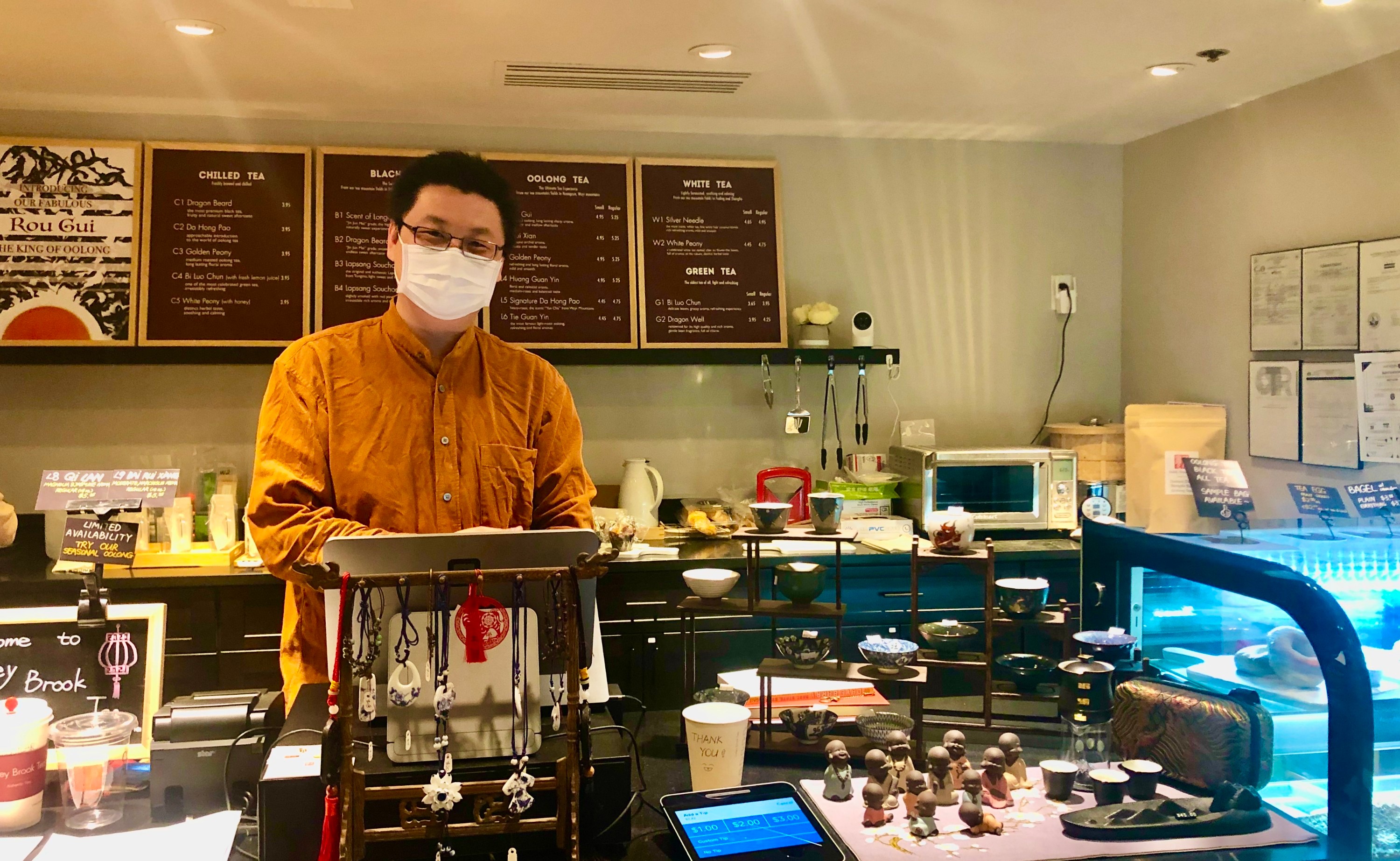
Although it wasn’t the first time he was the target of racist vitriol during the pandemic, when Yunhan Zhang was attacked in his Dupont store last November, he remembers being shocked.
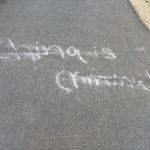
On an otherwise quiet Tuesday morning, a man walked into Valley Brook Tea and began shouting the words “COVID-19” and “Chinese.” As Zhang told the man to stop, the intruder pepper sprayed him in the face — not far from the Chinese fans Zhang’s father hand-painted with images of the shop — before shouting obscenities and walking out.
The whole event took less than a minute.
“I was trying to find the source of the voice. And I could see a figure of a person across from me. And I also saw him walking towards the door,” Zhang recounts, noting that, at first, he didn’t raise his head or say anything. He thought, “if I don’t say anything, they’ll just walk away,” he says.
Footage of the attack quickly went viral on Twitter, prompting a conversation about the anti-Asian hate that other business owners across the District were also facing. From verbal harassment to hate mail — one email Zhang received reads: “Don’t blame white Americans for the virus that came from Wuhan!” — Asian-owned businesses across the city report an increase in abuse.
There were 140 documented hate incidents against Asian Americans perpetrated in D.C. Maryland, and Virginia since March 2020, a new report by the group Stop AAPI Hate shows. Last Wednesday, in the wake of the attack in Atlanta, local advocates held a rally in Chinatown calling for recognition of anti-Asian racism, police reform, and solidarity.
For local Asian American business owners, who have already faced financial anxiety wrought by the pandemic, the uptick in racist violence has sown deep stress and fear — particularly in light of the fact that businesses are often targets of discrimination.
Cheska Perez, who is Filipina and owns an e-commerce boba shop near Howard University, describes being verbally accosted last spring while buying plants on U Street. “I was just walking in that intersection and this guy comes right next to me and starts shouting about me being Asian. He was using verbiage like ‘kung flu’ … and I froze,” she says.
Local chef and business owner Danny Lee was born in Washington, D.C. and grew up in Northern Virginia before co-founding The Fried Rice Collective, the team behind local restaurants Anju, CHIKO, and Mandu. Lee says that he and his wife, who is also Korean American, have both been on the receiving end of racist verbal abuse over the last year, with people shouting “‘kung flu’ or ‘go back to China’ or ‘Chinese virus’” at the couple.
While he was on his way to Anju recently, Lee says there was a person in a car “doing the old-school ‘putting your index fingers at your eyes to make your eyes look small’… I haven’t seen that since I was six.”
“It’s getting to the point nationally where it’s hard for me, as a Korean American, to not have this [anti-Asian hate speech] constantly in the back of my head,” he says.
Lee emphasizes that the racism Asian Americans are facing now “isn’t a new thing”; the pandemic, he says, just “put a larger spotlight on it, [and] Asian Americans are becoming more vocal on what’s happening and what has been happening to our community.”
“Previously, every time an Asian brought it up it would get brushed off [like], ‘oh it’s not that big of a deal’,” says Lee. “Now, just seeing the outpouring and support to the Asian community right now is amazing. I’m very protective of D.C. I have a lot of faith that this city and this community can rise up and be better than this hate we are seeing right now.”
Bobby Pradachith, who owns the Laotian restaurant Thip Khao on 14th Street NW, says the staff is worried all the time.
“Our staff is employed of Asian folks, and [members of] the Latinx and Black communities,” Pradachith says. “I know some of my friends, their restaurants have been broken into and have gotten things stolen all over the country. Our restaurant has big windows. And we’re really exposed. We have cameras and such, but we’re always worried about what’s happening and trying to be alert.”
Despite the economic effects of the pandemic, “we’re very lucky and fortunate to still be open,” says Pradachith. “Our main objection is how can we support our staff. Our staff is our number one priority. How can we take care of them and take care of their families?”
That fear is compounded by the anxiety of keeping a business afloat during a pandemic.
When Valley Brook Tea opened its doors for the first time on Feb. 14, 2020, the community responded well: On February 27, the Washington Post highlighted the shop, dubbing it one of the best spots for a cup of loose leaf tea. Around the same time, the U.S. Supreme Court contacted Zhang for “a tasting for nine people.” People were coming to Dupont just to visit the shop, and there was almost always a line at the counter. (“Flowers were blooming and birds were singing,” says Zhang, recounting his introduction to the city in April 2012. “And I was like, ‘oh, this is heaven!’”)
Things have changed since then, but Zhang also says the neighborhood showed an outpouring of support. While the store is quieter than it was in February 2020, it’s still frequented by neighbors — approximately 20 of whom are regulars, Zhang estimates. Many of the customers who learned of Valley Brook Tea after the November attack became permanent fixtures at the store. “They came to support us after the incident, but they come back because they like our tea, and that’s the best outcome,” Zhang says.
The business owners DCist/WAMU spoke with say that the anti-Asian hate they’ve experienced emphasized the importance of leading in their businesses and communities with solidarity in mind. “It doesn’t matter if you’re Asian, or you’re Black, or you’re Hispanic — there’s going to be hate out there. It’s white radicalized terror. That should be the focus,” says Jo-Jo Valenzuela, who is Filipino and the general manager and managing partner at The Game Sports Pub in Adams Morgan.
Even before last Tuesday’s violence in Atlanta, Lee and Anju Executive Chef Angel Barreto, who is Black and Latino, were already thinking of ways to show intersectional solidarity. Especially in the wake of the George Floyd murder and local protests, the two “started having very in-depth conversations after closing” explains Lee. “It became almost a nightly or daily routine, where we would talk about race and racism.”
The two were already planning an event at Anju in April to feature chefs from diverse backgrounds and to raise money for anti-racist education programs. “We had started planning this dinner prior to that because there was still a lot of silence,” says Lee. The event is now gaining more attention and has attracted fellow local chefs Paola Velez (Compass Rose, Maydan), Masako Morishita (Otabe), and Rock Harper (Queen Mother’s).
“[All racism] is hateful,” says Lee. “And I thought it was very important that we can show some time of unity at least in our little dinner we are doing, where we are all cooking together for a singular cause, which is to combat racism universally.”
For newer businesses like Valley Brook Tea, the pandemic-induced quiet has also meant a more personal introduction into a neighborhood.
“The pandemic silver lining is that, although we are no longer busy, we have more opportunities to know our customers,” says Zhang. “And they have the opportunity to really know us.”