Colleen Grablick
A new report from the D.C. Auditor’s office identified “serious lapses” in the Metropolitan Police Department’s handling and investigation of four high-profile police killings, concluding that the department has “fallen short” of the adequate standards for examining fatal use-of-force cases.
Conducted in partnership with the Bromwich Group, an independent consulting firm that provides counsel to state and local law enforcement agencies, the report reviewed the 2018-2019 killings of four Black men — Jeffrey Price, D’Quan Young, Marqueese Alston, and Eric Carter — and the department’s subsequent investigations.
While the report does not dispute that the officers involved in each case were justified in using force, it identifies several inadequacies in the department’s investigations, questions the department’s justifications and policies for deadly use-of-force, and provides a number of recommendations for improving transparency and avoiding the need for force in the first place.
“The case studies document failure to comprehensively review the events leading up to the four fatalities and to fully explore the policy, tactical, and training issues they raise,” reads a press release on the report from the D.C. Auditor, Kathleen Patterson.
In an emailed statement to DCist, acting D.C. Police Chief Robert Contee says he agrees with the recommendations provided in the report, and that the department has begun working on implementing them.
“While I am pleased that the Office of the District of Columbia Auditor’s report confirmed that the uses of force in the cases reviewed were justified, we recognize that the loss of any life is tragic, and as a Department, we must ensure that we are doing everything in our power to prevent those situations from occurring,” Contee says. “A number of the recommendations are current practices at MPD and many are currently aligned with my vision for the agency.”
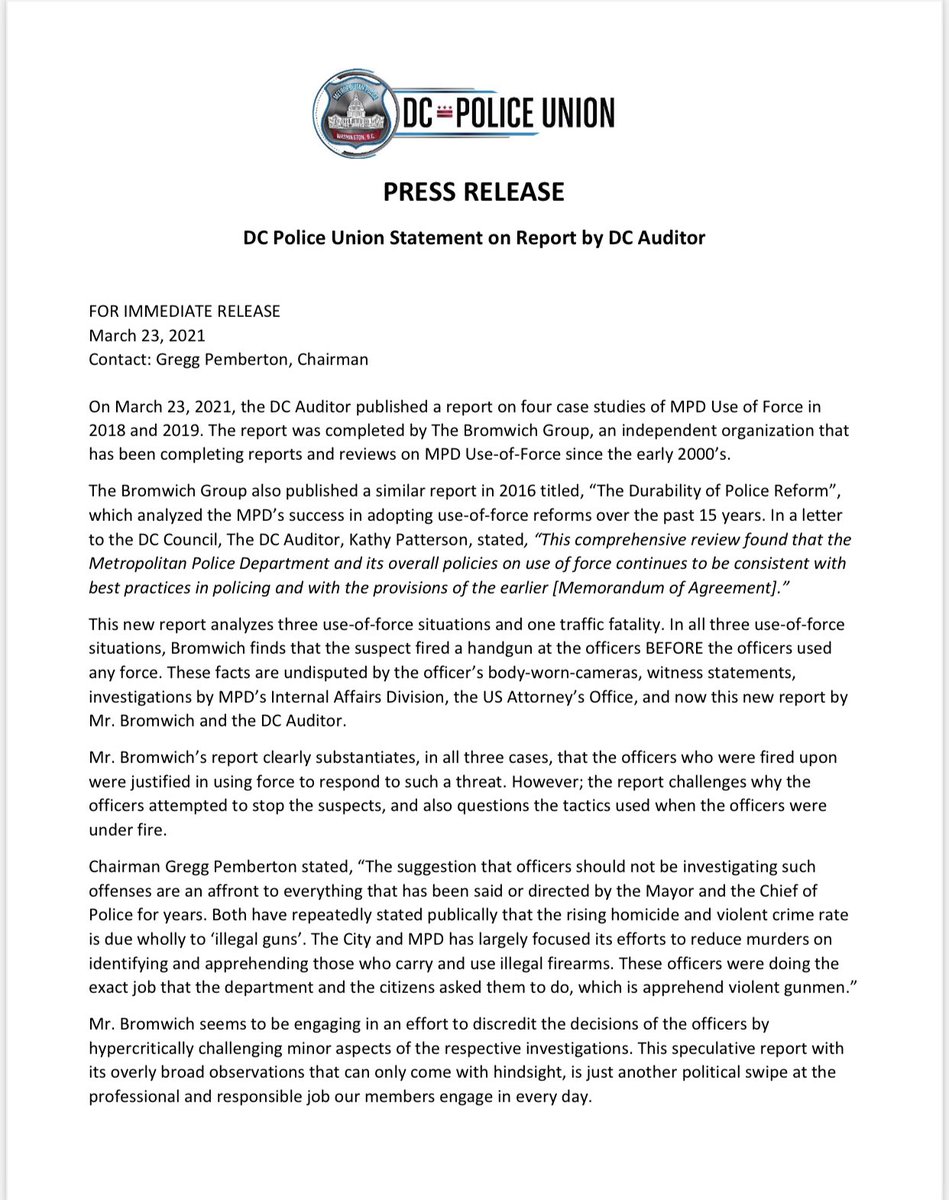
Meanwhile, the D.C. Police Union issued its own statement — opposite of the acting chief and seemingly dismissive of the report and its findings.
“This speculative report with its overly broad observations that can only come with hindsight, is just another political swipe at the professional and responsible job our members in engage in every day,” the statement reads.
The report comes as the newly created D.C. Police Reform Commission finalizes its first round of proposed reforms for law enforcement in the city, and as Contee prepares for his confirmation hearing before the Council this Thursday.
“We hope the case studies and resulting recommendations contribute to that ongoing discussion. It is important to keep before us the “why” of this review. Four young Black men — Jeffrey Price, Jr., D’Quan Young, Marqueese Alston, and Eric Carter — lost their lives,” the report states. “The very least the District government can do is recognize when and how and whether officer-involved fatalities can be averted and institute and maintain policy and practice with prevention as the goal.”
In the case of Jeffrey Price, Jr., who was killed in 2018 after a collision with an MPD cruiser while on his dirt bike, the report alleges that the department’s investigation had “significant shortcomings,” and criticizes the department’s lack of clarity regarding vehicular pursuit policies.
Price’s family filed a federal wrongful death lawsuit against MPD last year, claiming that D.C. police chased Price down the street — a violation of the department’s policy — and that a police cruiser intentionally cut him off, resulting in the crash. According to the report, MPD’s investigation of Price’s death focused on potential violations of MPD’s vehicular pursuit policies, and concluded that any alleged violations were “unfounded,” which by the department’s definition means “there are no facts to support that the incident occurred.” The auditor’s report disagrees.
“The collision occurred, and Mr. Price died as a result, so at best it is misleading and confusing to find that the allegations are “Unfounded,” the report reads. “As to each potential act of misconduct, there were obviously facts that showed that the incident occurred.”
The report states it did not find sufficient evidence to determine that the officers involved violated any procedures, but characterizes the department’s investigation of Price’s death as “superficial,” and recommends that the department create specific parameters for vehicular chases.
“More broadly, we found the investigative interviews…to be brief and relatively superficial, especially the re-interviews, which were perfunctory and lacking in substance,” the report reads. “This is unacceptable in any investigation, but especially in a case involving death.”
The report also questions MPD’s de-escalation tactics and training, and how the department weighs the possibility for de-escalation when investigating use-of-force incidents in its review of the killing of D’Quan Young, who was killed by an off-duty officer in May 2018.
Young was killed by officer James Lorenzo Wilson, who was off-duty and walking to a cookout in Northeast D.C. The report agrees with MPD’s assessment that Young drew a weapon and fired first, and finds that Wilson’s use-of-deadly force was justified. However, it states Wilson had “numerous opportunities” to engage in de-escalation tactics required by MPD policy during the confrontation with Young, but made no attempts to do so, and that this issue was not investigated in MPD’s review of the killing.
“We believe [Wilson’s] failure to make any effort to de-escalate the situation violated MPD’s policy, which requires de-escalation when feasible (as it was here),” the report states.” The investigation should have explored the de-escalation issue.”
In the case of Marqueese Alston, a 22-year-old man shot and killed by police in June 2018, the report agreed with MPD that deadly force was justified and supported by evidence — but questioned why police initiated the interaction with Alston. Police stated that officers suspected that Alston was armed, leading to a foot pursuit in which Alston first fired shots. But the report states that MPD’s investigation did not adequately address how the officers determined that Alston was armed, focusing only on the exchange of gunfire.
“The fact that Mr. Alston was in fact carrying a weapon does not eliminate the need for the propriety of the foot pursuit to have been addressed and evaluated,” the report reads.
The fourth case examined in the report is that of Eric Carter, who was killed by police in 2019 after his mother had called police and reported that Carter had fired shots inside their Southeast D.C. apartment. The report again concludes that the officer’s deadly force was justified, but found that the department failed to implement the tactical approach that Carter’s case required, posing “unnecessary risks to civilians both inside and outside the apartment building.”
The new report follows a similar review by the office of the D.C. Auditor in 2016, which identified several weaknesses in the department’s use-of-force investigations, and now claims that MPD has not improved in its procedures — but rather “grown substantially worse.”
“Unfortunately, the weaknesses identified in our 2016 report have not been remedied; indeed, they have grown substantially worse,” the report reads. “Our review of the four 2018-2019 fatal use of force cases has shown that those weaknesses persist, and that generally MPD has not recognized them and appears to resist or be unconcerned with remedying them.”
In addition to its recommendations to the department, including improving de-escalation policies, more comprehensive training, and completing more thorough investigations in cases of use-of-force, the report is calling on the U.S. Attorney for D.C. to issue declination letters explaining the office’s reasoning for choosing to not pursue charges against an office involved in a use-of-force case.
The auditor’s report comes amidst an ongoing push for transparency from the department that’s faced criticism and several lawsuits for its lack of clarity — and years of families’ and advocates’ calls for justice. The mother of Alston filed a wrongful death lawsuit against the city this past summer, claiming negligence by MPD leading to and following Alston’s death, and emotional distress that resulted from the department’s lack of information regarding her son’s death. Price’s family has filed two different lawsuits — one wrongful death claim, and another in 2019 for an alleged unreasonable search of Price’s mother’s home shortly after his death.
In late July 2020, D.C. Mayor Muriel Bowser released the body-worn camera videos linked to the killing of Alston, Young, and Price after the D.C. Council passed a bill that requires the city to make the footage and names of officers involved in police shootings and use of force incidents public within five days of the incident. But all three families claimed that the footage only further traumatized them and left them seeking further explanation.
The D.C. Auditor is also preparing two more case studies — one on the 2020 police killing of 18-year-old Deon Kay, who was fatally shot by D.C. police in September, and another on the police pursuit that led to the death of 20-year-old Karon-Hylton Brown in October.