Ally Schweitzer
At least 375 brick-and-mortar businesses in D.C. closed permanently or temporarily during the pandemic, as DCist/WAMU recently reported. But a report published today by the D.C. Policy Center shows a surprising parallel trend: New businesses have been sprouting up quickly to replace them.
The city lost roughly 68,000 private sector jobs between September 2019 and September 2020 — a 12.6% employment loss that exceeded the national average of 7.5%, according to Yesim Sayin Taylor, executive director of the business-backed think tank. But the number of wage-paying establishments grew 4.8% over the same period, compared to the 2.9% growth seen across the U.S. overall.
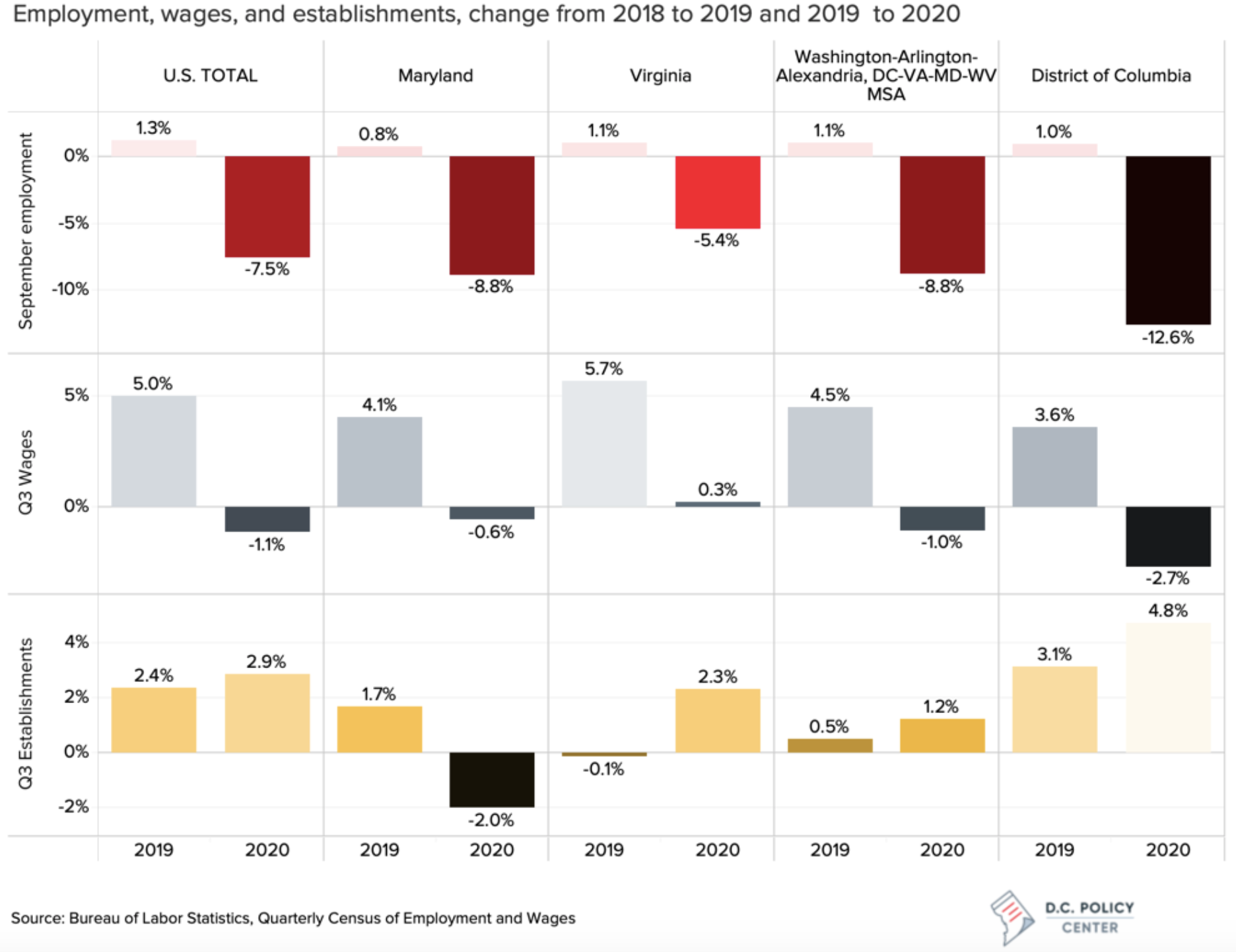
D.C. also outpaced new business openings in Maryland and Virginia, adding 1,951 of the 2,396 net new establishments that opened in the region between September 2019 and September 2020, the report says. Most of those are in the city’s biggest jobs category — professional and business services — though education, health services and “other” services saw big bumps, too. Even the leisure and hospitality sector added 40 new establishments, despite massive job losses at restaurants, hotels, bars and nightlife businesses during the health emergency.
By the middle of 2020, businesses were closing 19% faster than they did the previous year, but also opening 2% faster, Taylor says.
“While business closures have become more common, the pace of new business formation in the District has not slowed down,” Taylor writes. The economist relied on the latest Bureau of Labor Statistics data on employment, wages and Business Employment Dynamics to inform her findings.
Taylor says it’s not immediately clear why D.C. startups grew during the pandemic. It’s too early to say whether it stems from federal or city-level aid, like the Payroll Protection Program created by Congress or the $100 million D.C. released to support businesses in the wake of COVID-19. But evidence suggests that entrepreneurial activity ticked up during the crisis.
That’s clear from looking at the number of new business applications filed in D.C. last year, according to the economist. In 2019, business applications remained fairly stable over the previous year. But by February 2021, Taylor writes, “that number had jumped to over 16,000, showing an increase of 23 percent.”
Not all of those new business applications will go on to create jobs, Taylor says. But applications identified as “high-propensity businesses” by the Census Bureau — meaning they’re expected to lead to wage-paying jobs — have grown by 20% over previous years, Taylor says. A comparison of business applications and unemployment data suggest the trend is driven by individuals identifying new business opportunities during the crisis, as opposed to resorting to starting a new business because they lost their jobs.
But historically, the entrepreneurs who drive D.C.’s startup activity are women, immigrants and people of color, and they’re more likely to fund new ventures with their own money instead of taking out large bank loans, the economist says. To help ensure these new startups eventually create wage-paying jobs, the city needs to simplify the process of starting a new business, loosen the city’s clean hands requirements, improve internet access for all residents, and create incentives for landlords to rent office space to new businesses they might not have considered before, Taylor writes.
“The increases in the number of establishments and business application filings are most welcome news for the District of Columbia,” the economist writes. “Turning business ideas created in the aftermath of the pandemic into wage-paying and eventually brick-and-mortar businesses would not only bring back vibrancy but could create opportunities for residents who find themselves excluded from opportunity.”