 Dominique Maria Bonessi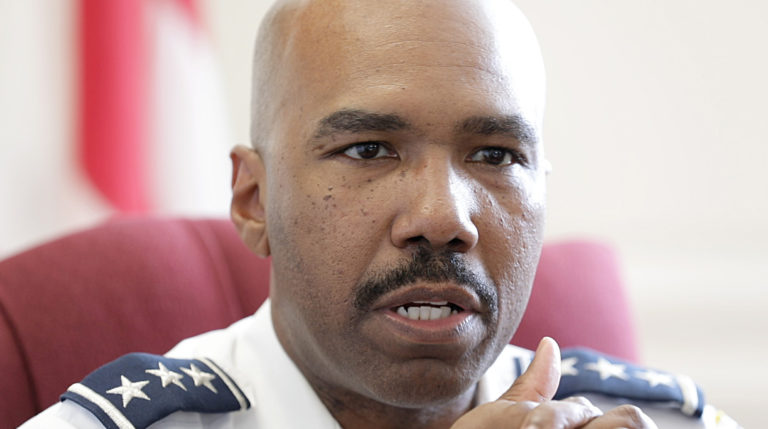
Acting Metropolitan Police Chief Robert Contee III was called “homegrown” and “reform-minded” by community members, while facing tough questions by D.C. councilmembers Thursday during his nomination hearing.
Mayor Muriel Bowser nominated the former assistant chief in late-December following a summer of racial justice protests, and the police-involved killing of 20-year-old resident Karon Hylton, which sparked increased demand for police reform and accountability. In his opening statement, Contee said he recognized that the department was at a “critical juncture” following the killing of George Floyd at the hands on Minneapolis police last year.
“We must continue to ensure that our policies, training, and day-to-day operations require our officers to employ de-escalation techniques to avoid the use of force whenever possible. Deadly force should only be used as a last resort: when there is a threat of serious bodily injury or death, and there are no other reasonable options available,” Contee told councilmembers.
During the hearing, councilmembers and residents repeated demands made by protestors over the summer.
Councilmember Janeese Lewis George (Ward 4) asked a series of questions related to transparency, including whether Contee supported a zero-tolerance policy for officers that don’t enable their body-worn cameras; whether he would release publicly the outcomes of use of force investigations; and whether he supported speeding up the response rate of freedom to information act requests.
To each of these questions, Contee had a similar noncommittal response. “That’s certainly something I’m open to,” he answered at one point. “That’s certainly something I’m willing to entertain,” he said at another.
Councilmembers Robert White Jr. (At-large) and Kenyan McDuffie (Ward 5) pushed Contee about the lawsuit filed last month by the D.C. chapter of the American Civil Liberties Union over unreported stop-and-frisk data. The department did release stop-and-frisk data from Jan. 1 through June 30, 2020 shortly after the suit was filed.
“What happened between the time you became chief and the decision to release that data?” McDuffie asked Contee.
Contee, a D.C. native, responded that he became chief on Jan. 2, just four days before the insurrection at the Capitol and a few weeks before the presidential inauguration — events that Contee said were “on a level that we have never experienced before in this city.”
Contee said going forward, the department would comply with data reporting deadlines, mandated by the Neighborhood Engagement Achieves Results (NEAR) Act. “It’s not going to require a lawsuit,” he said.
Monica Hopkins, executive director of D.C.’s ACLU, said it was important that Contee committed to releasing the data in a timely manner.
“I think we’re also cautious and we look forward to him keeping that commitment and to the council ensuring that he keeps that commitment as well,” Hopkins said.
Councilmember McDuffie also questioned Contee about the NEAR Act, which requires the department to collect extensive records of all police stops, including the reason for the stop, the duration of the stop, and whether a search was conducted. McDuffie pointed out that Bowser’s public safety website claims that the law “has been fully implemented,” showing green checks for all of the law’s requirements. However, said McDuffie, the section on community crime prevention, which would link mental health experts with police officers, was yet to be implemented.
“I will look into that,” Contee responded. “I know that the [Bowser] administration is working on alternative responses to mental health calls,” said Contee.
Contee vowed to make sure there is a plan in place for mental health crisis interventions. “I will work on doing exactly what we’re required to do and then some quite frankly.”
While many of the community members approved of Contee’s nomination, Hopkins, with the ACLU, said District residents had little input to the Mayor’s selection process. Bowser tapped Contee less than a month after his predecessor, Peter Newsham, announced he was stepping down for a post in Prince William County.
“What we heard back from many community members is that it’s too late,” said Hopkins. “Their input into the selection or their vision about what a chief of police could be was not valued.”
Hopkins added that Contee’s comments during the hearing and over the past few months “indicate that he is more reform-minded than his predecessor.” However, Contee also made statements saying he wanted to grow the department to 4,000 officers.
“There has never been a correlation between MPD officers and a reduction in crime,” Hopkins said.
Other community members stressed the need to develop comprehensive plans to eradicate gun violence, reduce the incarceration rate, and help expunge criminal records. Contee said he’s well aware of the issues with violent crime city, and recounted how his father was stabbed on the way home from work and taken to the hospital with a collapse lung. He vowed to make violent crime a top priority of the department.
“There any many families in our communities that seek justice for loved ones that have been victims of violence, and I assure you MPD will be tireless in our pursuit of criminals that hurt our family members and make our communities unsafe,” Contee said.
Brenda Richardson, a resident of Ward 8, said she was in full support of his nomination.
“In this season of trauma, exhaustion and racial bias, I find it quite liberating to have a chief of color at the helm,” Richardson said. “Chief Contee is homegrown. I understand that when he was growing up, he lived in a neighborhood like mine…Chief Contee knows, understands, and appreciates our urban culture and disparate communities and all the challenges that come with it.”
If confirmed by the council, Contee will be the city’s first Black police chief since Charles Ramsey in the early 2000s. He will make $270,000 annually, slightly less than Newsham’s $283,000.