Martin Austermuhle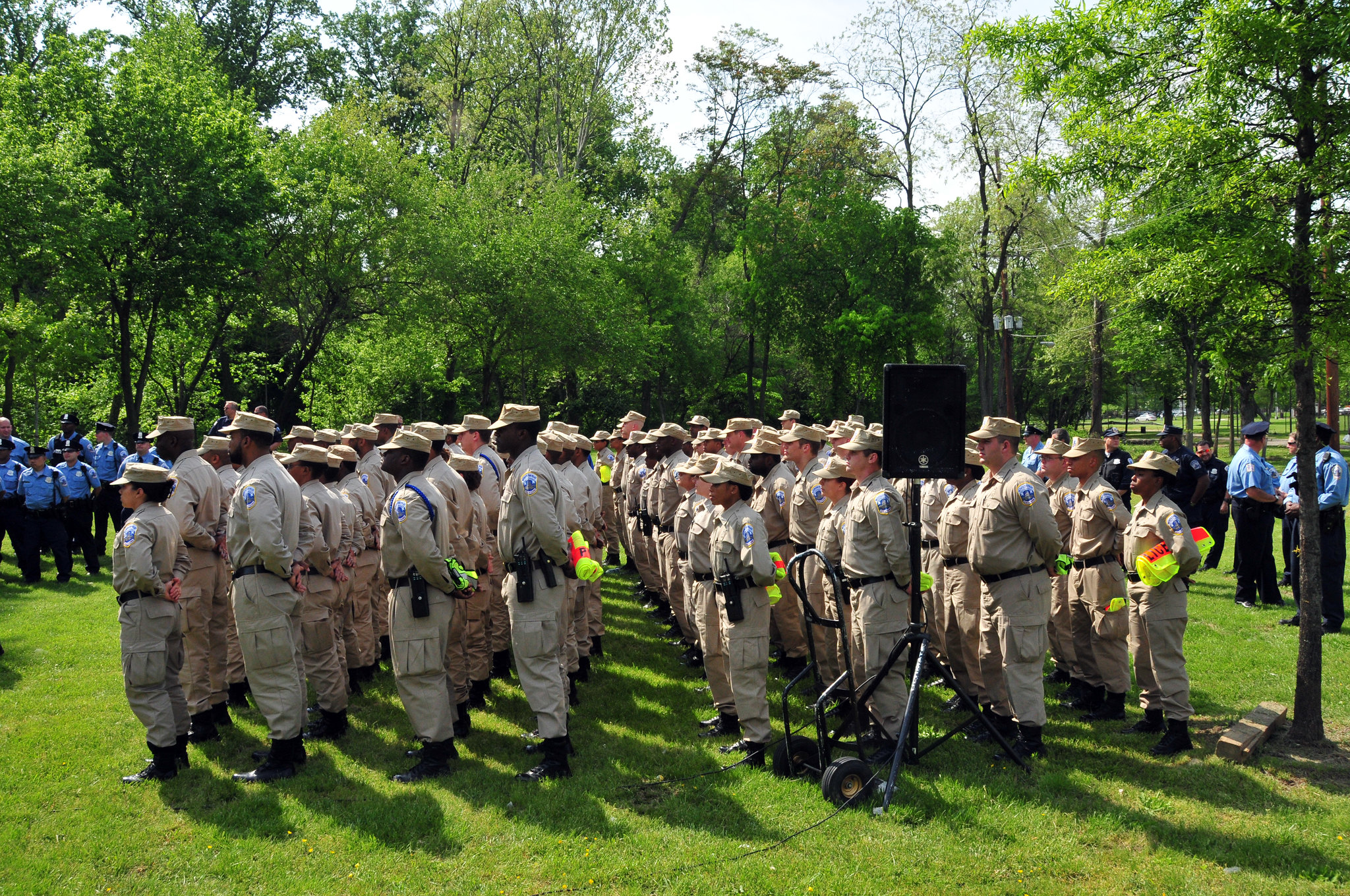
It’s often said that if you truly want to understand someone, you need to walk a mile in their shoes — or maybe walk their beat while you’re at it.
Rosa Brooks did just that. Facing a year-long sabbatical with no academic projects to fill her time, in 2016 the professor at Georgetown University’s Law Center became a reserve police officer with the Metropolitan Police Department. Under the program, Brooks underwent the same training and and certification as traditional police officers. When she was done, she was issued a badge, handcuffs, radio, and gun — the only requirement to keep her job would be to patrol at least 24 hours a month.
Her four-year experience policing the streets of D.C. — she resigned in 2020 — is the subject of a book published earlier this year, Tangled Up In Blue: Policing The American City.

In it, Brooks takes readers through the ups and downs of becoming and being a D.C. police officer. She admits she wasn’t the best shot to begin with, and struggled to use the bathroom while wearing the officer’s usual complement of equipment. Assigned to the Seventh District encompassing much of Southeast, Brooks writes of the tension between officers and the community they police, but also admits that much of the job can be tedious and repetitive. She says that many officers she met were committed public servants, but also trained to see danger around every turn and in every interaction.
Brooks admits that she “wanted the insider experience that would enable me to become a credible and effective advocate for change.” (It’s one that’s not far from her upbringing; her mother, author and activist Barbara Ehrenreich, detailed her experience living on minimum wage for three months in 2001’s Nickel and Dimed: On (Not) Getting By in America.) And the timing couldn’t be better.
Like many cities and states across the U.S., activists and elected officials in D.C. are pushing to rethink policing in the wake of last summer’s nationwide protests for racial justice. Later this week, the D.C. Police Reform Commission — created last summer — will publish its report and recommendations. She has also leveraged her policing experience at Georgetown, where she founded the Innovative Policing Program.
We spoke to Brooks about her experience as a D.C. police officer, what she learned, and what lessons could be applied as officials consider changing policing and public safety. The interview has been edited and condensed for clarity.
Why did you decide to do this?
Sheer curiosity, to be honest. I learned about the Reserve Corps 10 years ago. And since I heard that it existed, I thought, “You’re kidding me, you can be a volunteer police officer, like a real police officer?” You know, they’re going to give a gun to a law professor? It just it seemed so fascinating to have an opportunity to go inside a culture that I think is very opaque to people on the outside. I have always been interested in the relationship between law and violence and at different points in my career that has touched on policing issues in other countries. And needless to say, policing has been in the news in this country for four years now. And it just seemed like such a fascinating chance to see what it was like. All my friends and family members and colleagues thought I was nuts. But I thought, “When else will I have a chance to do something completely crazy?”
What was the training process like? Was there anything about it that surprised you or caught you off guard?
I think I was equally taken aback by what unspoken messages were in the training and what enormous issues were left out of the training. At the police academy, the instruction was primarily tactical. It was, how do you handcuff a prone person? How do you handcuff a kneeling person? How do you handcuff a standing person? And what are the nine property forms that you must fill out and what color ink should you use for each of them?
What was left out of the training was all the issues that the entire country has been talking about for years now, which is to say issues of race and policing, issues of violence and policing. Then as now — this is 2016 that I started at the D.C. police academy — there were protests in major American cities about police killings. There was a huge debate. And we didn’t talk about that at all. And that was quite stunning to me.
You mention in the book that one thing that did come up often in training was the idea of danger, how dangerous policing can be.
That was really drummed into us by instructors saying over and over, “There’s no such thing as a routine call. Any situation could turn lethal in a millisecond,” and a tremendous amount of attention to learning the tactical skills to minimize danger. You know, look at people’s hands, don’t look at their eyes. Their eyes can’t kill you. Their hands can.
I think that the underlying message that came through was one about the constant mortal peril that you’re in as a police officer, which which is both, I think, profoundly true and profoundly misleading. It’s profoundly true in the sense that, yes, any call could turn lethal. And the week before I started at the police academy, there was a young female officer in Virginia who was on her first day out of the police academy and was shot to death on a responding to a domestic violence call.
It can happen, but it doesn’t happen nearly as often as police officers think it happens. Policing is much less statistically dangerous than officers think. In fact, in Washington, D.C., until this year, when Capitol Police Officer Brian Sicknick was killed at the Capitol, there has not been a police officer killed in the line of duty for two decades.
I think the impact of the sense of, “Anyone could kill you at any time,” if that’s what you are primed and trained to think, then when you’re going around interacting with people, you treat everyone as if they’re likely to kill you. And that can, best case, mean that you’re, you know, you’re you’re a little jumpy. You’re more likely to yell at people. You’re more likely to stop and frisk someone who’s not doing anything wrong, etc. And worst case, it can lead to cops who are trigger happy and decide to shoot first and ask questions later.
There are parts of the book where you’re critical of policing, be it the training you got, some of the people you worked with, some of the things you had to do, and so on. But you also do sympathize with what many police officers and their experience on the job.
They’re just ordinary people. And they are powerfully influenced by what authority figures tell them to do, by what their peers are doing. And so I didn’t expect to meet monsters. I think the the vast majority of the police officers I got to know were decent people who went into policing, often for very idealistic reasons.
Many had been victims of crimes or had a loved one or friend who was a crime victim and went into policing, really thinking, “I want to help other people who are victims of crimes. I want to prevent crime.” That idealism gets beaten out of a lot of people by the nature of the training and the nature of the job. But I do think it’s a terrifically difficult job.
I think that one of the things that really gets lost in the protests about policing and critiques of policing is that police are in control of only a fairly small fraction of what they do. In a sense, police enforce laws that they didn’t make, in a social context that they didn’t create, and can’t do much to change. Essentially, they do what we tell them to do, what we as a society tell them to do. This is not to let police themselves off the hook either for abuses or for the things that police departments can change, like police training programs, recruiting, etc. But, you know, if we don’t like that police are locking people up for offenses that are nonviolent and trivial offenses, we need to look in the mirror, because we’re the ones who elected the people who pass the laws criminalizing trivial offenses.
I think that if we just demonize the police, we’re going to miss all of the deeper and more complicated reasons that policing in America is the way it is.
Over the last year there’s been a number of fatal incidents involving D.C. police, including the shooting of Deon Kay and the chase the resulted in the death of Karon Hylton-Brown. Have you looked at those incidents, compared it to what you were trained and come to any conclusions about what went wrong and what could have been different?
I don’t want to generalize because each incident is different.
But I will say that when you look at police shootings around the country, there are clearly some where the officer’s behaving abusively and violating the law and violating their own department’s directives. But part of the reason it’s so difficult to to have successful prosecutions of police officers is that most of the time, even in situations where we look at it after the fact and we rightly say, “Police killed a person who was harmless and that’s terrible, someone should be punished,” it very often does turn out that the officer was doing what they had been trained to do in accordance with the laws and regulations of that that city or that state. This is something that that one of my colleagues, Paul Butler at Georgetown, says very powerfully in his book Chokehold: Policing Black Men. He says the problem is that normal policing — lawful policing by police officers trying to abide by the law — itself causes tremendous harm.
The way the U.S. Supreme Court has interpreted the law, the standard the Supreme Court has set for a Fourth Amendment violation, search and seizure violations, is so tilted towards police that it is extraordinarily hard to hold people accountable. If you’re a prosecutor, no matter what you may personally feel or wish to change, if you look at something and you say, “Based on the law, I don’t think I can prove that this person is criminally liable.” That’s not because the person didn’t do things that we really wish they hadn’t done. Very often the framework in which they operate is itself rotten.
We’re always debating when there are police abuses, was it was it a bad apple or is the barrel rotten? I think it’s both. But it’s also that if you’re a good apple in a rotten barrel, even the good apples can end up doing things that are really harmful because that barrel is so rotten.
Given all this, what do you think D.C. police can do to avoid the types of situations that may end in a fatal shooting?
I think that a lot of the better training — and there are some terrific instructors in D.C., but officers don’t get enough time with them, quite frankly — really emphasizes to slow down, don’t go rushing into a situation. If you rush into a situation, you are so much more likely to end up in a moment where you don’t you don’t have time to evaluate whether there’s a lethal threat. And so the the culpability, the blameworthiness isn’t necessarily in that one panicky millisecond when, “Oh my God, somebody is running at me with a gun.” The place where we should be looking is what choices and decisions made you end up in that situation where someone could jump out at you with a weapon? And could you have prevented that?
Having served as a D.C. police officer and now working to improve policing, where do you come down on the debate over defunding the police? Is that a useful way to discuss reform?
I think if you ask a cop, I was in the Seventh District, “How do you feel about the defund the police movement?”, odds are very high that that officer is going to look at you as if you’ve lost your mind and say, “Have you seen the 7D station? Have you seen my vehicle? Have you seen our equipment? I can’t do what you’re telling me to do with the resources I have right now.” But if you say, “Tell me about the things that you do that you don’t think you should have to do because you’re not good at it, and tell me about the things that you wish somebody else did so that when you do do the things you think you should do they’ll be more effective,” you get a really different conversation.
Once you get officers to start thinking like that, then you discover that there’s actually an enormous amount of common ground between what critics of policing and defund the police, even abolish the police activists are saying. And I do think that a much healthier way to frame it is to frame it as as more and more people are doing, not as defund or abolish, but as “let’s reimagine public safety.” You know, let’s talk both police officers, community activists together about what are the needs here? Who right now is there who could meet those needs? Are they the kind of people in the long-term we want really meeting those needs? If they’re not, what kinds of people with what kinds of skills do we need? Is it just a problem throwing money at something? Or is it that we need to recruit a whole different kind of people? We need to train people? What’s the 10-year plan for getting to this place that we think is a better place? Then I think you actually can have some much happier, healthier, more fruitful conversations about the direction to go in.
Since leaving MPD, you’ve started working to help improve policing through the Police For Tomorrow Fellowship, where officers and staff from MPD get a chance to more deeply discuss policing now and policing in the future. Does that type of stuff make you optimistic about the prospects of changing policing in D.C.?
I am optimistic. I mean, let’s not kid ourselves. You know, even if D.C. managed to get everybody to come together and have a shared vision for public safety in 10 years, we still live in a broader society that is rife with the the toxic legacy of centuries of racial discrimination in which socio-economic disparities are very deep. We’re not going to magically solve any of those problems by fixing policing and fixing public safety. But that being said, can we make real progress? I think we can.