Martin Austermuhle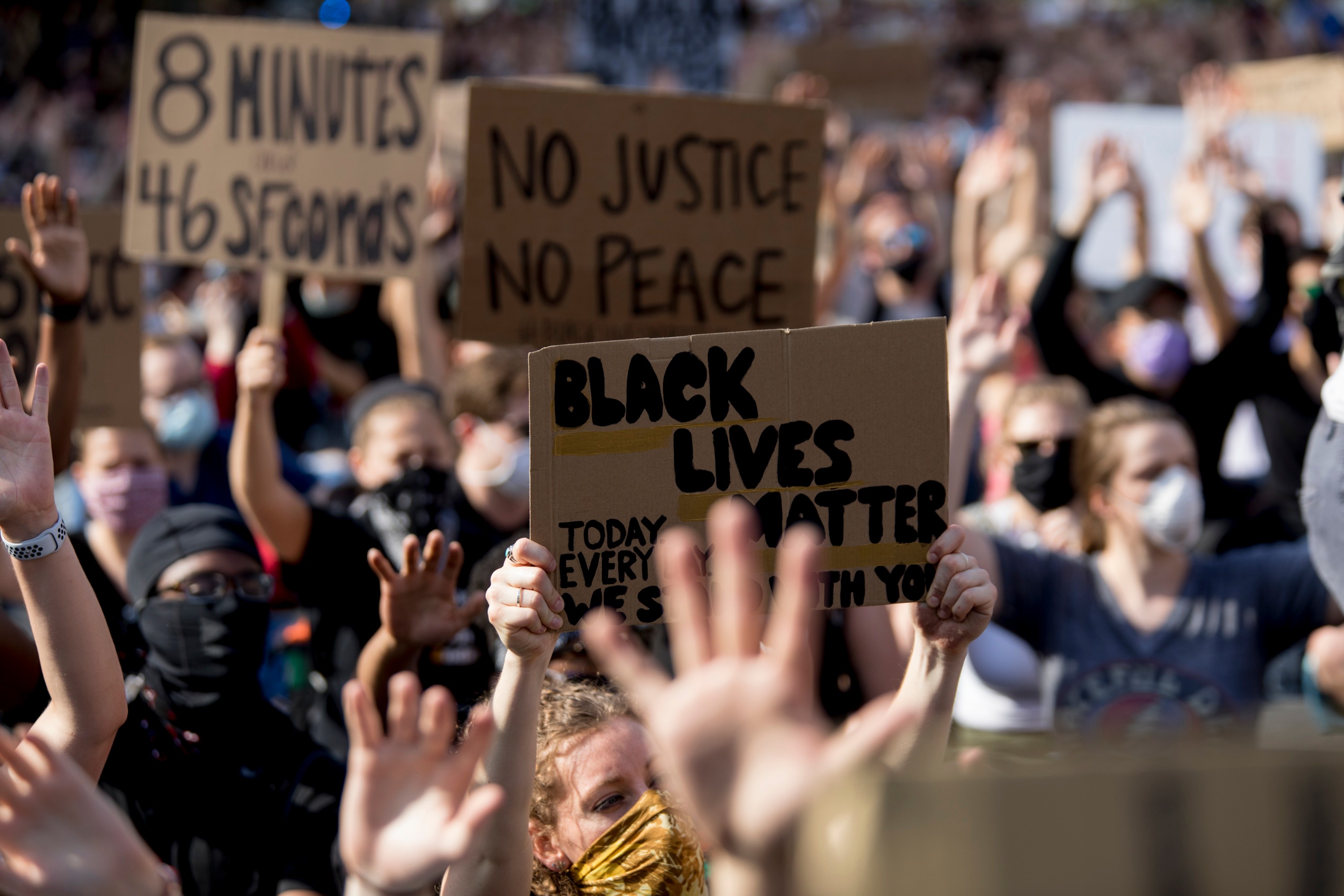
In a not-so-distant future, fewer armed police would patrol D.C.’s streets, social workers could respond to many 911 calls for service, and a strengthened social safety net would quickly help vulnerable residents get everything from drug treatment to permanent housing — preventing them from entering the criminal justice system altogether.
Those are among the sweeping recommendations outlined Thursday by the D.C. Police Reform Commission, the 20-member body created by the D.C. Council last summer in the wake of racial justice protests across the country. Initially charged with proposing changes to policing in the city, the commission’s 90 recommendations go far beyond how arrests should be conducted and instead touch on the many reasons arrests may even happen — and whether an arrest is the best way to address a range of social ills.
“We were told that we had a broad mandate to re-envision policing and public safety,” said Christy Lopez, a former Department of Justice official, current professor at Georgetown’s Law Center, and co-chair of the commission. “We didn’t want to have a set of anodyne recommendations that were of kind of boilerplate. We wanted to make sure that our commission report didn’t just talk about policing, but the entire public safety infrastructure.”
In the 259-page report — titled “Decentering Police To Improve Public Safety” — the commission states that “law enforcement should be one option in an array of emergency responders, not necessarily the first option.” It calls for making behavioral healthcare professionals the first responders for people in crisis, allowing those professionals to co-train and co-respond with police when necessary, and replacing police in schools with trained professionals better equipped to deal with children.
The commission also broadly calls for an expansion of the social safety net; decriminalization of minor offenses linked to poverty, such as illegal vending and panhandling; and a dramatic expansion of existing violence interruption efforts in D.C. neighborhoods.
“If you followed all the recommendations in this report, you would have a much stronger safety net. That would be conceived of as part of public safety so that people wouldn’t be falling into crisis and people would be thriving and they would be healthy,” said Lopez. “That’s really an important element of public safety that we just sort of like to brush off and say, ‘more police,’ but we have to stop doing that.”
Under the commission’s recommendations, the Metropolitan Police Department would remain — albeit with fewer officers who are better trained, more restrained, and subject to stronger accountability if something goes wrong.
The commission does call for reducing the number of officers — there are currently roughly 3,600 on the force — by at least the rate of attrition, though it also contemplates allowing for buyouts and layoffs. And it calls on the Council to do away with the decades-old Congressional mandate that MPD have at least 3,000 officers. (In recent years, the city’s elected officials have said they’d like to see MPD grow to 4,000 officers.)
Lopez says this would ultimately result in a defunding of the police department’s half-billion-dollar budget — as activists have been calling for since last year — but draws a distinction between the vague rallying cry and what the commission is seeking to do.
“When people talk often about divesting from the police or defending the police, literally what they’re talking about is using a reduction in the police department’s budget to drive the policy change,” she said. “In my experience, that has horrible unintended consequences. So what we did here was we reversed that. We said, ‘Here’s what we think public safety should look like. Here’s the role that we think MPD has to play in that new vision of public safety.’ And yes, it is a more narrow role. So, of course, we expect that there will be less money needed.”
The commission also recommends changes to how police do their jobs. It calls for the department’s Crime Suppression Teams and Gun Recovery Unit to be “immediately suspended” unless their aggressive tactics can be shown to be effective at reducing violent crime, and says the responsibility for responding to almost all traffic offenses should be shifted to the D.C. Department of Transportation.
It recommends that citations be used in lieu of arrests for a broader range of low-level offenses; suggests that no-knock warrants be banned (as Virginia recently did); says the department has to reinforce the use of non-fatal de-escalation; and proposes that the city adopt more developmentally appropriate practices for arresting minors, like increasing the use of pre-arrest diversion programs and ensuring that legal counsel is available for minors in police stations.
The commission also calls on improving training for officers, strengthening the D.C. Office of Police Complaints, making officers’ disciplinary records public, end qualified immunity for officers, employing technology that activates a body-worn camera anytime an officer draws their gun, and taking steps to improve collection and analysis of data. On that point, the commission says it requested 70 pieces of data from MPD as it did its work, but only received “a small fraction of those requests” — and only three weeks prior to the final report being finished. (In recent years, the ACLU of D.C. has sued MPD multiple times to get legally mandated data on stops and frisks by officers.)
The recommendations come just as MPD’s formal leadership is changing; on Wednesday, a council committee unanimously approved the nomination of Robert Contee to serve as the department’s chief. (At a confirmation hearing last week, Contee fielded questions from lawmakers that parallel recommendations from the commission, including on data collection and transparency.) And it’s not the first bout of reform that the department has undergone; in 2001, MPD voluntarily signed an agreement with the Department of Justice that kicked off a long process of internal changes after revelations of excessive shootings by officers.
In a statement on the commission’s recommendations, Acting Deputy Mayor for Public Safety and Justice Chris Geldart said it would look for “community input” into the recommendations before proceeding on any of them.
“We appreciate the time and effort that the D.C. Police Reform Commission members invested in this report,” he said. “As we review its recommendations, it is critical to ensure community input into fundamental policy changes. Recently, Mayor Bowser launched the Building Blocks D.C. initiative to better coordinate citywide violence intervention, social services, and community outreach programs with the needs of our communities most at-risk of violence. As we continue to develop programs to serve the needs of our residents without involving the criminal justice system, we know it will also require proper planning and community support. We look forward to working with the Council and the community over the next several months to identify these opportunities and determine our best path forward.”
Speaking at a press conference on Thursday afternoon, Council Chairman Phil Mendelson called the report’s recommendations “a bit edgy, for some, but necessary,” hinting that he would consider moving forward on many of them — or at least initiate a debate around them.
“The role of police in our society is something we view as necessary and of value,” he said. “At the same time… police and the police power, when you put it up against our democratic principles, is alarming, because one individual officer can deprive an individual citizen of their liberty and even take their life. What we need is an examination of the proper balance.”
Lopez said that she thinks many officers and department leaders will agree with what the commission is recommending, but also expects that there may be some pushback or hesitation — including from some rank-and-file officers. The D.C. Police Union expressed opposition to a number of provisions of a police reform bill the council passed last summer, including a provision to more quickly release body-worn camera footage after a fatal shooting. The union also sued to stop a provision removing disciplinary matters from being part of contract negotiations.
Union officials did not immediately respond to a request for comment on the commission’s report.
Lopez conceded that many of the commission’s proposals will take years to implement, and could change if they are proven to be ineffective. And she recognized that commissioners and advocates will have to work to sell the public and some elected officials on the recommendations, especially as shootings and homicides continue to increase in the city.
“They know the public sees them as the people who are supposed to keep crime down,” she said of both police officers and elected officials. “We’re proposing shifting our responsibility to other people who haven’t had that responsibility. And they’re going to be very nervous about how effective that’s going to be, whether they’ll be properly resourced, because they know that if it doesn’t work, people are going to get hurt and they’re going to get blamed. So I think we have a responsibility to make sure that that shift happens appropriately and effectively.”
Speaking at the press conference, commission co-chair and former City Administrator Robert Bobb said he and fellow members of the group would push for many of the recommendations to be implemented as quickly as possible.
“This report is not a term paper from a university,” he said. “It is not theoretical. It is practical with recommendations that can be implemented, with some that can be implemented immediately,” he said.
This post was updated with comments from speakers at a press conference on Thursday afternoon, including Council Chairman Phil Mendelson and commission co-chair Robert Bobb, and a new statement from D.C. officials.